
Nature’s Secret Glitches: Why Is This Waterfall Bleeding?
Antarctica is bleeding.

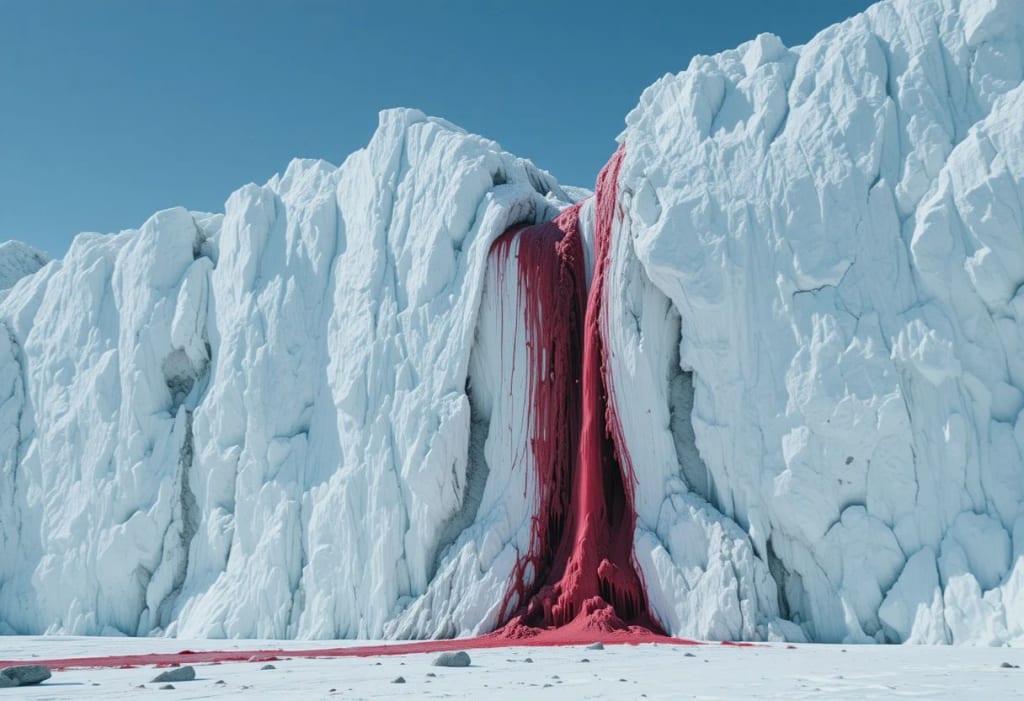
That’s not a metaphor. That’s not clickbait. For decades, scientists stared at a frozen white landscape where a bright red waterfall pours out of a glacier like an open wound.
The first researchers who saw it in 1911 thought algae might be responsible. Others suspected bacteria. Some thought the color had to be surface contamination.
They were wrong.
What they eventually discovered was stranger — and far cooler — than any sci-fi explanation. This wasn’t a glitch in nature. It was proof that nature runs on rules we barely understand.
Welcome to Blood Falls.
A Waterfall That Looks Like a Crime Scene
Blood Falls is located at the edge of the Taylor Glacier in Antarctica’s McMurdo Dry Valleys — one of the coldest, driest places on Earth. No plants. No animals. Barely any snowfall.
And yet, from the glacier’s icy face, a stream of deep red liquid flows out and stains the ice like rusted paint.
It looks violent. Wrong. Almost artificial.
Which is exactly why it unsettles people.
The Mystery That Took Decades to Crack
For years, Blood Falls made no sense.
Antarctica is locked in ice. Liquid water shouldn’t exist there, let alone a flowing waterfall. And red water only deepened the confusion.
Early theories didn’t hold up. The color wasn’t algae. It wasn’t blood. And it wasn’t pollution.
The real explanation took nearly a century to confirm — because the answer was buried beneath the glacier itself.
The Glitch Under the Ice
Hidden deep below the Taylor Glacier is a subglacial lake of extremely salty water, sealed off for millions of years.
This water is so saline it doesn’t freeze, even in brutal Antarctic temperatures. Think less “freshwater lake” and more “natural chemical brine.”
That underground water is also loaded with dissolved iron.
When pressure forces the water to the surface through fractures in the glacier, something dramatic happens.
As soon as the iron-rich water comes into contact with oxygen in the air, the iron oxidizes.
In simple terms: it rusts.
The same chemical reaction that turns metal reddish-brown is what transforms this water into its blood-red color.
Antarctica isn’t bleeding.
It’s rusting in real time.
Life Where It Shouldn’t Exist
Blood Falls revealed something even more surprising than the color.
Scientists discovered microbial life surviving inside that underground brine — without sunlight and without oxygen. These organisms survive by using chemical reactions involving iron and sulfur instead of photosynthesis.
That discovery shattered assumptions about where life can exist.
If microbes can survive trapped beneath Antarctic ice for millions of years, it raises an uncomfortable question:
What else might be alive in places we’ve written off as uninhabitable?
Mars.
Europa.
Enceladus.
Blood Falls quietly became a blueprint for astrobiology.
Nature Isn’t Broken — It’s Layered
At first glance, Blood Falls feels like a system error.
A frozen environment producing liquid.
A white glacier stained red.
Contradictory rules operating at the same time.
But this isn’t a failure of physics. It’s what happens when geology, chemistry, biology, and time collide.
Nature doesn’t run on clean lines or simple logic. It’s built from overlapping systems, each doing its own thing until conditions force them into view.
Blood Falls is one of those rare moments where the hidden layers surface.
The Bigger Takeaway
Blood Falls is a reminder that Earth still holds secrets — not because science is weak, but because nature is deep.
Some processes take centuries to notice. Others require extreme conditions to reveal themselves. And many exist quietly beneath our feet, waiting for the right crack in the ice.
The planet isn’t malfunctioning.
It’s just more complex than we expect.
And every once in a while, reality glitches — not because it’s broken, but because we finally see how it really works.
About the Creator
Reality Has Glitches
Reality Has Glitches explores the strangest bugs, hacks, and cheat codes hiding in nature, technology, and the future.
Keep reading
More stories from Reality Has Glitches and writers in Geeks and other communities.
Silver Screen Magic with Mae West
American actress and singer Mae West became a popular film actress during the Great Depression. She started entertaining in vaudeville, then performed on Broadway, and finally went to Hollywood. She signed up with Paramount Pictures and made her debut in the 1932 film “Night After Night.” She also starred in musicals, comedies, and crime dramas. The American Film Institute named her one of the best classic Hollywood actresses.
By Rasma Raisters11 days ago in Geeks
Lauren Sanchez leaves billionaire husband Jeff Bezos at home as she steps out solo in Paris in sexy designer look
Lauren Sanchez was spotted leaving her hotel in Paris, France on Friday. The 56 year old former journalist, who married billionaire Jeff Bezos last summer, was dressed to the nines in a burgundy turtleneck dress, sheer pantyhose, and high heels.
By Dena Falken Esqabout 9 hours ago in Geeks
The Summer I Was Chosen by a Northern Mockingbird
During the long, suspended days of the pandemic, a wild mockingbird began visiting my driveway and chose me, again and again. What started as a strange encounter became a brief, meaningful connection that I still carry with me.
By Erica Roberts 4 days ago in Petlife



Comments
There are no comments for this story
Be the first to respond and start the conversation.