
Yet another treasure hunt
one person's trash and another's treasure
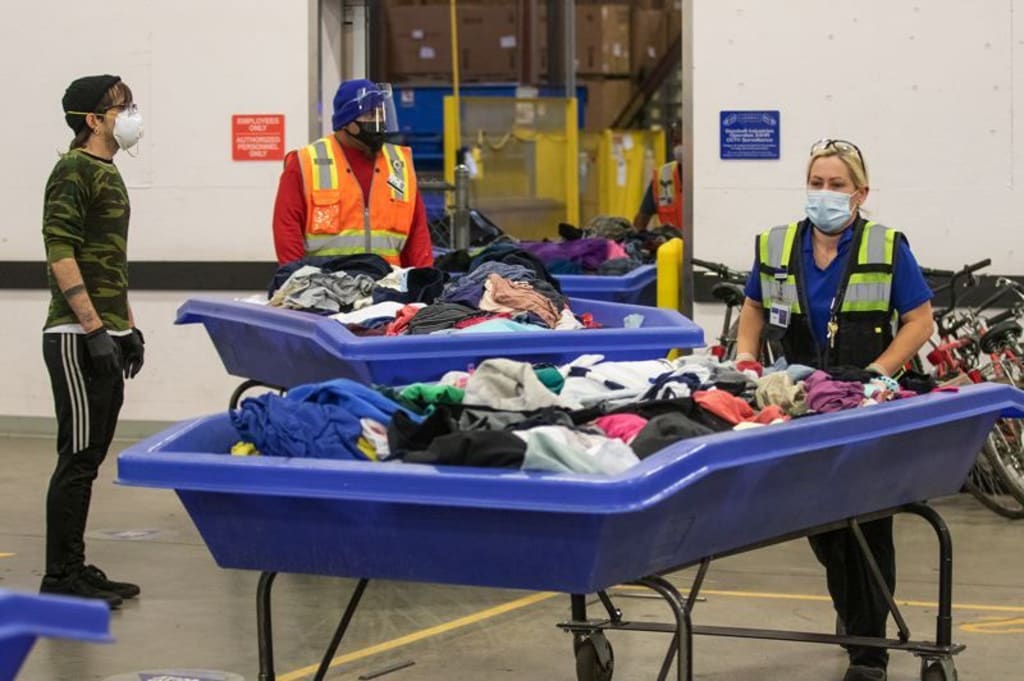
Having heard so much about "The Bins" from her cohorts and comrades in the creative community, curiousity and a deep-seated frugal nature demanded she explore. Horror stories had filtered down from disgruntled employees she'd met, so the mega-thriftstore had subconsiously slipped to the bottom of her preferred spots to bargain shop. Despite the anti-coporate stance she'd acquired as a 1960s survivor, having survived for years in poverty made such bargain-hunts a sweet indulgence for this grandma of five.
She had purchased a white 1990 Volvo 240 station-wagon a few years before, out of nostalgia and not necessity. But on occasions of moving a papasan or futon, playing grocery-trip chauffeur, or simply a pre-COVID cruising for chicken nuggets, the extra space came in quite handy. With a trip to The Bins, it was a necessity.
The din of the hollow warehouse space met her ears first. The indistinguishable chattering of some was juxtaposed to the intensity of the silent diggers. Selecting a cart and adjusting the double-layers of masks, she began... to scan the market of misfit items. Some sorting had been done: apparel seemed to cover a number of the portable rolling blue bins, as did bedding. Books had their own bins, as did toys and decorations out of season.
The diggers near the books seemed more subdued in their search, so as she was feeling a tad 'whelmed, she mosied over. There were vintage books, both soft and hardbound. Cookbooks of all ethnicities and dietary pursuasions. Her current passion was using vintage imagery for collage, so this was ideal. She found some 100 yr-old reference cyclopedias and medical books, old LIFE, TV-Radio Mirror, and Saturday Evening Posts with Norman Rockwell covers, and fully-illustrated Bibles in all their red-letter glory. Then, beneath a slough of Watchtower pamphlets, she saw a black leather cover. At first, she had thought it just another placement by The Gideons, but no. It was a notebook. The idea of someone's "little black book" being tossed haphazardly in a donation box and ending up at The Goodwill Outlet, buried beneath Jehovah's propaganda felt poignant and she retrieved it. She placed it with care and curiosity in her cart.
Once home, she began sorting through the treasure trove of nearly-free rejected materials she had rescued. Determined to offer them a new life as had been for her so often, through one reinvention or another, she stopped when she came to the little black book. Its pages were yellowed from time, temperature, and seemingly exposure to the elements. It predated the popular dayplanners of the 1990s. It had tabs, but they were not labeled. The 4"x6" loose-leaf pages had six holes, so being able to find filler paper would be a challenge. Seemed initially that it'd prove not to be a good investment, but then she turned to the back. There, imprinted in gold was the name, "Marshal McCoy," ... her late uncle's name. She was suddenly awash with a morbid curiosity, for Marshal had died a decade before. She knew little of him other than he had left the area and moved to Seattle, where he retired. She knew he had a life-partner, was very erudite and snarky. If this was her Uncle Marshal's book, it might offer some answers.
Cozying up in a wingback with Turmeric latte at her side, she flipped through the pages. At the back was an envelope taped to the inside backcover. It, too, was yellow, brittle, and weathered, but in the upper left corner it was stamped "Ensign Peak Advisors." Inside it were stock certificates. They were in the name of Marshall McCoy and listed a Portland address. She shook her head and laughed. She knew he had left The Mormon Church and not completed his Mission. It was always assumed that he was kicked out when it was discovered he was gay, but walking away from something to which he was so dedicated without a fight did not fit her image of him. He was, if nothing else, spunky.
A quick call to a broker revealed that the stock certificates were probably still good and worth around $20,000. Marshall had left children and she had no way of getting a hold of his partner (if he was still alive). She could not think of anything better to do with this treasure than to take it to the Q-Center and donate it. Such a place would have changed Marshall's life trajectory, had it been around in 1962 when this presumed pay-off was made. To have the organization that shunned him underwrite programs to support LGBTQ youth was a celebratory irony, a gift to them, investment in a more inclusive future, a burr in the financial saddle of one of the world's fattest religious and bigoted organizations, and would be a gift to herself, a treasured memory.
Yeh, for The Bins!
About the Creator
Keep reading
More stories from writers in Journal and other communities.
What are the top strategies for insurance compliance management in 2026?
Many insurers still rely on fragmented processes, manual reviews, and reactive controls; approaches that create blind spots, slow response times, and expose the business to regulatory and reputational risk. At the same time, digital distribution, AI-driven decision-making, and growing volumes of customer data are reshaping how insurance products are built, sold, and serviced.
By Fusion Business Solution P Limitedabout 2 hours ago in Journal
Silver Screen Magic with Mae West
American actress and singer Mae West became a popular film actress during the Great Depression. She started entertaining in vaudeville, then performed on Broadway, and finally went to Hollywood. She signed up with Paramount Pictures and made her debut in the 1932 film “Night After Night.” She also starred in musicals, comedies, and crime dramas. The American Film Institute named her one of the best classic Hollywood actresses.
By Rasma Raisters6 days ago in Geeks


Comments
There are no comments for this story
Be the first to respond and start the conversation.