
"Why Trump Pushed for Peace: The Ceasefire Between Iran and Israel"
"From legacy-building to geopolitical leverage, here are the key reasons behind Trump's unexpected Middle East diplomacy."
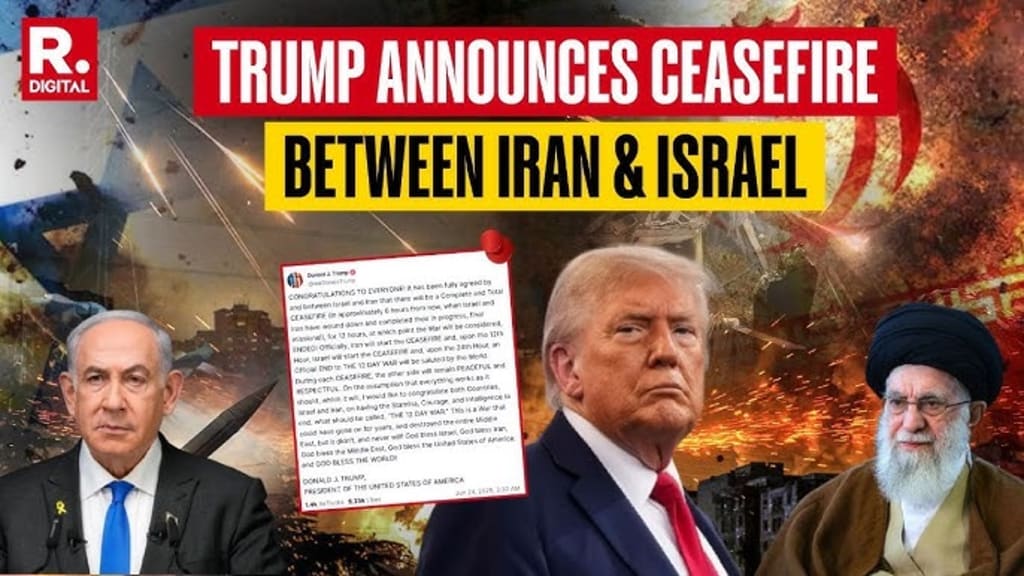
- Why Trump Pushed for Peace: The Ceasefire Between Iran and Israel
In a world often defined by entrenched conflicts and decades-old rivalries, the prospect of peace between Israel and Iran might seem like a distant dream. Yet, in an unexpected twist of geopolitical drama, former U.S. President Donald Trump emerged as a central figure advocating for a ceasefire between these longtime adversaries. Understanding why Trump would push for such a ceasefire requires diving into a complex web of political ambition,legacy-building, strategic calculation, and global optics.
- Legacy and Global Recognition
From the very start of his political career, Donald Trump has sought to carve out a lasting legacy—not only as a domestic leader but as an international statesman. His administration’s signature foreign policy achievement, the Abraham Accords, normalized relations between Israel and several Arab states, marking one of the few major diplomatic breakthroughs in the Middle East in decades.
Building on this, Trump recognized the immense historical weight that a ceasefire—or even a step toward peace—between Israel and Iran would carry. Unlike other leaders who tread carefully in the volatile Middle East, Trump saw an opportunity to cement his name in history as a peacemaker in a region long synonymous with conflict. A ceasefire brokered by Trump would not only eclipse previous efforts but could potentially earn him international accolades, including the much-coveted Nobel Peace Prize—something he has publicly desired.
This legacy motivation is crucial because it helps explain why Trump might take the unusual step of engaging directly in such a fraught and complex dispute. For Trump, peace isn’t just a political goal—it’s a chance to rewrite his story.
Political Comeback StrLegacy and Global Recognition
From the very start of his political career, Donald Trump has sought to carve out a lasting legacy—not only as a domestic leader but as an international statesman. His administration’s signature foreign policy achievement, the Abraham Accords, normalized relations between Israel and several Arab states, marking one of the few major diplomatic breakthroughs in the Middle East in decades.
Building on this, Trump recognized the immense historical weight that a ceasefire—or even a step toward peace—between Israel and Iran would carry. Unlike other leaders who tread carefully in the volatile Middle East, Trump saw an opportunity to cement his name in history as a peacemaker in a region long synonymous with conflict. A ceasefire brokered by Trump would not only eclipse previous efforts but could potentially earn him international accolades, including the much-coveted Nobel Peace Prize—something he has publicly desired.
This legacy motivation is crucial because it helps explain why Trump might take the unusual step of engaging directly in such a fraught and complex dispute. For Trump, peace isn’t just a political goal—it’s a chance to rewrite his story.
Political strategy
Another driving force behind Trump’s push for the ceasefire likely ties into his ongoing influence and potential political comeback. Having faced considerable controversy and criticism during and after his presidency, including two impeachments and legal battles, Trump remains deeply invested in maintaining his relevance on the world stage.
A high-profile peace deal would serve as a powerful political weapon. It could reposition him as a savvy dealmaker, capable of delivering results that other administrations could not. This narrative could broaden his appeal beyond his traditional base, attracting moderate Republicans, independents, and even disillusioned Democrats who value peace and stability.
In addition, the ceasefire would help Trump project strength and pragmatism simultaneously—a rare combination in politics. He could show voters that he is not only tough on adversaries but also smart enough to negotiate peace. This recalibration of his image could be vital for any future electoral ambitions, whether for the presidency or other influential roles.
- Reclaiming the Middle East Narrative
During his time in office, Trump adopted a hardline stance on Iran, withdrawing the U.S. from the 2015 Iran nuclear deal and imposing what he called “maximum pressure” sanctions aimed at crippling Iran’s economy and nuclear ambitions. However, the situation in the Middle East has remained precarious, with Iran continuing its nuclear program and supporting proxy groups across the region.
By pushing for a ceasefire, Trump could reposition himself as the architect of not just pressure but peace. This dual legacy would allow him to claim credit for forcing Iran into a corner and simultaneously opening a door to dialogue. It’s a strategic move designed to outshine his successors, particularly the Biden administration, which has struggled to revive nuclear negotiations with Tehran.
Moreover, such a ceasefire would reinforce U.S. influence in the Middle East without direct military intervention—an outcome appealing to both hawks and doves. It’s a diplomatic tightrope walk, but one that Trump might see as a masterstroke in reclaiming the narrative that the U.S. remains the indispensable power broker in the region.
- Economic and Security Calculations
Beyond legacy and politics, practical considerations also play a role. A prolonged conflict between Israel and Iran threatens to destabilize global oil markets, driving up energy prices and disrupting supply chains. For the United States and its allies, this is an economic risk with wide-reaching consequences.
By fostering a ceasefire, Trump could contribute to regional stability, easing fears of a wider war that would send shockwaves through the global economy. Lower oil prices and reduced conflict risk benefit the U.S. economy directly and reduce the need for expensive military deployments and interventions abroad.
Additionally, a ceasefire reduces the immediate threat to American personnel and interests in the region. By encouraging dialogue rather than escalation, Trump’s approach could preserve U.S. military resources and redirect attention to other global challenges, such as great power competition with China and Russia.
- Strategic Leverage Over Iran
A ceasefire doesn’t necessarily signal friendship or weakness. For Trump, it could be a tactical move to divide and weaken Iran from within. Iran’s political system is split between hardliners, who oppose any negotiation with the West, and moderates, who may see diplomatic engagement as a pragmatic way forward.
By orchestrating a ceasefire, Trump could empower moderates who want to de-escalate tensions, while isolating hardliners who rely on hostility toward Israel and the U.S. as a rallying cry. This internal pressure might eventually compel Tehran to reconsider its nuclear ambitions or regional activities.
Furthermore, a ceasefire could act as a strategic pause—a way to slow down military escalations while gathering intelligence and building diplomatic channels. It’s a calculated gamble to manage a volatile adversary through controlled engagement rather than unchecked conflict.
- Optics and Media Domination
Trump’s skill as a media operator cannot be underestimated. He understands that global politics is also about narratives and optics. A ceasefire is a story that captures headlines, dominates social media, and shapes public discourse.
By claiming credit for peace, Trump can shift the media spotlight away from controversies and legal troubles, presenting himself as the man who tamed one of the world’s most dangerous flashpoints. This narrative shift can mobilize supporters, silence critics, and reshape his public image.
Moreover, the symbolism of peace resonates universally. It appeals not just to political allies but to ordinary citizens weary of war and instability. Through this lens, Trump’s ceasefire initiative serves as a powerful tool to unite and inspire, even if the underlying politics remain complex.
- Conclusion
Donald Trump’s push for a ceasefire between Israel and Iran is not just about halting conflict—it is a multifaceted strategy combining legacy-building, political calculation, strategic diplomacy, economic interests, and media savvy. Whether or not the ceasefire holds, and whether or not Trump’s efforts lead to a lasting peace, this move represents a bold and unprecedented chapter in modern diplomacy.
For Trump, peace is more than an ideal—it is a way to redefine his place in history, influence geopolitics, and maintain his political vitality in an ever-changing world..
About the Creator
Jackii
True stories that stir the heart.
Global issues that shake the mind.
Einstein’s Early Struggle: The 1895 Swiss Federal Polytechnic Entrance Exam and Lessons in Talent and Perseverance
In 1895, a 16-year-old Albert Einstein faced a setback that many might have seen as a sign of failure: he failed the entrance exam for the Swiss Federal Polytechnic in Zurich. While this moment is often remembered as a youthful stumble in the life of one of history’s greatest scientific minds, it offers profound insights into the nature of talent, learning, and perseverance. Einstein’s experience reminds us that early academic challenges do not define one’s potential, and that success often comes from persistence and leveraging one’s strengths.
By Salaar Jamali3 days ago in Journal



Comments
There are no comments for this story
Be the first to respond and start the conversation.