
Why the Europe Used Car Market is Growing Faster Than New Car Sales in 2026-2034
Inflation, rising living costs, and an aging vehicle fleet push consumers toward more affordable mobility solutions.

Key Takeaways
- The European used car market is currently valued at 65.1 billion USD and is projected to grow steadily to 93.8 billion USD by 2034.
- Used electric vehicle sales jumped by 57 percent in late 2024 due to price corrections and improved consumer trust in battery longevity.
- An aging fleet average of 12.3 years combined with economic inflation is pushing more buyers toward the secondary market for affordable mobility.
- Consumers are increasingly shifting from risky private sales in favor of organized dealerships that offer certified pre-owned protection and warranties.
- Future market growth will be driven by the rising dominance of SUVs and the expansion of digital retail platforms for online vehicle purchasing.
Buying a car in Europe has fundamentally changed over the last five years. As new vehicle prices skyrocket and production lead times fluctuate, the Europe used car market has transitioned. It is no longer just a secondary alternative. Instead, it has become a primary choice for millions of pragmatic buyers. Whether driven by economic necessity or the sustainable appeal of the circular economy, pre-owned vehicles now dominate the automotive landscape.
Recent data backs this shift. In 2025, the market valuation stands at a massive USD 65.1 billion. This reflects a mature sector that is rapidly professionalizing. This article dives deep into the statistics, trends, and forecasts shaping the future of mobility across the continent.
What Is the Current Valuation of the Europe Used Car Market?
The market reached USD 65.1 Billion in 2025 and is projected to grow to USD 93.8 Billion by 2034.
The financial trajectory of the European second-hand vehicle sector shows robust, steady growth. It avoids volatile boom-and-bust cycles. According to the latest market analysis by IMARC Group, the industry will expand at a Compound Annual Growth Rate (CAGR) of 4.15% between 2026 and 2034.
This growth signifies stability. The post-pandemic supply chain crisis saw used car prices briefly eclipse new car prices in some regions. However, the market has corrected itself. Inventory levels have normalized. Structural changes now drive growth rather than temporary shortages. The projection hitting nearly $94 Billion in the next decade indicates a shift in investor focus. Major automotive groups are betting on "fleet remarketing" and "Certified Pre-Owned" (CPO) programs as major revenue streams. They are moving away from a reliance solely on new car sales.
Request the full research report sample with the list of TOC
Why Is the Demand for Pre-Owned Vehicles Rising Across Europe?
Inflation, rising living costs, and an aging vehicle fleet push consumers toward more affordable mobility solutions.
The economic landscape in Europe has forced a re-evaluation of household spending. Inflation impacts everything from groceries to energy bills. Consequently, fewer Europeans are willing to absorb the depreciation hit associated with new cars. New vehicles often lose 20-30% of their value in the first year. Therefore, the demand for high-quality used cars has surged.
Furthermore, we see a distinct trend in vehicle longevity. Data from the European Commission and ACEA indicate that the average age of cars on EU roads has risen to 12.3 years. This statistic reveals two key insights. First, manufacturers are building cars better. Second, a vibrant market exists for older vehicles. This "aging fleet" phenomenon supports a thriving ecosystem of aftermarket parts, service centers, and private sales. It creates a self-sustaining cycle of supply and demand.
How Is the Market Segmented by Propulsion and Vendor Type?
The market is split between unorganized private sellers and organized dealerships. Additionally, we see a rapid shift toward hybrid and electric propulsion systems.
To understand the European used car market, one must look at who is selling and what they are selling.
By Vendor: The market divides into the Organized and Unorganized sectors.
- The Unorganized Sector: This includes private-to-private sales and small, independent lots. Historically, this sector held the largest volume due to lower prices.
- The Organized Sector: This comprises franchise dealerships, rental companies, and leasing firms. This segment is growing the fastest. Buyers increasingly pay a premium for peace of mind. They value warranties, financing options, and vehicle history reports (VHR).
By Propulsion: Petrol and diesel vehicles still command the lion's share of the volume. This is due to the sheer number of legacy internal combustion engine (ICE) cars in circulation. However, trends are shifting. The IMARC Group report highlights a decline in diesel market share. Strict emission zones in cities like London (ULEZ) and Paris drive this decline. Conversely, the Hybrid and Electric segments witness the highest growth rates. Early-adopter EVs from the late 2010s are now entering the second-hand market in volume.
Are Used Electric Vehicles (BEVs) Becoming a Viable Option?
Yes, used Battery Electric Vehicle (BEV) sales surged by roughly 57% in Q3 2024. This signals a maturing secondary market.
For years, consumer anxiety regarding battery health and residual value plagued the used EV market. However, 2024 marked a turning point. Industry reports indicate a massive 57% increase in used BEV transactions.
Why the sudden jump?
- Price Correction: Tesla and other manufacturers cut new car prices. This forced used EV prices down, making them accessible to a wider demographic.
- Battery Durability: Real-world data proves that modern EV batteries degrade slower than feared. This builds consumer trust.
- Incentives: Several European governments have begun discussing subsidies for used green vehicles. This aims to spur adoption among lower-income brackets.
This segment is crucial for the "Circular Economy." The EU pushes for net-zero emissions. Therefore, keeping existing EVs on the road for a second and third lifecycle is just as important as manufacturing new ones.
Organized vs. Unorganized Market: Which Should You Choose?
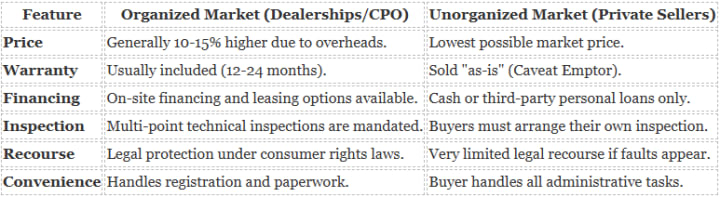
Organized vendors offer reliability and legal protection. Unorganized sellers provide lower upfront costs but higher risk.
Choosing where to buy is often as important as choosing the car itself. The "Organized" segment (dealerships/CPO) is expanding because modern cars are complex computers. Buying one privately carries risks that didn't exist with simpler mechanical cars of the past.
Below is a comparison to help you evaluate the best channel for your purchase:
What Are the Projected Trends for the Next Decade?
The market will see a dominance of SUVs, increased online penetration, and AI-driven pricing models.
Looking toward 2034, the IMARC Group forecast suggests several key evolutions in the marketplace:
- The SUV Takeover: SUVs and Crossovers are becoming the most requested vehicle type in the used sector. This mirrors the new car market. Their perceived safety and practicality make them a favorite for families. Consequently, their residual values remain higher than sedans or hatchbacks.
- Digital Retail: Currently, 99% of transactions may still involve some offline component (like a test drive). However, the transaction is moving online. Platforms like AutoScout24 and BCA make it possible to buy a used car entirely online. Home delivery and 14-day return policies are becoming the new standard.
- AI Valuation: The days of guessing a car's value are over. Advanced AI algorithms now analyze millions of data points. They track local demand and specific trim rarity to set real-time prices. This ensures fair market value for both buyers and sellers.
Conclusion
The European used car market is no longer just a budget-friendly alternative. It is a sophisticated, high-value ecosystem worth over $65 Billion. With a steady CAGR of 4.15%, the sector proves resilient against economic headwinds.
For consumers, the advice is clear. The market is stabilizing. Inventory is returning. The options - especially in the electric and hybrid segments - have never been better. You might opt for the security of an organized dealership. Or, you might choose the bargain of a private sale. Regardless, the second-hand market offers the smartest path to mobility in 2026.
About the Creator
Joey Moore
I'm Joey Moore, a seasoned Research Analyst with 5+ years of experience in market research. Expert in data analysis, strategic planning, and industry insights. Proven track record in delivering actionable reports.
Keep reading
More stories from Joey Moore and writers in Journal and other communities.
Legacy vs Innovation: How the German Automotive Industry is Pivoting in the Age of EVs
Key Takeaways The Germany automotive market is projected to expand at a steady 3.5% annual rate to reach nearly 2 million units by 2033. Domestic manufacturers export roughly 76% of all vehicles produced, which creates a heavy reliance on international economic health. Electric vehicle production is forecast to rebound sharply in 2025 as strict EU emission targets force automakers to ramp up sales. High energy prices and emerging Chinese competitors currently pose the most significant threats to the profitability of legacy German brands. Government policy aims to have 15 million electric vehicles in operation by 2030 to accelerate the transition away from combustion engines.
By Joey Mooreabout 9 hours ago in Journal
Elizabeth Smart: The Full Story of Her Kidnapping, Rescue, and Legacy
Elizabeth Smart is one of the most well-known kidnapping survivors in American history. Her case captured national attention in 2002 and has resurfaced in the spotlight with the release of the Netflix documentary Kidnapped: Elizabeth Smart in January 2026.
By Vincent Otiri6 days ago in Journal



Comments
There are no comments for this story
Be the first to respond and start the conversation.