
Why I Love My Job
a team leader has three key tasks


I love my job because I help my colleagues to become better at achieving their professional endeavors.

I’m a team leader working for an outsourcing company for almost eight years now. I do three key tasks in developing my team members to become better. Leading, managing, and coaching are my key tasks as a team leader.
In an outsourcing company, we basically provide customer service to a particular product or service. My team members are the frontliners, which means they are the ones who provide direct service to our customers through phone, chat, email, or social media. I, too, am the second-level frontliner, who normally takes in escalation from them. To ensure they deliver an excellent service, we must equip them with the knowledge and skills needed in their day-to-day job. And that’s where my three key tasks come in.
Leading

It’s a broad term, but it basically means to make your team members follow you because they trust you, not because the company says to do so. Leading starts in establishing trust within the team. I have to set proper expectations with the team members, make them aware of our objectives, in this case providing excellent customer service under the company’s standards and values, and getting to know them, and digging deeper into their interests and motivation. Part of leading the team is to be open with feedback from them on how you’re doing with leading them and, of course, improve as a team leader if necessary. If I’ve done a mistake, it’s important to apologize to them. After all, nobody is perfect and mistakes develop us to be better. As a leader, I have to set the best possible example for my team. I have to be knowledgeable of my team members’ daily tasks so that if they need my help, I can definitely provide support to them.
Managing
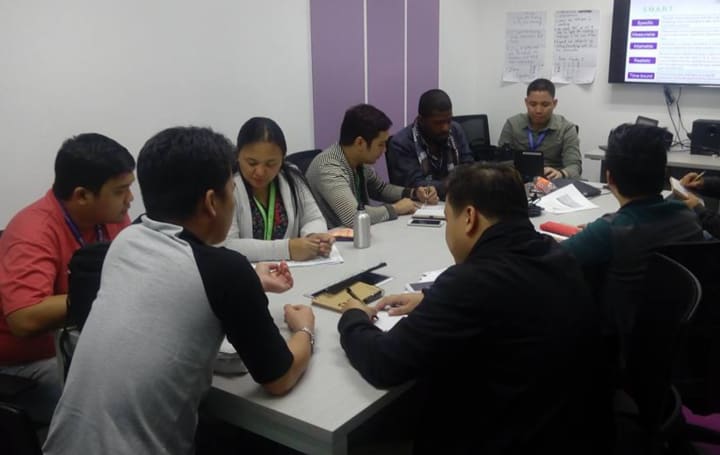
Managing comes in when the team is required to do a particular task. Performance management, for example. If a team member fails in performance for the second time, although I already talked about it with him or her, I now have to give a memorandum based on the due process set by the company standard. I make them understand that the action I do is not a punishment, rather a corrective action in order to help them achieve their fullest potential in their work. A good example of employing managing is if my team member consistently incurred absences or tardiness. At first incurrence, I talk to my team member and discuss actions we can take in order to avoid the same opportunity, get his or her commitment, and, of course, connect that opportunity to his or her motivation. I normally ask how being late or absent impacts the team member’s motivation. Most of my team members are aiming for career growth, and with that, I make sure they understand the connection between absenteeism or tardiness to their aim of getting promoted someday.
Coaching

Coaching is my favorite part. I’ve been an advocate of coaching since I became a team leader. I always believe it’s the best among the three key tasks of a team leader. It’s a task that takes up much of my time on a weekly basis. During my first day of the week, after reading email updates from our stakeholders, I immediately do my coaching preparation for each team member. I review their performance individually, drill-down per Key Performance Indicator, identify behaviors affecting them, choose the best case or call to present during the coaching session, and prepare possible questions that can help guide the team member to realize the opportunity. Coaching preparation takes the entire day because I need to ensure that I’m targeting the exact behavior that the team member needs to improve on. Part of the preparation is to employ root cause analysis based on the data I gathered from the team member’s cases or calls. And then, identify and classify the fundamental root cause, whether it’s a skill or a will issue. Once done, I send a calendar invite to them with their coaching schedule.
On the second day of my work week, I coach my team’s bottom performers and do follow-through coaching on the fifth day to check how their action plans have been working, so, in case, the action plans don’t work, we can change them. The middle and top performers get their coaching on the third and fourth days.
My coaching session with my team members normally takes from 45 minutes to 1 hour individually. The company I work for has a standard coaching practice and I’ve been loving it because, although we have guidelines, they allow me to be flexible in how I facilitate the coaching. I normally do some engagement activity at the start of the session to boost the team member’s confidence and establish comfortability. These activities relate to my team member’s interests. Say, for example, my team member is a gamer. I must prepare for an engagement activity related to gaming.
It’s in coaching that my team members get to learn something new which they can use in their job. It could be a process update or something the team member discovers. It’s where they get kudos for a job well done, create action plans to address any opportunities to improve on, and get reminded of their reasons they are working, their motivation. On a weekly basis, they realize how their actions, the good things, and the even betters impact their motivation and affect the company we work for and the customers. They get to understand how they impact society, the world.
I had this one unforgettable coaching session with my team member, who got promoted last year and is now a team leader like me. I reviewed a call he had with a customer who was not tech-savvy. The concern was about a cloud computing project that had been suspended because the billing account linked to it had a payment method issue. He tried his best to help the customer, but he missed reviewing the primary cause of the cloud project suspension. The call ended with the customer frustrated and without resolution. I coached him about it and we came up with an action plan to always exhaust all available tools in identifying the root cause of the issue, in that case, double-checking the status of the billing account.
The second time he got a call on a similar concern, the customer was so happy and satisfied that she asked the supervisor (that was me) so she could commend him for a job well done. He approached me to talk to the customer. I initially thought it was an escalation call. When I took the call, the customer was thrilled. She was satisfied with how he handled her issue. During that conversation, I learned she was a doctor in a hospital in Colorado and that she was the one maintaining the cloud computing project with the issue my team member had just resolved. Although she was on the other line, I could feel the happiness in her voice. And, it overwhelmed me to learn that the project with the issue was cloud storage of the hospital’s schedule of medication for patients. I realized how it could have negatively impacted the hospital had the issue not been resolved in a timely manner. After the call, I talked to my team member, and, of course, I congratulate him for an excellent job by announcing it on the operations floor.
After that inspiring event, my team member had improved well in tool utilization. He had consistently shown his mastery of the product and the process. He had become consistent with his performance, hence I recommended him to get promoted to a Subject Matter Expert, which our manager approved of. By that time, I could see the fruition of my role as a leader.

That experience always reminds me that, as a team leader, developing and motivating people, has a tremendous impact on the world through the customers like the doctor I talked to. Apart from the help we provide to our customers, we also develop people within our organization, help them reach their fullest potential and achieve their professional aim, and create the next generation leaders. This is the main reason I love my job.
About the Creator
M.G. Maderazo
M.G. Maderazo is a Filipino science fiction and fantasy writer. He's also a poet. He authored three fiction books.
Keep reading
More stories from M.G. Maderazo and writers in Journal and other communities.
How AI Is Reshaping the Future of Software Development
Artificial intelligence is no longer an experiment running in parallel to engineering. It has moved directly into the production pipeline. For modern software development companies, AI is changing how code is written, tested, secured, and evolved. This shift is not cosmetic. It is structural. Businesses that treat AI as a feature will fall behind those that redesign their development model around it.
By Gabriella Browne2 days ago in Journal



Comments
There are no comments for this story
Be the first to respond and start the conversation.