
When Worlds Collide: Asteroid Strike
When Worlds Collide: Assessing the Impact of a Major Asteroid Strike - Which Countries Face the Greatest Threat?
When Worlds Collide: Assessing the Impact of a Major Asteroid Strike - Which Countries Face the Greatest Threat?
Introduction:
The image of a massive asteroid hurtling towards Earth has captured the human imagination for decades, fueling blockbuster movies and sparking scientific debate. While the likelihood of a civilization-ending asteroid impact in our lifetime is relatively low, the potential consequences are so catastrophic that it's crucial to understand the risks and prepare for the unthinkable. This article examines what would happen if a significant asteroid were on a collision course with Earth, the factors that would determine the impact's severity, and which countries would be most vulnerable.
The Threat Assessment: Size, Composition, and Trajectory:
The severity of an asteroid impact depends on several key factors:
Size: This is the most critical factor. Small asteroids, a few meters in diameter, would likely burn up in the atmosphere, creating a spectacular meteor shower. Larger asteroids, hundreds of meters or even kilometers in diameter, could cause widespread devastation.
Composition: The asteroid's composition (rocky, metallic, or icy) affects its density and how it interacts with the atmosphere. Metallic asteroids tend to be denser and more likely to reach the ground intact.
Trajectory: The angle of entry and the impact location are crucial. A shallow angle of entry increases the atmospheric friction, potentially breaking up the asteroid before it reaches the ground.
Impact Location: An impact in a densely populated area would obviously cause far more damage than an impact in a remote ocean.
Immediate Consequences: From Fireballs to Global Tsunamis:
The immediate consequences of an asteroid impact would be devastating, including:
Airburst or Impact: Depending on the size and composition of the asteroid, it would either explode in the atmosphere (airburst) or impact the Earth's surface. An airburst can still cause significant damage through the shockwave it generates.
Shockwave: A powerful shockwave would radiate outwards from the impact site, leveling everything in its path. The intensity of the shockwave would decrease with distance, but it could still cause widespread damage hundreds of kilometers away.
Thermal Radiation: The impact would generate intense heat, causing wildfires and igniting flammable materials.
Earthquakes and Tsunamis: A large impact could trigger earthquakes and tsunamis, further exacerbating the damage. An ocean impact would generate a massive tsunami that could inundate coastal areas thousands of kilometers away.
Ejecta: The impact would eject vast amounts of debris into the atmosphere, including dust, rock, and molten material. This ejecta could block sunlight, leading to a period of global cooling known as an "impact winter."
Which Countries are Most Vulnerable?
While an asteroid impact would have global consequences, some countries are more vulnerable than others due to their geography, population density, and level of preparedness:
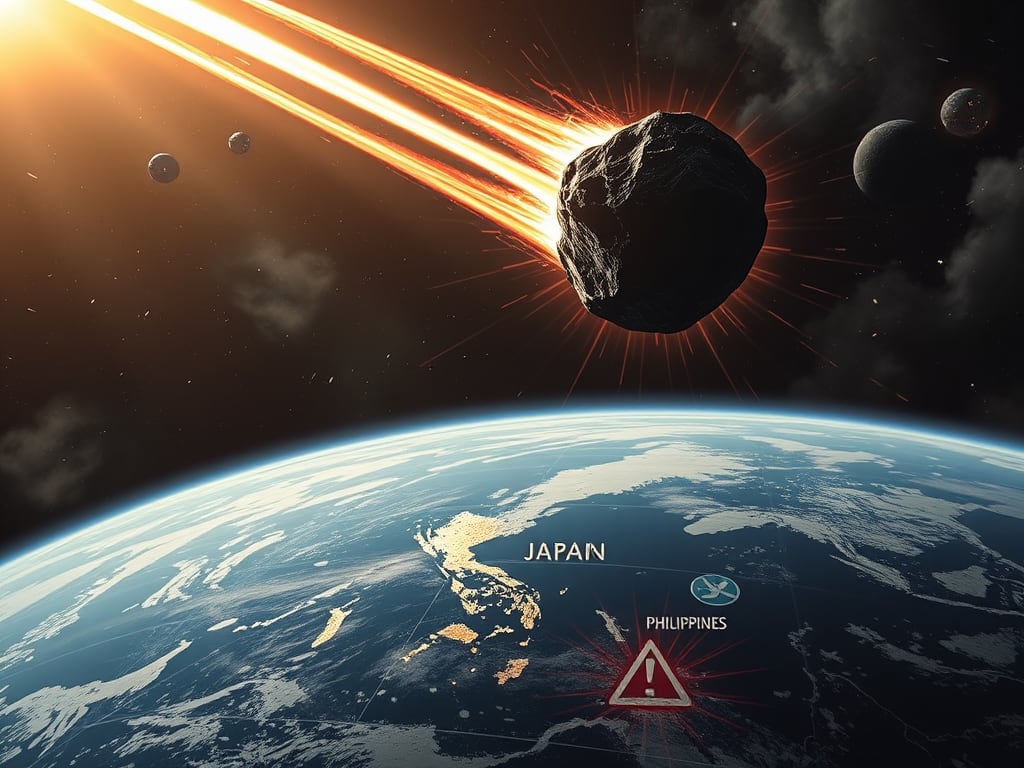
Coastal Nations: Countries with extensive coastlines are particularly vulnerable to tsunamis generated by an ocean impact. This includes nations in the Pacific Ring of Fire, such as Japan, Indonesia, the Philippines, and the West Coast of the Americas.
Island Nations: Small island nations are especially vulnerable, as they could be completely inundated by a tsunami or rendered uninhabitable by an impact.
Densely Populated Regions: Countries with high population densities, particularly in coastal areas, would suffer the greatest loss of life. This includes many nations in Asia, Europe, and the Americas.
Countries Near Tectonically Active Zones: Countries located near major fault lines or volcanoes are at higher risk of earthquakes and volcanic eruptions triggered by an impact.
Nations with Limited Infrastructure and Resources: Countries with limited infrastructure and resources would struggle to respond effectively to an asteroid impact, making them more vulnerable to its consequences.
Specific Countries at Risk (Examples):
Japan: Highly vulnerable to tsunamis due to its location in the Pacific Ring of Fire and its high population density along the coast.
Bangladesh: Low-lying and densely populated, making it extremely vulnerable to tsunamis and flooding.
Netherlands: Much of the country lies below sea level, making it highly vulnerable to tsunamis.
Indonesia: An archipelago nation with a high population density, making it vulnerable to tsunamis, earthquakes, and volcanic eruptions.
United States: With its vast coastline, diverse geography, and high population density, the United States faces a wide range of potential impacts.
Warning Systems and Mitigation Strategies:
Fortunately, scientists are working to detect and track potentially hazardous asteroids. Several warning systems are in place, and research is underway to develop mitigation strategies:
Asteroid Detection Programs: NASA and other space agencies operate telescopes and survey programs designed to detect and track asteroids.
Impact Prediction Models: Scientists use computer models to predict the trajectory of asteroids and assess the likelihood of an impact.
Deflection Strategies: Several strategies have been proposed for deflecting an asteroid, including using a "gravity tractor," a kinetic impactor, or a nuclear explosion.
Conclusion:
While the threat of an asteroid impact is real, it is not a reason for despair. By understanding the risks, developing effective warning systems, and investing in mitigation strategies, we can significantly reduce the potential for a catastrophic event. The key is to be prepared, informed, and proactive in protecting our planet from this potential threat. A coordinated global effort is essential to ensure the survival of humanity in the face of this cosmic challenge.
About the Creator
Chad Pratt and the Quiet Strength of Lifelong Running
Running is often portrayed as a competitive sport, a pursuit of speed, or a quest for medals. But for some, it becomes something more—a way to cultivate balance, clarity, and resilience. Chad Pratt exemplifies this philosophy. His lifelong commitment to running shows how steady movement, discipline, and focus can shape not only physical fitness but also emotional and spiritual well-being.
By Chad Prattabout 20 hours ago in Journal




Comments (1)
A great asteroid strike story! Great work