
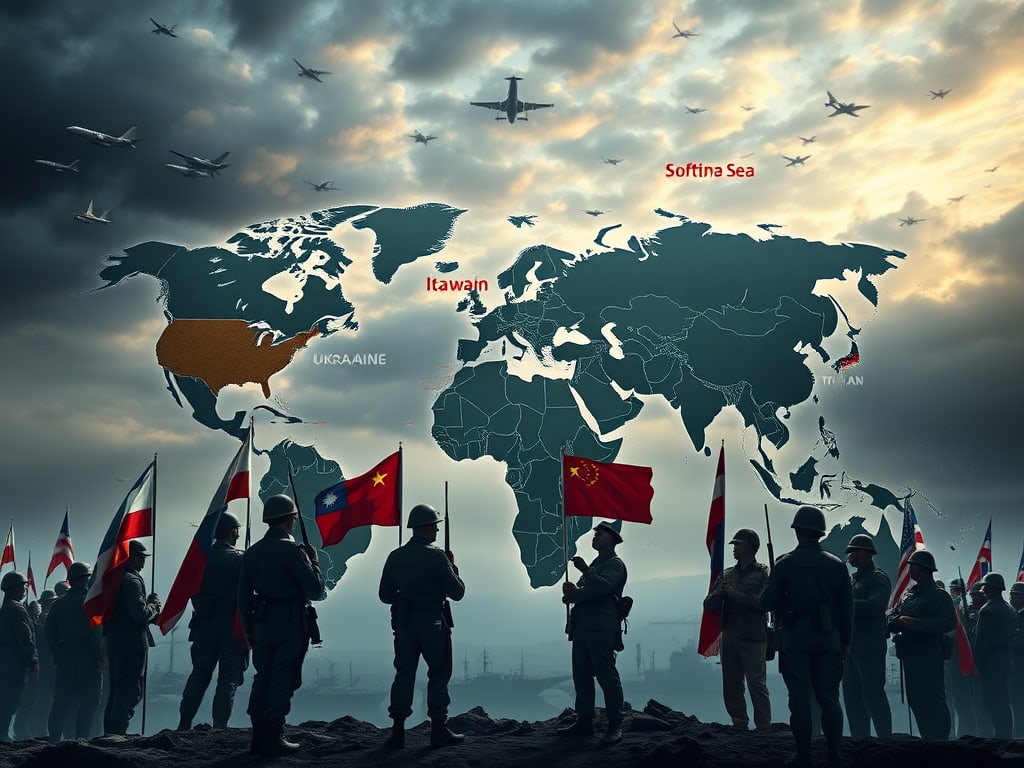
The Precipice of Global Conflict: How Could World War III Arise?
Introduction:
The specter of World War III, once relegated to the realm of dystopian fiction, is increasingly discussed as a genuine possibility in the current geopolitical climate. While no one can predict the future with certainty, it's crucial to understand the potential flashpoints, underlying tensions, and cascading events that could lead to a global conflagration. This article examines the most plausible pathways to World War III, exploring the complex web of factors that could push the world towards the brink.
The Shifting Sands of Global Power:
The post-Cold War era, characterized by American dominance, is giving way to a multipolar world, where power is more diffused and competition between major actors is intensifying. This shift in the global order is creating new opportunities for conflict and instability.
The Rise of China: China's rapid economic and military growth is challenging the established world order and leading to increased competition with the United States for global influence.
Resurgent Russia: Russia, under President Vladimir Putin, is seeking to restore its former glory and reassert its influence in its near abroad. This has led to tensions with NATO and the European Union.
Regional Powers: The rise of regional powers such as India, Brazil, and Iran is further complicating the global landscape and creating new potential flashpoints.
The Key Flashpoints: Where Could the Spark Ignite?
Several regions around the world are currently simmering with tension and could potentially serve as the spark that ignites a global conflict:
Ukraine: The ongoing conflict in Ukraine, with Russia's annexation of Crimea and support for separatists in the east, remains a major source of tension between Russia and the West. A further escalation of the conflict could draw NATO into a direct confrontation with Russia.
Taiwan: China's growing assertiveness towards Taiwan, which it views as a renegade province, is raising concerns about a potential military invasion. A Chinese invasion of Taiwan would almost certainly trigger a response from the United States and its allies.
South China Sea: The South China Sea is a hotly contested waterway, with China, Vietnam, the Philippines, Malaysia, and Brunei all making competing territorial claims. China's militarization of the region and its assertive actions against its neighbors are increasing the risk of conflict.
The Middle East: The Middle East remains a volatile region, with numerous conflicts and rivalries simmering beneath the surface. The ongoing conflict in Syria, the rivalry between Saudi Arabia and Iran, and the Israeli-Palestinian conflict all have the potential to escalate into a wider war.
The Korean Peninsula: North Korea's nuclear weapons program and its aggressive rhetoric are raising concerns about a potential conflict on the Korean Peninsula. A North Korean attack on South Korea or the United States could trigger a devastating war.
The Escalation Ladder: How Could a Regional Conflict Turn Global?
Even if a conflict starts in a localized region, there are several ways it could escalate into a global war:
Miscalculation: A miscalculation or misinterpretation by one side could lead to an unintended escalation of the conflict.
Alliance Commitments: Alliance commitments, such as NATO's collective defense clause, could draw multiple countries into the conflict.
Cyberattacks: Cyberattacks could be used to disrupt critical infrastructure or spread disinformation, leading to a further escalation of tensions.
Economic Warfare: Economic sanctions and trade wars could be used to weaken an adversary, but they could also backfire and lead to a more aggressive response.
Nuclear Weapons: The use of nuclear weapons, even in a limited fashion, would have catastrophic consequences and could trigger a full-scale nuclear war.
The Role of Misinformation and Propaganda:
In the age of social media and readily available information, misinformation and propaganda can play a significant role in escalating tensions and fueling conflict. False narratives, conspiracy theories, and hate speech can be used to demonize an adversary, mobilize public support for war, and incite violence.
Mitigating the Risks: What Can Be Done to Prevent World War III?
Preventing World War III requires a multifaceted approach:
Diplomacy and Dialogue: Open communication and dialogue between major powers are essential to de-escalate tensions and prevent misunderstandings.
Arms Control: Agreements to limit the production and proliferation of weapons can reduce the risk of an arms race and prevent a catastrophic conflict.
International Law and Institutions: Strengthening international law and institutions, such as the United Nations, can provide a framework for resolving disputes peacefully.
Economic Cooperation: Promoting economic cooperation and interdependence can reduce the incentive for conflict and create a more stable global order.
Addressing Root Causes: Addressing the underlying causes of conflict, such as poverty, inequality, and political oppression, can reduce the risk of instability and violence.
Promoting Education and Understanding: Education and understanding about different cultures and perspectives can help to break down stereotypes and promote tolerance.
Conclusion:
The threat of World War III is real, but it is not inevitable. By understanding the potential flashpoints, underlying tensions, and escalating factors, we can work to prevent a global conflagration. The time for action is now. We must prioritize diplomacy, arms control, international law, and economic cooperation to build a more peaceful and just world. The future of humanity depends on it.
About the Creator
How Paid Advertising Services Changed the Way I See Online Growth
A while ago, I helped a friend launch a small online business. We spent weeks building the website. The design looked clean, the content was clear, and the products were carefully listed. When everything was finally ready, we felt confident that visitors would soon begin exploring the site.
By Anthony Rodgersabout 16 hours ago in Journal
The Great Data Strike: Why 2026 is the Year of "Digital Poisoning"
The era of the "Passive User" is dead. For the last decade, we lived under a silent social contract: we get "free" services, and in exchange, big tech gets our data. But in 2026, the stakes have changed. Your data isn’t just being used to show you ads for sneakers anymore; it’s being fed into Large Language Models (LLMs) and Image Generators to create a digital twin of your intellect, your art, and your professional edge.
By Alex Sterling 2 days ago in Journal


Comments (1)
World war 3 is a scary thought! Great work!