
When the Sea Turns Red: Prophecy, Fear, and the Mystery of Galilee
Is the blood-red Sea of Galilee a scientific wonder, a sign of the end times, or a divine reminder to humanity?
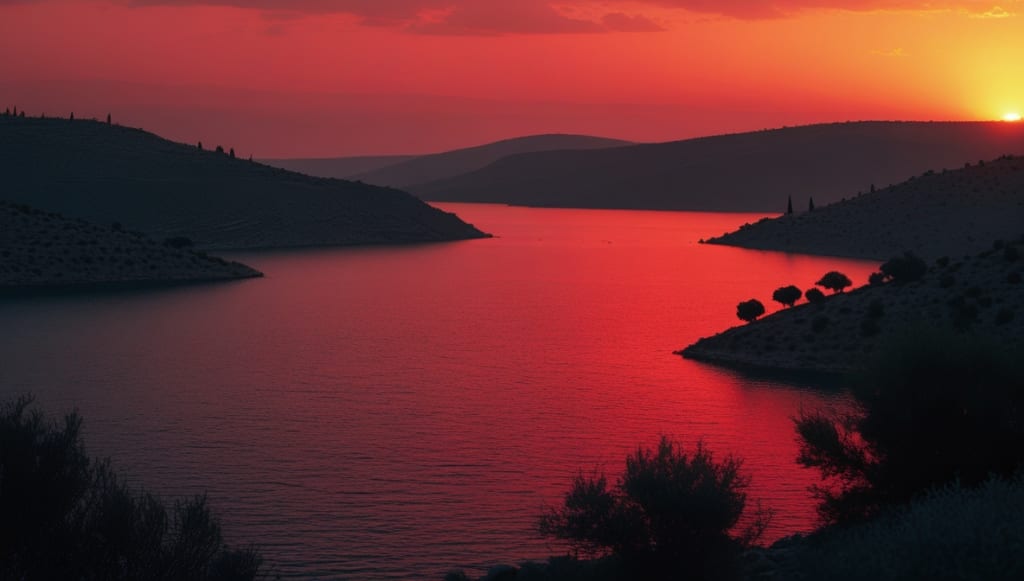
In early September, the world watched in awe as a lake in Palestine—the Sea of Galilee, also known as Lake Tiberias—underwent a sudden and shocking transformation. Once a calm body of crystal-blue water, it reportedly shifted into a shade so red it resembled flowing blood. Videos and images spread across social media almost instantly, sparking waves of fascination, fear, and prophecy-driven speculation.
For many, this was no ordinary event. Within hours, conversations began linking the phenomenon to ancient religious texts—the Qur’an, the Bible, and even the Torah. Some declared it a miraculous warning from God, others dismissed it as a natural occurrence explained by science, while countless voices stood suspended in the middle, shaken by the symbolism of what they had just witnessed.
The question echoed across continents: Was this a scientific coincidence—or a sign of the end times?
The Prophetic Weight of Lake Tiberias
In Islamic tradition, the Sea of Galilee carries profound eschatological importance. The Prophet Muhammad (peace be upon him) spoke of this very lake in hadiths, linking it to the terrifying emergence of Gog and Magog—two mighty forces destined to spread across the earth in the final days. He foretold that these beings would drink the lake dry, until not a drop remained.
Thus, when Muslims hear of anything unusual happening in Lake Tiberias—its waters receding, or its color changing—their hearts tremble. These events are not mere headlines, but reminders of prophecies that have lived in the Islamic imagination for over 1,400 years.
Jewish and Christian traditions also place weight on blood-red waters. In the Torah and Bible, one of the earliest and most devastating signs against Pharaoh was the transformation of the Nile River into blood during the time of Prophet Moses. In the Book of Revelation, the imagery is even clearer: in the last days, “the seas and rivers will turn red like blood.” For Christians, the Sea of Galilee turning red struck uncanny parallels with these warnings, leading many priests and preachers to proclaim it a wake-up call for humanity.
Even Jewish rabbis drew from their ancient scriptures, interpreting the event as a sign pointing to the long-awaited arrival of a messianic figure.
Science or Sign?
Skeptics argue that the reddening of lakes and rivers is often caused by natural phenomena—such as red algae blooms, mineral shifts, or even microbial activity. Scientists note that changing climates and rising global temperatures increase the likelihood of such ecological events.
And yet, even if explained by science, the symbolism of the transformation remains haunting. Natural or not, the timing and location of the incident—Galilee, a lake loaded with centuries of spiritual meaning—have led many to look beyond science and toward prophecy.
As one observer wrote online:
“If it was any other lake, we’d chalk it up to nature. But this is Galilee. This is where prophecy meets reality.”
Shared Human Reactions
Interestingly, the responses across Muslim, Christian, and Jewish communities carried a shared emotional core: fear, awe, and reflection.
Muslims recalled hadiths of the Prophet Muhammad, who tied the lake to the march of Gog and Magog. Some feared this was a sign their appearance was near. Others saw it as a divine nudge, urging believers to repent and prepare for the afterlife.
Christians connected it to biblical plagues and the apocalyptic visions of Revelation. Many pastors described it as a last warning before divine judgment falls upon the world.
Jewish scholars pointed to passages in their scriptures, interpreting it as a marker of the messianic age, while some cautioned it could mean the approach of the Antichrist figure Muslims call the Dajjal.
Despite doctrinal differences, the astonishment was universal. The lake’s transformation reminded people across faiths that human history is deeply intertwined with the sacred, and that our natural world often carries messages larger than itself.
A Drying Lake, a Warning World
Beyond the shock of its sudden color change, the Sea of Galilee has already been a matter of concern for decades. Scientists confirm that its water levels have been receding year after year, a crisis driven by climate change, overuse, and drought. This fact alone intersects eerily with Islamic narrations that mention Lake Tiberias drying up as one of the signs of the Day of Judgment.
Here lies a profound truth: whether natural or supernatural, symbolic or literal, the state of this lake mirrors the fragile state of our planet. Humanity stands at a crossroads—environmentally, morally, and spiritually. Perhaps the greatest sign is not merely the red hue of the water, but the stark reminder that time is running out, and our actions carry consequences.
Signs or Coincidences?
It would be easy to brush this event aside as coincidence. Yet history reminds us that signs—whether miraculous or natural—often carry meaning beyond their mechanics. Earthquakes, floods, eclipses, and storms have long been read as signals from the divine, forcing people to pause and reflect.
The Qur’an itself declares:
“We shall show them Our signs in the horizons and within themselves until it becomes clear to them that this is the truth.” (41:53)
Whether through natural wonders or supernatural events, the message remains consistent: wake up, reflect, and return to God.
The Call to Reflection
So, what are we to make of the Sea of Galilee turning red? Is it an omen of Gog and Magog, a biblical plague reborn, or a rare ecological shift? The truth may be known only to God. But perhaps the greater lesson lies not in deciphering whether it’s a final sign, but in recognizing the urgency it places upon our lives.
The trembling hearts, the rush of fear, the astonishment—these emotions themselves are reminders of our fragile existence and the nearness of accountability. Signs like these, whether prophetic or scientific, urge us to repent from heedlessness, to mend our ways, and to prepare for the inevitable journey beyond this world.
In the end, the Sea of Galilee’s transformation may not simply be about water turning red. It may be about humanity seeing itself reflected in that blood-red surface—fragile, mortal, and in desperate need of God’s mercy.
About the Creator
Keep reading
More stories from Shahjahan Kabir Khan and writers in Journal and other communities.
📸 iPhone 17 Pro’s Camera Could End the DSLR Era Once and for All
Over the past few years, photography has been undergoing a gradual transformation. First seen as simply a tool for capturing basic shots, smartphones have grown over time to fill the void formerly filled by hefty digital single-lens reflex (DSLR) cameras. With the iPhone 17 Pro release, Apple could have dealt a knock out blow.
By Shahjahan Kabir Khan4 months ago in Journal
What are the top strategies for insurance compliance management in 2026?
Many insurers still rely on fragmented processes, manual reviews, and reactive controls; approaches that create blind spots, slow response times, and expose the business to regulatory and reputational risk. At the same time, digital distribution, AI-driven decision-making, and growing volumes of customer data are reshaping how insurance products are built, sold, and serviced.
By Fusion Business Solution P Limitedabout 14 hours ago in Journal
Silver Screen Magic with Mae West
American actress and singer Mae West became a popular film actress during the Great Depression. She started entertaining in vaudeville, then performed on Broadway, and finally went to Hollywood. She signed up with Paramount Pictures and made her debut in the 1932 film “Night After Night.” She also starred in musicals, comedies, and crime dramas. The American Film Institute named her one of the best classic Hollywood actresses.
By Rasma Raisters6 days ago in Geeks


Comments
There are no comments for this story
Be the first to respond and start the conversation.