
What is a humanitarian corridor? Where else in the world is there such a corridor?
Humanitarian corridors: Relief corridors or routes to war?
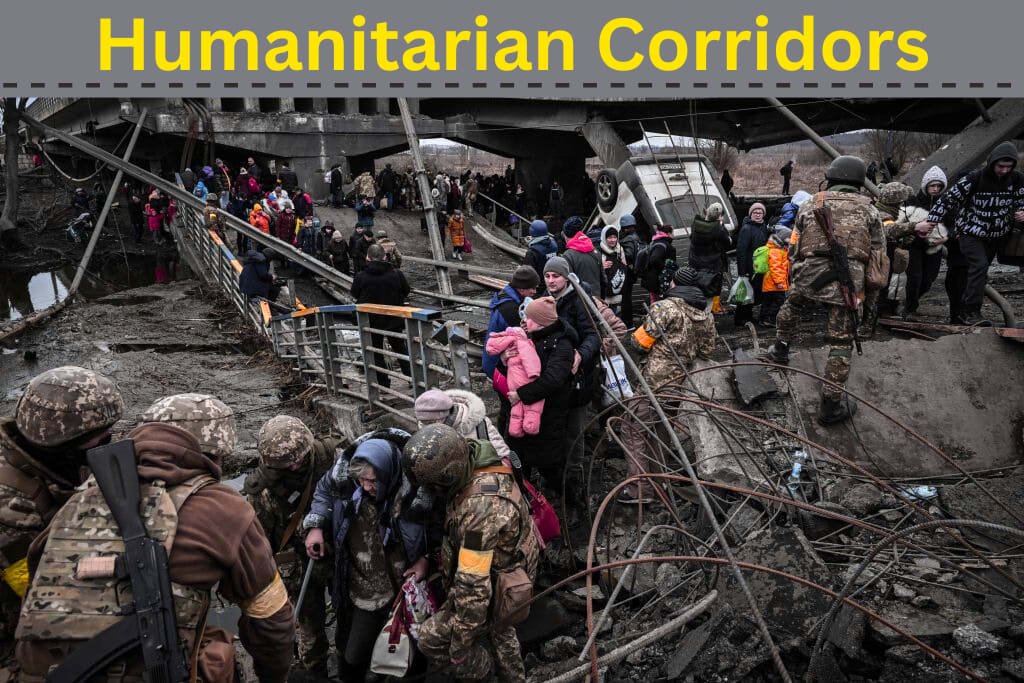
The issue of ‘humanitarian corridors’ is not new in the world. There have been examples of such corridors being provided in various war-torn countries of the world before. However, there are many questions about how much benefit they have brought.
Bangladesh’s recent in-principle agreement to send relief to Myanmar’s Rakhine state at the request of the United Nations is like a complex juncture of war and politics. Although the government is saying that it is conditional, what those conditions are is still not clear. There are conflicting statements on this in the country’s political arena.
The question has also arisen in the minds of the common people of the country – is this corridor just a way to provide relief? Or is this the beginning of a new crisis behind the guise of humanity?
To find answers to all such questions, I have tried to find out where and when such humanitarian corridors were provided in the world and how successful and unsuccessful they were. In this video, we will learn about those corridors. Along with this, we will also discuss the risks that could arise if Bangladesh provides these humanitarian corridors.
What is a humanitarian corridor?
Let's start by knowing what a humanitarian corridor is.
A 'humanitarian corridor' is a safe passage or area where, during an armed conflict, warring parties agree to use a route to provide civilians, relief organizations, or emergency aid by ceasing hostilities for a certain period of time. The purpose is mainly to deliver food, medicine, water, or other emergency relief to war-torn areas or to safely evacuate civilians.
However, in reality, these corridors are not just humanitarian aid, but also become part of various political, strategic, and military calculations.
The reality of humanitarian corridors in different countries: success or failure?
Gaza, 2023
On October 9, 2023, Israel announced a blockade of the Gaza Strip in Palestine. Israeli Defense Minister Yav Galant announced, 'I have ordered a complete blockade of the Gaza Strip. There will be no electricity, no food, no fuel, everything is closed.’
In this situation, the United Nations and other international organizations took the initiative to open a humanitarian corridor in Gaza so that relief could reach it. But due to the Israeli blockade, security concerns and political deadlock, the corridor was not effectively successful even though it was opened.
Ukraine (Mariupol), 2022
In March 2022, the first year of the Russia-Ukraine war, a humanitarian corridor was opened with a plan to evacuate about 215,000 civilians in Mariupol and Volnavka.
However, shortly after the 5-hour ceasefire, the bombing began, resulting in the closure of the corridor for security reasons.
Although this had limited success, it raised the debate around the world about the use of humanitarian corridors as a ‘lack of trust and a strategy of war’.
Syria (Aleppo and Eastern Ghouta), 2016-2018
During the Syrian civil war, the UN, Russia and other organizations opened corridors in Aleppo and Ghouta to deliver aid and evacuate civilians.
But in reality, in many cases, rebel fighters also fled through these corridors, and sometimes civilians were used as shields.
As a result, the credibility of such corridors in the international community was questioned.
Sudan, Ethiopia (Tigray), Yemen
In these countries, relief corridors were also opened by the UN, but most of the corridors failed or became ineffective due to obstacles from local rebel groups or pro-government forces, allegations of looting of aid, lack of impartiality, or arms smuggling.
Humanitarian corridors in Bangladesh and Rakhine: Dangerous or pragmatic decisions?
In the context of this global experience, the decision to open a humanitarian corridor from Bangladesh to Myanmar's Rakhine State has now come under discussion. At the request of the United Nations, and in the wake of the recent visit of Secretary-General Antonio Guterres, Bangladesh has agreed in principle—but with conditions.
In Rakhine, almost the entire border is currently occupied by the armed group Arakan Army. The Myanmar government and military are effectively defeated here. The fear that reaching this rebel group, which is facing a shortage of food and supplies, will give them a military advantage has now given rise to a major debate.
According to experts, just as this decision will gain Bangladesh international sympathy, it may also further complicate the Rohingya repatriation tangle, because the Arakan Army is anti-Rohingya. At the same time, the question has arisen—what will be China's reaction, because China is a close ally of the Myanmar military junta and has taken a stand against the Arakan Army.
Political Debate and Security Risk
The decision to launch the humanitarian corridor has also sparked a debate in the country's politics. BNP Secretary General Mirza Fakhrul Islam Alamgir has expressed concern, saying, "We don't want to become another Gaza." According to him, such a major diplomatic decision should have been taken through discussions with all political parties.
On the other hand, several Bangladeshi advisers have admitted that informal contact is being made with the Arakan Army, and they are even infiltrating Bangladeshi territory, getting married, and collecting taxes—all of which have brought to light a complex geopolitical reality.
Final words: Launching the corridor—but at what cost?
Just as stories of humanitarian corridors in world history have raised hopes, they have also resulted in failure in various realities. The Rakhine situation on the border with Bangladesh is now a reality. Experts say that if security, regional relations, or internal stability are threatened in the process of addressing that reality—it could also be the beginning of many years of political mistakes.
About the Creator
Making Time for God: Daily Prayer in a Busy Life
Life is busy. Work, family, errands, and responsibilities often fill every corner of the day, leaving little space for reflection or prayer. Yet daily prayer is one of the most powerful tools a Catholic has for staying grounded, cultivating patience, and experiencing God’s presence in every moment. Finding ways to integrate prayer into a busy life is not about creating a rigid schedule; it is about building habits that allow moments of connection, however brief, to become transformative.
By Sound and Spirit3 days ago in Journal
Smart phones, Humans and Aliens.
WARNING. I will be tapping into one of your favorite creative tensions: The absurdity of humans worshipping their glowing rectangles as if they were tiny oracles. There’s something deliciously poetic about that contradiction, and it lends itself beautifully to an instructive proviso.
By Novel Allen5 days ago in Poets


Comments
There are no comments for this story
Be the first to respond and start the conversation.