
India vs Pakistan. Who is stronger? Who will win in a war?
India vs Pakistan: Who has the upper hand in the power struggle?
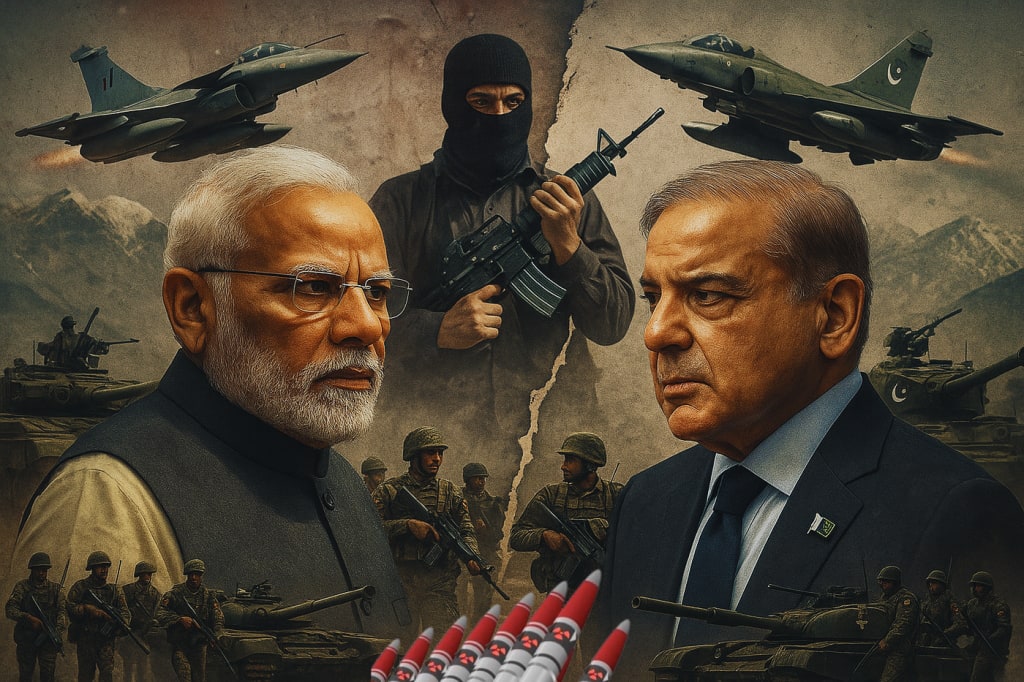
Since the partition of 1947, India and Pakistan have been arch-rivals. Every incident across the border seems to cast a shadow over the long-standing tension between the two countries. Especially in terms of military strength, there is always a comparative discussion about who is more prepared and who is more advanced.
Tensions have increased between the two neighboring countries after 26 people were killed in a gun attack on Pahalgam, a popular tourist destination in Indian-controlled Jammu and Kashmir, on April 22. Alleging that Pakistan was behind the attack, India has taken several steps against the country. Pakistan has also taken countermeasures.
In such a context, many fear that India and Pakistan may also engage in a military conflict. If a war really breaks out, what could happen? Who has the upper hand? Let's find out the answer to this exciting question.
Who is ahead in the ranking of military power
India and Pakistan - Both countries have strengthened their military power over time. Malaysia-based 'Defense Security Asia' recently drew a comparative picture of the power of the two countries in their analysis, according to the 'Global Firepower Index 2025'. They published the ranking on the basis of manpower, military equipment, economic and geographical conditions, etc.
It can be seen that India is in fourth place in the world in the military ranking. Their capability score is 0.1184, where the lower the score, the greater the power. Pakistan is not far behind - they are in twelfth place, with a score of 0.2513. India's large population, huge budget and military equipment are the basis of their power. Although Pakistan is relatively small, it is still a very agile and capable opponent in terms of strategy. Especially despite its dependence on China, it is focused on strategic issues to confront India.
…
Military-civilian manpower
India is ahead when it comes to manpower. They have a huge military force of 5.1 million out of a population of 1.4 billion. India is the second largest in the world in terms of active military personnel, with 1.46 million active military personnel. Reserve forces are 1.16 million (seventh in the world). Paramilitary forces are 2.53 million (second in the world).
In contrast, Pakistan has a population of 250 million, a military force of 1.7 million. Of these, active forces are 6.54 million (seventh in the world). Reserve forces are 6.5 million.
India's manpower is more than double that of Pakistan, and its reserve and paramilitary forces are also large. Although Pakistan operates with fewer manpower, it has ISI-controlled irregular forces like 'Mujahid' among them.
Defense budget
India is also far ahead in defense budget. In 2025-26, their budget is $79 billion, third after the United States and China. Whereas Pakistan's budget is only $1000 to $1000 million. Huge difference! India's defense budget is 6 to 8 times that of Pakistan.
India's large budget helps it with technology, infrastructure, and modernization, while Pakistan has to rely on foreign aid, especially from China.
Land Forces
The land forces are at the heart of the India-Pakistan conflict. The two countries share a 3,323-kilometer border. The two countries have a history of conventional warfare in 1947, 1965, and 1999.
India has 4,614 tanks. 151,248 armored vehicles. 9,719 artillery pieces. The special forces include Para SF, Ghatak Force, and MARCOS.
Pakistan has 3,742 tanks. 50,000 armored vehicles (estimated). 4,472 artillery pieces (including 375 automatic howitzers). The special forces include the Special Service Group (SSG), SSG Naval, and Special Service Wing. These are relatively small in size, but are formidable.
India has a numerical advantage in tanks, armored vehicles, and artillery. Pakistan's tank fleet is also competitive. This fleet is modernized with the Chinese VT-4. There are various ground combat vehicles like M113 and Al-Fahad.
Air Force
In modern warfare, the superiority of the Air Force is very important, especially for quick response and precision attacks.
India has a total of 2,229 aircraft. Of these, 513 to 606 are fighter aircraft. Modern aircraft include SU-30MKI, Rafael, Tejas. It has the S-400 air defense system. There are Apache and Chinook helicopters. There are also four ‘Airborne Early Warning and Control (AEW&C)’ systems.
Pakistan has a total of 1,399 to 1,434 aircraft. Of these, 328 to 387 are fighter aircraft. Modern aircraft include F-16 Fighting Falcon, JF-17 Thunder, Mirage Three/Five. It has more combat-ready helicopters (including the AH-1F Cobra) than India. It has seven AW&Cs, more than India.
India's air fleet is large and diverse; however, it lacks squadrons. Pakistan's air fleet is relatively small, but it is being modernized. Pakistan's AW&C facilities are used for additional surveillance.
Navy
Naval capability is crucial to protecting India's maritime interests in the Indian Ocean and Pakistan's operations in the Arabian Sea.
India has 294 ships. There are 2 aircraft carriers. 18 submarines (including the nuclear-powered submarine INS Arihant). 13 destroyers. 14 frigates. 106 patrol boats. 75 combat-ready aircraft (Navy). Navy strength 67,700.
Pakistan has 121 ships. 8 submarines. 9 frigates. Patrol boats 17. The force has 8 fighter aircraft. The navy has 23,800 personnel.
The Indian Navy is comparatively stronger and better suited to deep-sea operations. Pakistan's relatively small navy focuses mainly on coastal defense and regional operations. The lack of aircraft carriers and limited number of fighter aircraft limits the navy's ability to conduct operations in the deep sea.
Nuclear capabilities
Both India and Pakistan have nuclear capabilities. This capability plays an important role in their defense strategies.
India has 130 to 140 nuclear weapons. The delivery system includes Agni-3/5 ballistic missiles (range 3,000 to 5,000 kilometers), Mirage 2,000 and Rafael, and INS Arihant for maritime defense. India is in favor of a no-first-use (NFU) policy. However, the country is in favor of a large-scale retaliatory strike if attacked.
On the other hand, Pakistan has 140 to 150 nuclear weapons. In this respect, Pakistan's capabilities are greater than India's. The delivery system includes Shaheen-II/III ballistic missiles, F-16 fighter jets, and Babur cruise missiles. The country favors the policy of 'full-spectrum deterrence' when it comes to using nuclear weapons. Under this policy, the country can use nuclear weapons first in the battlefield if necessary.
Strategic alliance
India has powerful allies like Israel, Russia, and France. Pakistan receives strong support from China, and sometimes even gets some help from the United States.
…
Although India's lead in manpower, military spending, and other conventional defense sectors is clear, there is no room to underestimate Pakistan's military power. Its rich arsenal of nuclear and strategic weapons, asymmetric warfare, and strong support from China have put the country in an advantageous defense position.
One of the obstacles to India's modernization in the defense sector is its bureaucracy and dual focus (China-Pakistan). The country's aging air force is also a constraint. The country's heavy focus on "counter-terrorism" operations is another weakness.
On the other hand, Pakistan's economic struggles, relatively small manpower, outdated military equipment, and regional tensions hamper its military capabilities.
…
Therefore, if the two countries clash, the outcome will depend not only on numbers, but also on strategy, the international situation, and political decisions.
About the Creator
Florida Business Insurance Requirements
Running a business in Florida means operating in one of the most dynamic—and complex—risk environments in the country. Between climate exposure, legal requirements, contractual obligations, and industry-specific risks, insurance is not just a formality. It is a structural component of how a business survives disruptions, disputes, and unexpected losses.
By American US Insurance4 days ago in Journal




Comments
There are no comments for this story
Be the first to respond and start the conversation.