
What happened in Bangladesh that led to India cancelling transshipment facilities?
India claims transshipment cancelled because of Bangladesh
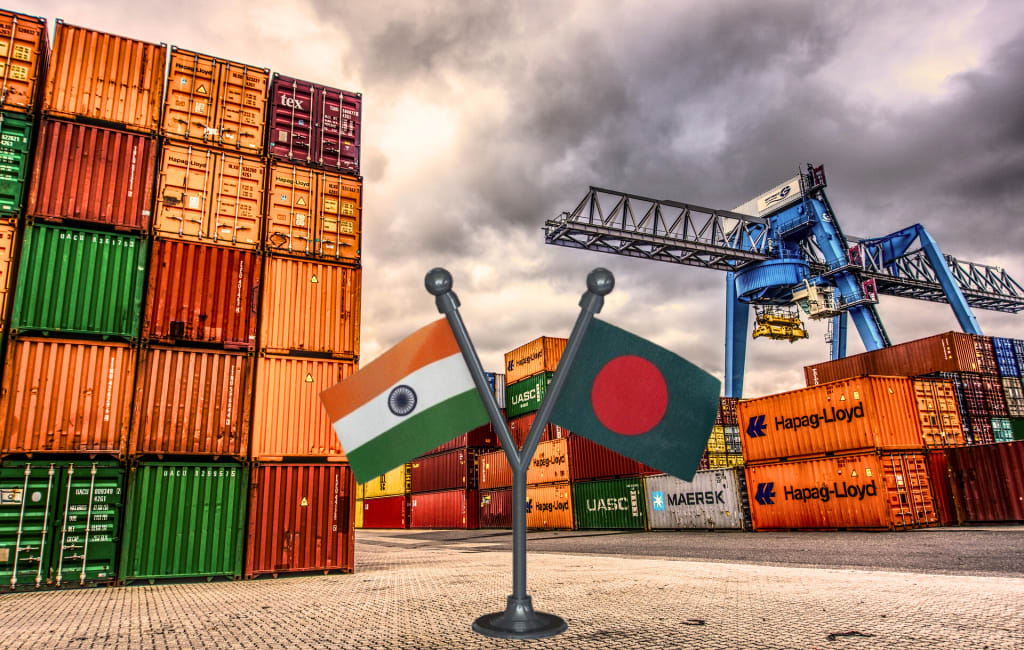
India's sudden cancellation of transshipment facilities for Bangladesh has raised several questions. Various analyses have been started on the reasons behind this decision.
Many are wondering, what happened in Bangladesh that forced Delhi to take this decision?
A partial answer to this question was found in a briefing by Indian Foreign Ministry Spokesperson Randhir Jaiswal on April 17. He told reporters, *"Look at what happened in Bangladesh before the steps we have taken."
His statement indicates that some political or commercial events played a role in India's decision.
To shed light on the issue, we need to look at some recent steps by Bangladesh, which many analysts believe could make Delhi uncomfortable.
Subscribe to The Report Live to watch the full video. Stay tuned with us by liking, commenting and sharing!
What was the incident that influenced India's decision?
This is the first time an Indian government official has directly opened up on this issue. Ever since India scrapped the transshipment facility on April 8, questions have been arising—why did Delhi suddenly do this?
Under this transshipment system, which was introduced in June 2020, Bangladeshi exporters could send goods by road across the Benapole-Petrapole border to Kolkata or Delhi airports, from where they could be exported abroad. It became quite popular during and after the Covid-19 pandemic, as it was relatively fast and often cheaper.
But what happened in Bangladesh that led to India suddenly shutting down this important facility?
Decision to close border land ports
According to government documents obtained, on November 6, 2023, the interim government of Bangladesh formed a six-member committee. Their task was to examine the commercial feasibility of eight land ports. Most of them are located on the border with India.
On March 2, 2024, the committee recommended the closure of Chilahati in Nilphamari, Daulatganj in Chuadanga, and Tengamukh in Rangamati land ports, and the suspension of operations at Balla land port in Habiganj.
The document states that the first three land ports have no infrastructure, and while Balla port has infrastructure on the Bangladesh side, there are no roads or facilities on the Indian side. As a result, operations have been suspended.
The Bangladesh Land Ports Authority's statistics for 2023 and 2024 did not show any trade or passenger traffic at these ports. However, the Indian newspaper The Hindu reported that Delhi sees these initiatives as "unilateral and retrograde steps."
Ban on yarn imports: Retaliation or long-term demand?
A few days after revoking the transshipment facility, Bangladesh banned the import of yarn via land ports via India on April 13. Although many consider this a counter-measure to India's decision, in fact, it was a long-standing demand of entrepreneurs in the country's textile sector.
Bangladesh Textile Mills Association (BTMA) said that in 2024, Bangladesh imported 1.215 million tons of yarn, 95 percent of which came from India. It cost about $3 billion.
Since Indian yarn is 20-25 cents cheaper per kg, garment exporters are interested in buying Indian yarn instead of local yarn. However, this is hurting domestic yarn mill owners, whose production costs are high and they suffer from gas and electricity shortages.
In addition, although the Bangladesh government has reduced cooperation in the textile sector, the Indian government has increased cash incentives in this sector—which has made Indian yarn more competitive.
BTMA, the Ministry of Commerce, and the National Board of Revenue (NBR) have sent multiple letters at different times. On March 27, the Commerce Ministry said that the price of yarn imported through land ports was being shown much lower than that of yarn coming through Chittagong port—which was seriously hurting local producers.
Finally, on April 13, the NBR issued a gazette banning the import of yarn, powdered milk, tobacco, newsprint and other paper products from India, Nepal and Bhutan through land ports.
Political environment and diplomatic tensions
The recent history of Bangladesh-India relations may also have played a role in this trade decision. The resignation of then Prime Minister Sheikh Hasina in August 2024, who sought refuge in India and Delhi’s concerns over the safety of the Hindu community in Dhaka, created a kind of diplomatic instability.
On the other hand, Bangladesh’s interim leader Mohammad Yunus and Indian Prime Minister Narendra Modi met on the sidelines of the BIMSTEC summit in Thailand in March. India viewed the statement made by Bangladesh after the meeting as “politically motivated,” according to the Indian Express.
Within days of this incident, India cancelled the transshipment. Four trucks carrying goods were then stopped at Petrapole port—a clear blow to the trade relations between the two countries.
How much is the trade loss?
Bangladesh’s trade advisor Sheikh Bashir Uddin said that the cancellation of the transshipment facility could increase the cost of the country’s traders by about Tk 2,000 crore.
This route became particularly popular in the post-COVID-19 era. It was easier and cheaper to send goods from Kolkata or Delhi airports across the Benapole-Petrapole border, which was more convenient than using Hazrat Shahjalal International Airport.
India's sudden cancellation of transshipment and the ban on Bangladesh's yarn imports—these two moves are not only commercially sensitive, but also diplomatically sensitive. Both countries are important economic partners in the region. If such moves are not resolved through negotiations, they could impact not only trade but also the overall bilateral relationship.
A question now arises—are Bangladesh-India relations under renewed pressure?


Comments
There are no comments for this story
Be the first to respond and start the conversation.