
United States Lab Automation Market Set to Surge with Rising Demand for High-Throughput Screening and AI-Driven Solutions
Innovative Automation Technologies Poised to Transform Drug Discovery, Diagnostics, and Laboratory Efficiency Through 2030
The United States lab automation market, a rapidly evolving segment of the global life sciences industry, is witnessing significant growth as laboratories and research institutions increasingly adopt automated solutions to enhance efficiency, precision, and productivity. Valued at US$6.36 billion in 2025, the market is projected to grow at a resilient compound annual growth rate (CAGR) of 7.2% from 2025 to 2030, reaching an estimated US$9.01 billion by the end of the forecast period. This surge is largely driven by the rising demand for high-throughput screening technologies, which enable the rapid processing of large volumes of samples in drug discovery, clinical diagnostics, and research laboratories.
The demand for automation in laboratories is being fueled not only by the need to accelerate workflows but also by a shortage of skilled personnel. Automated systems minimize the need for manual intervention, thereby reducing labor costs, improving accuracy, and allowing researchers to focus on higher-value scientific tasks. Advances in robotics, artificial intelligence (AI), and machine learning are further enhancing the capabilities of these systems, making them indispensable for modern laboratory operations.
North America Leading the Adoption of Lab Automation Technologies
In North America, the lab automation market has emerged as the largest regional segment, capturing 40.5% of the global market share in 2024. Factors contributing to this dominance include significant investments in research and development, technological innovation, and the adoption of sophisticated laboratory informatics systems. Automated workstations and AI-driven diagnostic platforms are becoming increasingly common in hospitals, pharmaceutical laboratories, and biotechnology firms, all of which benefit from higher throughput, consistent data, and reduced human error.
Key Drivers of Growth in Lab Automation
The growing need for automation in drug discovery remains one of the primary drivers of market expansion. High-throughput screening systems are transforming drug discovery by enabling the rapid testing of thousands of compounds, which significantly accelerates the identification of potential drug candidates. Automated workflows minimize human error, increase data accuracy, and allow for robust data management. Technologies such as bioprinting, acoustic ejection mass spectrometry (AEMS), 3D cell models, and microfluidic organ-on-chip systems are redefining how pharmaceutical research is conducted.
In addition, the push for personalized medicine, along with rising R&D expenditures, regulatory compliance requirements, and cost-effectiveness, are further motivating laboratories to adopt automation. Companies such as ArrayJet (UK), SCIEX (US), and Automata (UK) are at the forefront of delivering innovative solutions that optimize drug discovery and laboratory processes, thereby supporting faster and more reliable results.
Challenges in Adoption
Despite significant growth, the adoption of lab automation in developing countries faces financial and operational challenges. The high initial cost of laboratory automation systems, along with recurring maintenance and software update expenses, can represent up to 30% of total investment. Additionally, staff training adds approximately 15% to the overall cost, creating barriers for smaller laboratories with limited budgets. Uncertainty around the long-term cost-effectiveness of these systems also slows adoption, particularly in regions where proof of financial returns is limited.
System integration remains another significant challenge, as modern automation solutions often need to work alongside legacy equipment and disparate software platforms. Compatibility issues, extensive customization requirements, and the need for calibration and validation can result in delays, increased costs, and operational inefficiencies. These hurdles underscore the importance of tailored integration strategies and comprehensive staff training to fully realize the benefits of laboratory automation.
Opportunities in Emerging Pharmaceutical and Biotech Markets
While North America currently leads in pharmaceutical R&D, emerging economies such as India and China are rapidly expanding their biotechnology and pharmaceutical sectors, creating substantial opportunities for lab automation. India, which produces over 50% of the world’s vaccines and 40% of generic drugs consumed in the United States, is home to roughly 5,000 biotech firms and continues to invest heavily in advanced laboratory technologies. Similarly, China’s strategic initiatives under programs such as "Made in China 2025" aim to strengthen the biotechnology sector and increase global competitiveness.
The expansion of these markets increases the demand for automated laboratory systems, particularly for high-throughput screening and AI-driven analysis. Lab automation companies are well-positioned to capitalize on this growth by providing cost-effective, scalable, and technologically advanced solutions tailored to emerging markets.
Automated Workstations: Driving Efficiency and Precision
Automated workstations are emerging as a key segment in the lab automation market, offering significant benefits in sample preparation, liquid handling, and data processing. Leading solutions, such as Tecan Group’s Fluent Liquid Handler, feature multiple robotic arms capable of performing precise pipetting, tip disposal, and object manipulation tasks, while intelligent software platforms optimize workflow efficiency and ensure regulatory compliance. These systems are particularly valuable in pharmaceutical and biotechnology laboratories, where error-free, high-throughput processes are critical.
Drug Discovery: The Largest Application Segment
Drug discovery continues to dominate the lab automation market due to the growing need for scalable, efficient screening solutions. Automation reduces manual intervention in compound screening, assay development, and lead optimization, streamlining the process and enhancing result consistency. Increasing investment in research for oncology, infectious diseases, and neurological disorders has further accelerated the adoption of automation technologies in pharmaceutical research. Platforms such as Automata’s LINQ system exemplify the ability of automated solutions to support complex drug discovery workflows, improving accuracy and throughput while complying with stringent regulatory standards.
Hospitals and Diagnostic Labs Leading End-User Adoption
Hospitals and diagnostic laboratories accounted for the largest share of the lab automation end-user segment in 2024. The growing demand for rapid, reliable, and high-throughput testing in clinical diagnostics has driven the adoption of automated systems that reduce human error, streamline workflows, and enable accurate patient testing. Advanced laboratory management software, robotic sample handling systems, and AI-assisted diagnostic platforms are critical in enabling these facilities to provide faster, more reliable healthcare outcomes.
Competitive Landscape
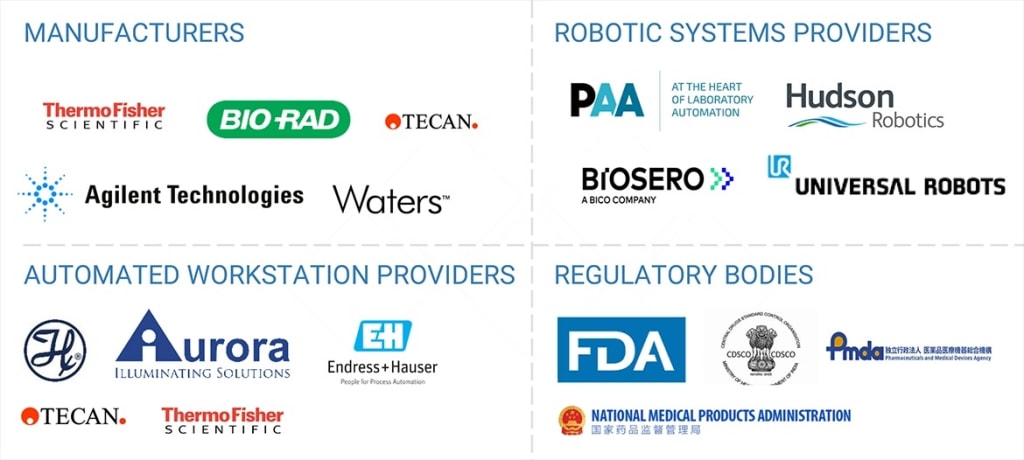
The lab automation market is highly competitive, with several prominent companies driving innovation and technological advancements. Key players include Thermo Fisher Scientific (US), Danaher Corporation (US), Agilent Technologies (US), Tecan Group (Switzerland), F. Hoffmann-La Roche Ltd. (Switzerland), Revvity (US), Eppendorf AG (Germany), Becton, Dickinson and Company (US), Waters Corporation (US), Siemens Healthineers (Germany), Abbott Laboratories (US), bioMérieux (France), Hamilton Company (US), and Hudson Robotics (US). These organizations continue to invest in R&D and strategic partnerships to expand their product portfolios and enhance automation capabilities.
Outlook
With rapid advancements in robotics, AI, and machine learning, the United States lab automation market is poised for sustained growth through 2030. As laboratories increasingly adopt automated solutions to improve accuracy, efficiency, and throughput, the sector will continue to play a transformative role in drug discovery, diagnostics, and research. The combination of technological innovation, rising demand in emerging pharmaceutical and biotechnology markets, and ongoing investments in automation is expected to shape the future of laboratory operations, setting new standards for precision, productivity, and reliability in scientific research.
About the Creator
Keep reading
More stories from Juan Martinez and writers in Journal and other communities.
United States GLP-1 Analogues Market Projected to Soar Amid Robust Innovation and Expanding Therapeutic Applications
The global GLP-1 (glucagon-like peptide-1) analogues market is on an extraordinary growth trajectory, reflecting one of the fastest-expanding sectors within the biopharmaceutical industry. Valued at US$37.4 billion in 2023, the market grew to US$47.4 billion in 2024 and is projected to advance at a compound annual growth rate (CAGR) of 33.2% from 2024 to 2032, ultimately reaching US$471.1 billion by the end of the forecast period.
By Juan Martinez3 months ago in Journal
I Stopped Chasing Motivation and Focused on Systems.
Motivation feels good. It also fades fast. You wake up inspired one day and stuck the next. I learned this the hard way. I waited for the right mood before I worked. Progress stayed slow. Results stayed random. Everything changed when I stopped chasing motivation and built systems instead.
By Wilson Igbasi3 days ago in Journal



Comments
There are no comments for this story
Be the first to respond and start the conversation.