
Trump Threatens Tariffs on Countries Trading With Iran — Why Global Markets Are on Edge
Global Markets Are on Edge

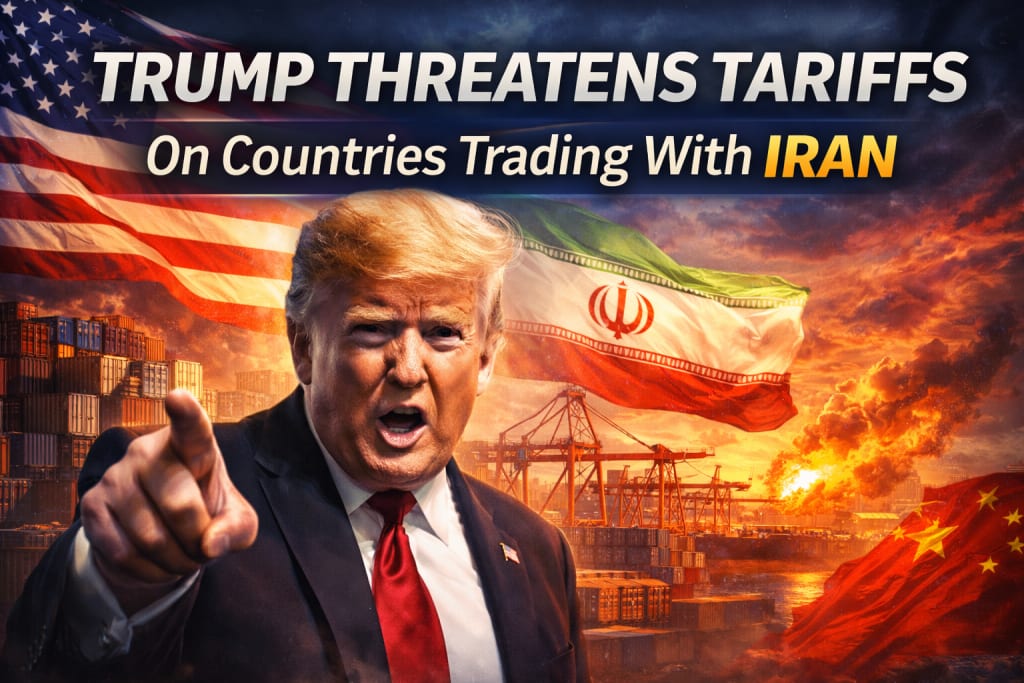
A bold tariff warning from Donald Trump could reshape global trade, strain alliances, and intensify economic pressure on Iran. Here’s what it really means—and why the world is paying attention.
Former U.S. President Donald Trump has once again sent shockwaves through global markets by threatening to impose tariffs on countries that continue trading with Iran. The move signals a return to aggressive economic diplomacy—one designed not only to pressure Tehran, but also to force America’s trading partners to choose sides.
While the policy has not yet taken full effect, the warning alone has sparked concern among governments, investors, and multinational corporations. If implemented, it could alter supply chains, raise consumer prices, and test the limits of international trade law.
A New Chapter in Economic Pressure on Iran
On February 6, 2026, Donald Trump signed an executive order authorizing U.S. officials to impose tariffs on countries that “directly or indirectly purchase, import, or otherwise acquire” Iranian goods or services.
The order does not immediately trigger new tariffs. Instead, it creates a legal framework that allows the United States to levy duties—potentially up to 25%—on imports from countries that maintain commercial ties with Iran.
This strategy is part of a broader effort to economically isolate Tehran, particularly as tensions persist over Iran’s nuclear program, regional influence, and sanctions compliance.
The message is clear: trading with Iran may now come at a cost far beyond diplomatic criticism.
How This Strategy Differs From Traditional Sanctions
What makes this threat especially significant is how different it is from past U.S. sanctions.
Key Differences Explained
- Secondary Economic Pressure
Instead of targeting only Iranian companies or banks, the policy penalizes other countries for doing business with Iran.
- Global Reach
Any nation—regardless of geography—that maintains trade ties with Iran could face U.S. tariffs.
- Unclear Enforcement Rules
The executive order does not fully explain timelines, exemptions, or enforcement mechanisms, creating uncertainty for governments and businesses alike.
This approach blends trade policy with geopolitics, using access to the U.S. market as leverage to reshape global behavior.
Which Countries Are Most at Risk?
Despite decades of sanctions, Iran still maintains trade relationships with several major economies.
Countries With Significant Trade Ties to Iran
- China – Iran’s largest trading partner, particularly in oil exports
- United Arab Emirates – A key regional trade hub
- Turkey – Energy and industrial trade links
- India – Oil, agriculture, and infrastructure cooperation
- Germany and other EU states – Machinery and industrial exports
If the U.S. follows through:
- Chinese exporters could face steep tariffs on goods entering the U.S.
- European manufacturers may see higher costs on automobiles and machinery
- Indian exporters could be forced to rethink trade strategies amid ongoing U.S.–India negotiations
Because modern supply chains are deeply interconnected, even indirect trade exposure could trigger penalties—making the policy’s reach truly global.
Global Reactions: Support, Resistance, and Strategic Silence
China Pushes Back
Beijing quickly criticized the threat, calling it coercive and counterproductive. Chinese officials reiterated that “trade wars have no winners”, arguing that unilateral economic pressure undermines global stability.
Europe Urges Caution
Several European Union members expressed concern about compliance with World Trade Organization (WTO) rules. EU officials emphasized diplomacy and multilateral solutions over punitive trade measures.
India Walks a Tightrope
India has taken a more measured stance. While maintaining strategic ties with Iran, New Delhi is also deepening economic cooperation with Washington—placing it in a delicate balancing act.
Economic Ripple Effects That Could Hit Everyone
If enacted, these tariffs could have consequences far beyond Iran.
1. Supply Chain Disruptions
Industries such as automotive manufacturing, electronics, and energy depend on cross-border components. Tariffs could make production more expensive and less predictable.
2. Higher Consumer Prices
Tariffs act like taxes. Importers often pass added costs to consumers, potentially raising prices on everyday goods in the U.S. and beyond.
3. Shifts in Global Trade Alliances
Countries may accelerate new trade agreements or deepen regional partnerships to reduce exposure to U.S. tariffs—reshaping long-term trade patterns.
Legal and Policy Challenges Ahead
Trade experts warn that penalizing countries for their third-party trade relationships could face serious challenges under international law.
- WTO rules generally discourage discriminatory tariffs
- Secondary trade penalties are legally complex and rarely tested
- Retaliatory tariffs or formal disputes could follow
The lack of clarity around exemptions—such as humanitarian goods—adds another layer of uncertainty.
What This Means for the Future of Global Trade
Trump’s tariff threat represents more than a policy proposal—it reflects a philosophy that uses economic power as a primary geopolitical tool.
Whether this approach successfully isolates Iran or instead triggers wider trade conflicts remains an open question. What is certain is that markets dislike uncertainty, and this policy introduces plenty of it.
Final Thoughts: A High-Stakes Gamble
This latest move underscores how deeply politics and economics are intertwined in today’s world. A single executive order—still largely undefined—has already influenced diplomatic conversations, market sentiment, and strategic planning worldwide.
As governments and corporations wait for clearer guidance, one thing is undeniable:
global trade relationships may soon be tested not just by markets—but by politics.
About the Creator
Adil Ali Khan
I’m a passionate writer who loves exploring trending news topics, sharing insights, and keeping readers updated on what’s happening around the world.
Keep reading
More stories from Adil Ali Khan and writers in Journal and other communities.
China’s Central Bank Keeps Buying Gold as the Bull Market Cools
While global gold prices are taking a breather after a historic rally, China is sending a clear message to the world: its commitment to gold remains firm. The People’s Bank of China (PBoC) has continued to increase its gold reserves, reinforcing a long-term strategy aimed at protecting financial stability, reducing reliance on the U.S. dollar, and preparing for a more fragmented global economic order.
By Adil Ali Khanabout 6 hours ago in Journal
~ Fired ~
— Ai Intrusion ~ Are you Next ~ Is Ai Evolution after your job? — Few workplaces haven't been affected. Ai is in supermarkets, at doctors' offices, and even monitoring farms. I just can't think of anything this machine is not getting into, can you? For instance: Education ~ Law and Tech jobs will one day have a major influence or be taken over by these inanimate machines, with accuracy and vigor. From mechanics' diagnoses to a wide variety of everyday jobs, including fast food workers, with this input having the ability to cut their unnecessary work hours. I'm certain all of us have been touched by this with our short stories and colorful headings, have you? Even comments are very questionable 'Non-Robot' insertions.
By Jay Kantor7 days ago in Journal
The Panama Canal Is Forgotten: A New Interoceanic Corridor Opens That Will Change Global Trade
For more than a century, the Panama Canal has stood as one of the most important arteries of global trade. Since its opening in 1914, the canal has linked the Atlantic and Pacific Oceans, saving ships weeks of travel around South America and becoming a symbol of engineering brilliance and geopolitical power. Yet today, a growing number of experts argue that the Panama Canal is no longer the uncontested king of interoceanic trade. A new generation of interoceanic corridors—combining rail, road, port, and pipeline infrastructure—is emerging, with the potential to reshape global trade flows and reduce reliance on the historic waterway.
By Sadaqat Aliabout an hour ago in Journal


Comments
There are no comments for this story
Be the first to respond and start the conversation.