
China’s Central Bank Keeps Buying Gold as the Bull Market Cools
Why Beijing’s quiet gold accumulation still matters—even as prices lose momentum

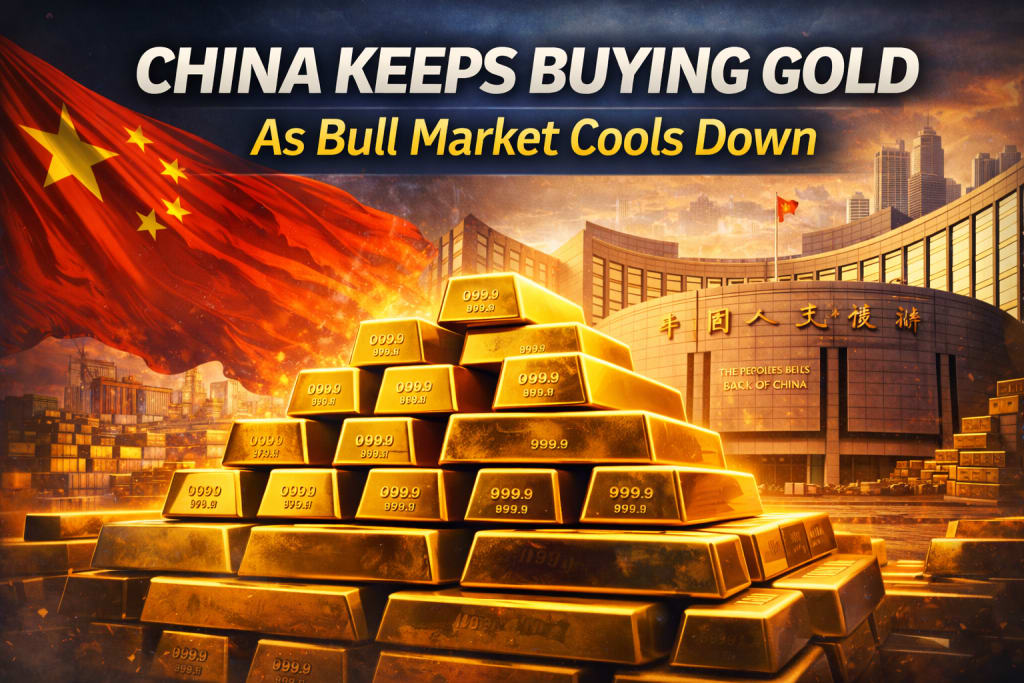
While global gold prices are taking a breather after a historic rally, China is sending a clear message to the world: its commitment to gold remains firm. The People’s Bank of China (PBoC) has continued to increase its gold reserves, reinforcing a long-term strategy aimed at protecting financial stability, reducing reliance on the U.S. dollar, and preparing for a more fragmented global economic order.
At a time when many investors are stepping back, China’s steady accumulation stands out—not as a short-term trade, but as a calculated policy move with global implications.
Gold Prices Cool, but China’s Demand Doesn’t
After reaching record highs, gold prices have recently lost momentum. Shifting expectations around interest rate cuts, a stronger U.S. dollar, and profit-taking by investors have all contributed to the slowdown.
Yet while market sentiment fluctuates, central bank behavior tells a different story.
Unlike hedge funds or retail investors, central banks don’t chase price swings. Their buying decisions are guided by long-term stability rather than quarterly returns. China’s continued gold purchases during a period of consolidation suggest that Beijing views gold as a strategic asset, not a speculative one.
A Long-Term Strategy, Not a Market Bet
Gold has always played a unique role in global finance. It carries no credit risk, cannot be frozen by foreign governments, and is not tied to any single country’s monetary policy.
For China, these qualities are especially valuable.
By steadily increasing its gold holdings, Beijing is:
- Reducing dependence on U.S. dollar–denominated assets
- Hedging against geopolitical and sanctions risk
- Strengthening the resilience of its foreign exchange reserves
This approach doesn’t signal an abandonment of the dollar, but rather a diversification strategy designed to limit exposure to political and financial shocks.
Why Gold Still Matters to Beijing?
China’s gold strategy has been building quietly for years. As global tensions rise and financial systems become increasingly politicized, policymakers are prioritizing assets that offer neutrality and security.
Gold fits that role perfectly.
Unlike government bonds, gold is no one’s liability. It retains value during inflation, currency volatility, and financial stress. Even as the recent gold rally cools, its strategic importance to China remains unchanged.
In short, the price may fluctuate—but the purpose does not.
Market Pullback vs. Policy Conviction
The current pause in gold prices reflects broader market dynamics:
- Sticky inflation in major economies
- Resilient labor markets
- Caution from central banks on cutting interest rates
These factors have pushed bond yields higher, reducing gold’s short-term appeal for traders. Exchange-traded gold funds have seen uneven flows, and speculative positions have softened.
But central banks operate on a different timeline.
Historically, they tend to increase purchases during periods of price stability rather than during sharp rallies. Lower volatility allows for gradual accumulation without disrupting markets—a pattern China appears to be following closely.
Gold as a Signal of Stability
China’s gold buying is not just about reserves—it’s also about confidence and perception.
Domestically, the Chinese economy faces challenges ranging from a property slowdown to deflationary pressures. Strong reserve management helps reassure markets that Beijing retains ample financial buffers.
Internationally, rising gold holdings support China’s broader goal of promoting the yuan’s role in global trade—especially across Asia, Africa, and the Middle East. While Beijing has not proposed a gold-backed currency, the symbolism of growing bullion reserves enhances credibility in a multipolar monetary system.
A Global Trend Led by Central Banks
China is not acting alone.
Central banks worldwide have been among the largest gold buyers in recent years. Concerns over asset freezes, sanctions, and financial weaponization have prompted many nations to rethink traditional reserve allocations.
What sets China apart is scale.
As one of the world’s largest holders of foreign reserves, even modest adjustments by Beijing can influence global demand and shape long-term market dynamics.
What a Cooling Gold Rally Really Means
A pause in gold’s rally does not mean its relevance is fading. Instead, it may mark a transition from speculative momentum to structural demand driven by governments and institutions.
If interest rates remain elevated, gold may struggle to surge as it did before. However, sustained central bank buying—especially from China—could provide a strong price floor, limiting downside risk.
For long-term investors, this creates a different environment:
- Less volatility
- Shallower corrections
- Pullbacks that look more like opportunities than warnings
Looking Ahead: Quiet Accumulation, Loud Message
China’s continued gold purchases send a powerful signal: short-term market fluctuations do not override long-term strategy.
While traders react to yields and headlines, central banks plan for decades. For Beijing, gold remains a cornerstone asset—insurance against uncertainty and a tool of financial independence in a changing world.
Whether gold prices resume their climb or consolidate further, China’s stance is unmistakable:
bullion still matters, and Beijing intends to keep buying.
About the Creator
Adil Ali Khan
I’m a passionate writer who loves exploring trending news topics, sharing insights, and keeping readers updated on what’s happening around the world.
Keep reading
More stories from Adil Ali Khan and writers in Journal and other communities.
Trump Threatens Tariffs on Countries Trading With Iran — Why Global Markets Are on Edge
A bold tariff warning from Donald Trump could reshape global trade, strain alliances, and intensify economic pressure on Iran. Here’s what it really means—and why the world is paying attention.
By Adil Ali Khanabout 5 hours ago in Journal
~ Fired ~
— Ai Intrusion ~ Are you Next ~ Is Ai Evolution after your job? — Few workplaces haven't been affected. Ai is in supermarkets, at doctors' offices, and even monitoring farms. I just can't think of anything this machine is not getting into, can you? For instance: Education ~ Law and Tech jobs will one day have a major influence or be taken over by these inanimate machines, with accuracy and vigor. From mechanics' diagnoses to a wide variety of everyday jobs, including fast food workers, with this input having the ability to cut their unnecessary work hours. I'm certain all of us have been touched by this with our short stories and colorful headings, have you? Even comments are very questionable 'Non-Robot' insertions.
By Jay Kantor7 days ago in Journal
Architectural Lighting Design: How to Balance Aesthetics and Functionality
Architectural lighting design is more than just glow, it adjusts the space, influence how people act, and provide a unique look to a building. Good lighting can produce textures that stand out, present a flat surface more deepness, and centers concentration on features like columns, arches, or artwork. It's significant in spots like stores, hotels, homes, and offices to design spaces that are fun, welcoming, and useful for people.
By LEDOS Lighting3 days ago in Journal
Should We Not Try to Get Too Political?
Here's something you often hear people say, "I try not to get too political." I understand the sentiment and I sympathize with it... while at the same exact time, I completely disagree with the notion. Whether it's referring to social media or wherever, it's kind of unavoidable. You can attempt to sidestep it, not engage, leave the less important things for actual politicians to discuss... you can want it to not take over your life, your conversations, your relationships, and that makes perfect sense.
By Stephen Kramer Avitabile3 days ago in Writers



Comments
There are no comments for this story
Be the first to respond and start the conversation.