
Trump Proposes $2,000 Tariff Rebate Checks for Americans
A bold promise tied to tariff revenue — but serious questions linger over eligibility, funding, and feasibility

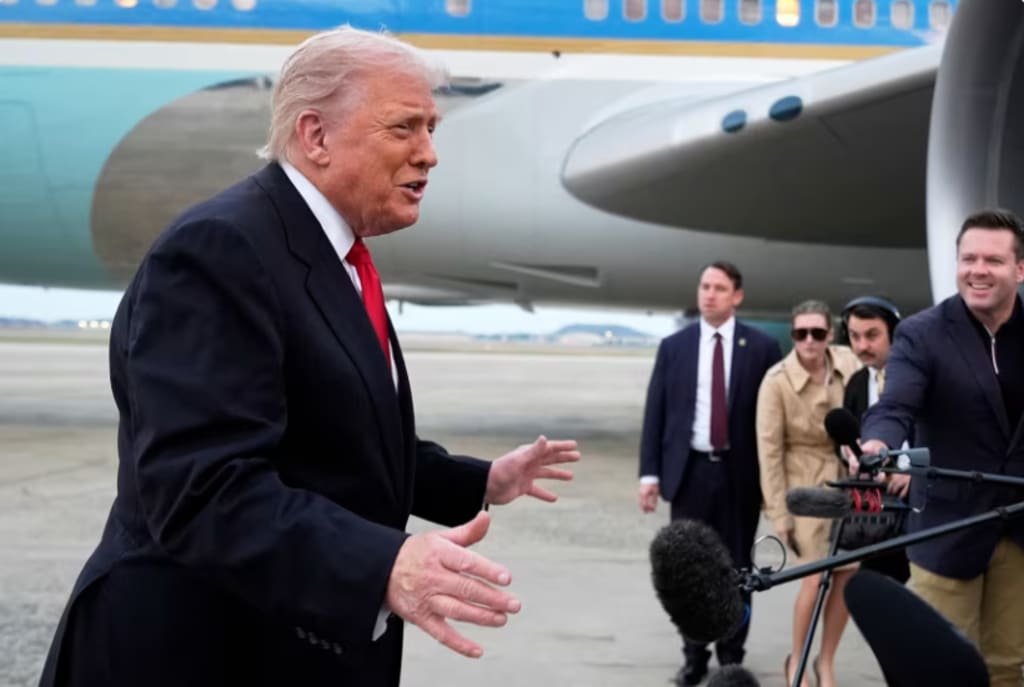
Former President Donald Trump has proposed that most Americans receive a $2,000 “tariff dividend”, funded by the revenue his administration claims to generate from sweeping import duties. The idea, first mentioned on his Truth Social platform, suggests the rebates would exclude “high income people,” though the plan’s details remain vague.
The announcement arrives amid ongoing voter frustration over high living costs and political pressure to deliver tangible economic benefits. Trump’s proposal positions his tariff policies not just as a tool for trade control, but as a direct way to “put money back” into American pockets.
What Trump Said
In his message, Trump declared that a dividend of “at least $2,000 a person” would be paid to everyone except high earners. He linked the funds to the “trillions of dollars” he says the U.S. is collecting from foreign imports under his tariff policy.
He also hinted that this revenue could be used to help reduce the national debt. It’s an ambitious claim — one that reimagines tariffs, traditionally seen as a trade barrier, as a funding mechanism for direct payments to citizens.
Mixed Messages from Officials
Treasury Secretary Scott Bessent later sought to temper expectations. He noted that the $2,000 figure may not represent a literal check and could instead appear as part of broader tax relief measures or credits.
“It could be delivered in many forms,” Bessent said, adding that he had not yet discussed the specifics with the president. This statement fueled speculation that the so-called “tariff dividend” could be more symbolic than concrete — part of a larger economic messaging strategy rather than a fully developed fiscal plan.
The Math Behind the Promise
Economists were quick to question the feasibility of the idea. Providing $2,000 to roughly 150 million American adults would cost around $300 billion or more. By comparison, total U.S. tariff revenue for the last fiscal year was roughly $195 billion — and net revenue after administrative costs is even lower.
In short, the numbers don’t seem to add up. Even if tariff revenues rise, they are unlikely to cover such a large payout without increasing national debt or cutting spending elsewhere.
Legal challenges also complicate the proposal. Several lawsuits currently question the president’s authority to impose broad tariffs under emergency trade powers. If courts overturn those tariffs or require refunds to importers, the supposed revenue stream for these rebate checks could vanish entirely.
Who Would Get the Money?
Key details remain unresolved. The administration has not specified who qualifies as “high income” or what the income cutoff would be. It’s also unclear whether the rebate would apply only to adults or include dependents.
There is no clarity on how the funds would be distributed — whether as a direct cash payment, a tax credit, or some other mechanism. Likewise, officials haven’t said whether this would be a one-time payout or an annual dividend tied to future tariff collections.
Policy analysts have suggested that, if implemented at all, the “tariff rebate” might appear as a line item in future tax legislation — potentially reducing taxes rather than sending physical checks.
Political and Economic Context
The proposal comes as Trump seeks to reframe his economic legacy and trade agenda heading into an election year. By linking tariffs — often criticized for raising consumer prices — to personal payments, he is attempting to flip the narrative and portray tariffs as a source of national wealth.
Politically, the idea has broad populist appeal. It connects directly with voters feeling economic strain and echoes earlier pandemic-era stimulus checks that were widely popular across party lines.
However, critics argue that turning tariffs into a revenue-sharing scheme misunderstands how tariffs work. Import duties are effectively taxes on imported goods — often passed on to U.S. consumers through higher prices. In other words, the money for these checks might ultimately come from Americans’ own pockets.
A Promise, Not a Policy
As of now, Trump’s proposed $2,000 rebate remains a concept without clear implementation. It would require congressional authorization, a reliable source of tariff income, and legal backing — all significant hurdles.
Still, the announcement has served its purpose: it reignited debate over tariffs, trade, and direct economic relief, and positioned Trump once again at the center of America’s pocketbook conversation.
For now, the “tariff dividend” remains an attention-grabbing promise rather than an actionable policy. Whether it ever materializes as a real check, a tax break, or simply a campaign talking point will depend on both political will and fiscal reality.
:
#TrumpEconomy #TariffRebate #EconomicPolicy #USPolitics #TradeWar #StimulusChecks #WhiteHouseNews #Election2025 #TariffDividend
About the Creator
Shakil Sorkar
Welcome to my Vocal Media journal💖
If my content inspires, educates, or helps you in any way —
💖 Please consider leaving a tip to support my writing.
Every tip motivates me to keep researching, writing, sharing, valuable insights with you.
Keep reading
More stories from Shakil Sorkar and writers in Journal and other communities.
Beyond Protection: Why Sexual Satisfaction Is the Missing Piece in Global Contraception
For decades, conversations about birth control have revolved around two themes: pregnancy prevention and disease protection. But a groundbreaking World Health Organization (WHO) study has just reframed that narrative, showing that sexual satisfaction—not just safety—is one of the most powerful motivators behind contraceptive use around the world.
By Shakil Sorkar4 months ago in Journal
Modern Global Colonialism and the Echoes of the Ancient Provincial System: Is the World Still Under the Influence of a New Empire?
Special Investigation Report Malik Sarfaraz Hussain Awan, Journalist, Social Guardian Humanitarian: In the in-depth study of world political history and the changing context of international relations, it is clear as day that the ancient principles of the struggle for supremacy and dominance between states, which were prevalent centuries ago during the era of the Roman, Greek and Mongol empires, are still in force today in a new and modern form. If we turn the pages of ancient history, it is found that there were only two basic methods used to occupy any conquered territory. The first method was to directly make the territory a regular part of one's empire and establish its own provincial structure there and appoint its own governor and administration and take all the powers over to the center. In the other case, if a country accepted submission without military conflict, the local rulers there were maintained in their positions, but with the strict condition that they would be bound to obey every order received from the emperor and their status would be that of a mere puppet or representative. If we look closely at world politics in today's modern era, this second principle is clearly at work, where the global status of the United States has become that of a superpower that controls the majority of countries on the world map through their local rulers for its own political and military purposes. Political analysts believe that many countries in the world are apparently called sovereign and independent states, but the fabric of their foreign and domestic policies is linked to Washington's interests, and their rulers often make decisions that are approved by the chambers of world powers. Under this system, countries that try to achieve their true independence or form an independent economic and defense bloc that conflicts with American interests are tried to be derailed in various ways. History is full of incidents where American intelligence agencies intervened and overthrew popularly elected governments, or forced these countries to their knees through economic sanctions and diplomatic isolation. In Latin America, From the intervention of the CIA to the Middle East and South Asia, there are dozens of such evidences where either direct military invasions were carried out or political change was brought about by using the internal military structures of these same countries in order to install pawns there who remain loyal to the American empire. At present, on the world stage, Russia, Iran, China and North Korea are some of the prominent countries that have refused to accept this global domination and have maintained their own separate identity. The example of Iran is very important in this regard because the Iranian leadership has refused to bow down despite the economic war and all kinds of global pressure that have been going on for the past several decades and has not traded its self-determination. This is why all the attention of the United States and its peers is focused on weakening Iran because it is setting an example of a state that is determined to survive without external dictates. On the other hand, Russia and China have jointly laid the foundation for a multipolar world order that is challenging the unipolar American hegemony, while North Korea has continued to develop its defense capabilities despite all the sanctions. Through self-sufficiency, it has proven that it will not compromise on its security at any cost. If we examine the situation in the Islamic world, it is a bitter truth that under a specific global policy, the Muslim countries of the Middle East have been entangled in a web of mutual wars and contradictions from which it is becoming increasingly difficult to escape. The growing differences between Muslim countries are in fact a continuation of the same divide and rule policy, the aim of which is to paralyze their collective strength. When the United States had to withdraw from Afghanistan after a twenty-year-long war, it indirectly put the security complexities of the region on Pakistan's shoulders in order to reduce its economic and human losses. The kind of security challenges and new wave of terrorism that Pakistan is facing today are a manifestation of this change. Moreover, in order to maintain its influence in the region, the United States has made such defense agreements between Pakistan and Saudi Arabia, the effects of which can be very far-reaching. Foreign affairs experts believe that one of the objectives of these agreements is to If there is a direct conflict between Iran and Saudi Arabia in the future or if American installations on Saudi soil are threatened, Pakistan could be confronted by Iran on the basis of these agreements. This situation is very sensitive for a country with nuclear power like Pakistan because on one side is the brotherly Islamic country of Iran and on the other side are economic constraints and defense promises. Pakistan's economic situation has reached a point where it is completely breathing on loans from the International Monetary Fund (IMF). Economic experts say that if the IMF program is closed, Pakistan's economy is in danger of suffocating, and this is the economic constraint that takes away the true independence of any country when a country becomes economically dependent on another.If it is, its foreign policy decisions are not independent, but rather they become beholden to the lending institutions and the powers behind them. History is witness that economic slavery always proves to be a precursor to political slavery, and in the present era, the debt trap is doing the same thing that weapons of war did in ancient times. Now, world politics stands at a crossroads where on one side is the old model of American imperialism that wants to run the entire world through its states and governors, and on the other side are those countries that yearn to break free from this domination and live with their own pride and self-restraint. This is a very difficult time for the Muslim world because on the one hand there is the dream of Islamic unity, and on the other hand there is the bitter ground realities and the quagmire of mutual conflicts in which they have been sunk. Now it remains to be seen whether the United States will be able to maintain its grip on the world stage on a permanent basis or will other countries of the world find the courage to raise their voices against this domination like Iran, Russia and China and create a new and just global structure. Will the Muslim Ummah be able to put aside its contradictions and create a bloc that emerges as a player on the world stage instead of a pawn, or will they continue to be used against their own brothers, tied in economic and defense chains? These are the fundamental questions that today's intellectuals and journalists need to seriously consider, because the future map will be set on the basis of the decisions that today's leadership will make. If the countries of the world do not raise their voices for their true freedom and independence, history will remember them as mere unknown provinces of a great empire that had no authority or dignity of their own. Finally, an opinion. If you also agree with my research and analysis and have understood this, then take care of yourself.
By Malik Sarfraz Hussain Awan6 days ago in Journal




Comments
There are no comments for this story
Be the first to respond and start the conversation.