
Travel Nursing 2025: 7 Trends & The Exact Moves to Stay Ahead
7 trends shaping travel nursing in 2025—and the exact moves to stay in demand, win better schedules, and grow pay without burning out


By noon, you’ve logged out of two EMRs, troubleshot a smart IV pump, and oriented a new traveler—before lunch. Change isn’t coming; it’s already here. This field guide breaks down the real shifts shaping travel nursing in 2025—and the precise moves that turn those trends into your next great assignment.
1) The Nursing Shortage Still Sets the Market
“One of the most significant contributors to the shortage is the wave of retiring nurses. Approximately 600,000 baby boom registered nurses are expected to retire by 2030.” — Davis & Elkins College
The U.S. Bureau of Labor Statistics continues to project 197,200 annual RN openings in the coming years—retirements + burnout are the core drivers. With 77 million 65+ by 2034, the demand curve remains elevated.
What’s new in 2025: more hospitals are hard-wiring flexible staffing and treating travelers as core capacity, not just last-minute backfill. If you can float and adapt, your options—and speed to offer—rise.
Negotiation pointers (get it in writing):
• Guaranteed hours, cancellation rules, shift differentials.
• Overtime rates, call expectations, and post-call protections.
• Housing/travel reimbursements and pay timing.
• Extension terms (what triggers offers and when).
Compensation varies by geography and setting; Nursing Outlook underscores how location and inequities shape pay—compare before you commit.
2) Home Health Is a Real Travel Path
As the population ages (77 million 65+), in-home care expands. Travel RNs are increasingly requested for post-op recovery, chronic disease support, and hospice.
Why many nurses pivot: fewer nights, more schedule control, stronger continuity with patients. Expect more case-management work, remote patient monitoring, and robust education at home.
3) Mental Health Support Moves From “Nice” to “Necessary”
In 2025, awareness is turning into structure: debriefs after high-acuity events, counseling access, and explicit rest policies are in more contracts. For practical, team-level retention tactics, see nurse burnout.
Stress strategies that fit a 12:
• Build a peer triad (two go-to colleagues for fast clinical gut checks).
• Micro-boundaries: silence noncritical alerts during two charting blocks.
• 60–90-second reset between difficult cases to protect decision quality.
Pro bargaining tip: Ask what support follows high-stress shifts—structured debriefs? counseling access? stepping down a shift? Those signals matter.
4) Hybrid Learning: Credentials Go Digital
Hospitals cut some in-person education; nurses moved online. Between contracts, stack credentials that widen your funnel and speed submittals:
• Nurse.com (CNEs, targeted refreshers)
• Coursera (university-backed coursework)
• ANCC (board certifications)
High-impact certs—CCRN, CNOR, CEN, RNC-OB—often unlock higher tiers and faster clears. To translate experience in interviews, this STAR interview prep guide helps you frame results succinctly.

5) Specialization Is Your Golden Ticket
General med-surg and ER stay strong, but targeted experience floats to the top of the stack. Use this quick map to focus effort:
Specialty Snapshot (Why It Wins in 2025)
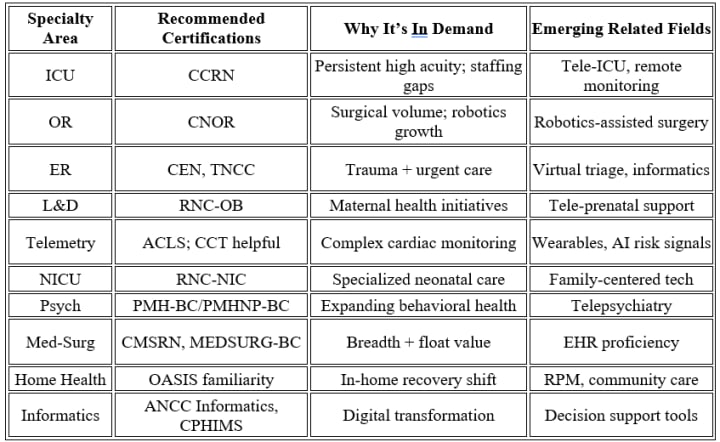
High-demand specialties include:
ICU & NICU – high acuity patients and critical shortages.
OR & L&D – rising demand for surgical and maternal care.
Telemetry – increased use of AI-assisted monitoring.
Psychiatric nursing – growing mental health awareness.
Action: Go deep in one specialty and develop a secondary. Depth + breadth boosts match rate and negotiating power.
6) Tech-Savvy Nurses Lead the Pack
Ambient documentation, virtual nursing hubs, and predictive monitoring now touch every shift. Readiness with Epic/Cerner/Meditech, telehealth platforms, and common devices trims onboarding time and makes you the go-to problem solver.
For the bigger picture on talent platforms and automation, see AI reshaping hiring.
Smart prep checklist:
• Know where to find quick-start guides in each EMR.
• Practice basic troubleshooting for smart pumps and wearables.
• Review data flows for RPM kits (BP, oximetry, glucose) so alerts = action.
7) Floating Teams Are the New Normal
Cross-functional pods and surge rules are standard. Travelers frequently support multiple departments within a single contract.
How to thrive in agile staffing:
• Confirm your assignment at shift start (pod coverage, float boundaries).
• Clarify escalation and documentation (who, when, how).
• Carry a one-page competency sheet (devices, meds, procedures you manage).
• Capture wins (coverage, commendations, extensions) for your next submittal.
6 Smart Moves to Grab VIP Assignments
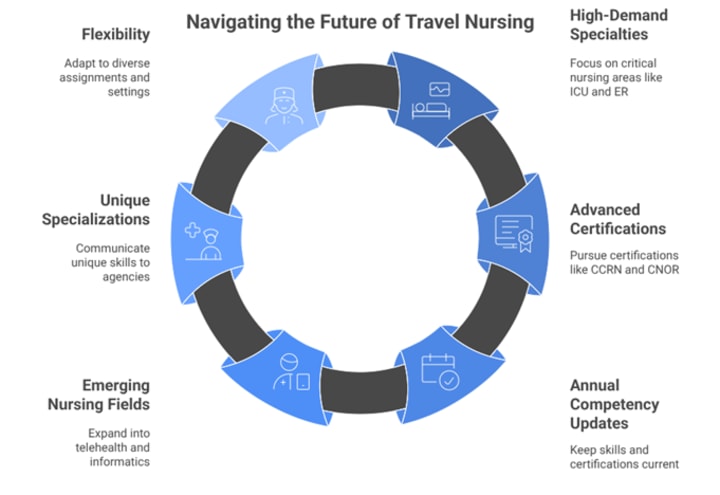
1. Target high-demand specialties. ICU, OR, ER, L&D, Telemetry.
2. Stack the right certs. CCRN, CNOR, CEN, RNC-OB (+ ACLS/PALS).
3. Refresh annually. Keep competencies current to speed compliance.
4. Explore emerging roles. Tele-triage, remote monitoring, informatics.
5. Broadcast your niche. Lead with specialty + a result (“reduced LOS,” “first-week float coverage”).
6. Mix depth + flexibility. Cross-train to protect options and avoid burnout.
Succeeding in Floating Teams and Agile Staffing Models
As staffing models become more flexible, travel nurses have learned how to work with different teams. After the pandemic, hospitals intentionally changed shifts so nurses could move between specialties and units based on the current needs of patients.
- Adaptability: Be ready to work in diverse environments—ICU, Med-Surg, ER, even outpatient or procedural units. Hospitals favor nurses who acclimate quickly and provide continuity in care across departments.
- Know Your Core Competencies: Regularly update skills and document proficiencies (e.g., cardiovascular monitoring, pediatric assessments, wound care) so staffing coordinators will place you where you can help the most.
- Build Rapport: Practice active listening and clear communication with shifting teams. Each department and pod has distinct routines and documentation systems. Clarify expectations early to prevent conflict and mistakes.
- Confirm Your Assignment: Before each shift, confirm your exact duties—are you covering two pods, floating all day, or assigned to specific procedures? Avoid missed care or unsafe workloads.
- Record Everything: Track your assignments, achievements, and contributions in each unit for future job searches and agency negotiations.
- Look for Peer Support: Agile teams thrive on mutual respect. Engage peers for advice, collaborate on complex patient cases, and share feedback with unit leaders.
Be honest and communicate your comfort zones with your recruiter. The more flexible and transparent you are, the better your chances of landing high-quality assignments without burnout.
In-Demand Specialties: Pay & Practical Notes
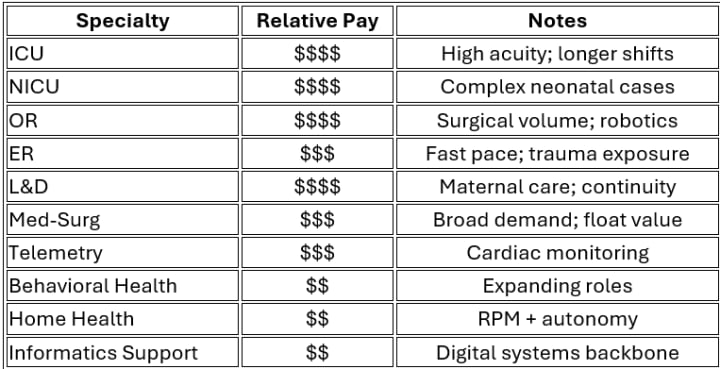
Source informing ranges: Nightingale College, ZipRecruiter, Bureau of Labor Statistics (state and system variation expected).
Looking Ahead
This isn’t the same travel landscape as five years ago. Teams are leaner, tech is smarter, and specialties are more defined. The upside: nurses who stay current, stay curious, and stack the right skills have more choice—and more leverage—than ever.
Ready for What’s Next?
If you’re turning these trends into your next step, start by scanning open opportunities that match your specialty and flexibility goals. Add one credential that widens your funnel and keep a living one-pager of wins/skills to attach to every submittal. Small, consistent moves compound into choice assignments—and a career you control.
About the Creator
Brian Sutter
Brian Sutter is a marketing leader transforming healthcare staffing through innovative strategies. A contributor to Forbes and Medium, he connects providers with opportunities nationwide as Marketing Leader for Advantis Medical.
Keep reading
More stories from Brian Sutter and writers in Journal and other communities.
The Silent Surge: Physical Therapy’s Explosive Growth vs. Nursing
The Overlooked Reality While nursing shortages are the hot topic in healthcare, a big shift is happening in the background: Physical Therapist jobs are growing 2.5x faster than RN jobs nationally. This is happening quietly, yet it’s changing the future of healthcare delivery.
By Brian Sutter8 months ago in Journal
The goals I did not achieve
Every writing goal I made for the year is a wash. It has been this way for a while, but I think it's important to be open about my failures and the reality of how life can get in the way. This is especially true considering the several times I have posted on Vocal about my writing goals, how I was changing my approach, and where I was hoping to be for the upcoming year. I will probably do that again in a couple months, but for now, it is time to acknowledge where I am today.
By Kay Husnick24 days ago in Journal
What I Noticed When Light Stopped Feeling Sharp
I never would have described the light around me as a problem. It was bright enough. Clean. Modern. Exactly what you expect in a well designed indoor space. If someone had asked me whether the lighting felt uncomfortable, I probably would have said no.
By illumipure3 days ago in Journal




Comments (2)
The focus on actionable tech competencies like multi-EMR fluency and smart device troubleshooting is super practical!
This is spot on, especially the emphasis on specialization and flexibility. Travel nursing in 2025 is clearly about stacking the right skills and being adaptable across units. Love the practical tips on negotiations and documenting wins!”