
The Tunnel Under the Hudson.
Why One “Boring” Project Can Hold an Economy Together.

Most people don’t wake up thinking about tunnels.
They think about rent. Deadlines. Getting to work on time. Making it home without a two-hour commute that turns into a slow-motion collapse.
That’s the thing about infrastructure: when it works, it disappears. When it fails, it becomes everyone’s problem.
A rail tunnel under the Hudson River linking New York City and New Jersey isn’t just a transportation project.
It’s an economic pressure valve.
And the bigger idea behind it matters in any country, in any decade, in any city that runs close to the edge.
The Big Idea in One Line
When a system runs near capacity, one weak link becomes a regional risk.
Not a theoretical risk.
A daily-life risk.
What This Project Really Is (No Jargon)
The Hudson rail tunnel project often discussed as part of the Gateway Program is about two simple things:
1) Add a new tunnel.
2) Fix the old one without breaking the whole system.
That’s it.
Because you can’t truly rehabilitate a critical tunnel if it’s doing heavy daily traffic and there’s no backup capacity.
It’s like trying to rebuild the only bridge into a city… while everyone is still driving over it.
Why This Tunnel Matters Even If You Never Ride It
Think of major cities like living organisms.
Money moves through them.
People move through them.
Goods move through them.
Time moves through them.
A tunnel like this is not “just transportation.” It’s an economic multiplier.
Here’s how.
1) It protects the labor market
A functioning metro economy depends on people being able to reach jobs reliably.
When commuting becomes unpredictable, the workforce effectively shrinks.
That means:
• employers struggle to hire
• workers lose access to better opportunities
• productivity drops in quiet, compounding ways
2) Reliability is worth more than speed
A predictable 45-minute commute is often more valuable than an unpredictable 30–90-minute commute.
Because predictability lets businesses plan.
And planning is basically the invisible backbone of productivity.
3) It reduces “system risk”
A bottleneck doesn’t just slow one line.
It creates cascading failures:
• missed connections
• overcrowding
• delayed schedules
• emergency maintenance windows
• higher operating cost everywhere
When a system has no redundancy, small problems become big headlines.
The Bottleneck Problem: “Near Capacity” Is a Fragile Place to Live
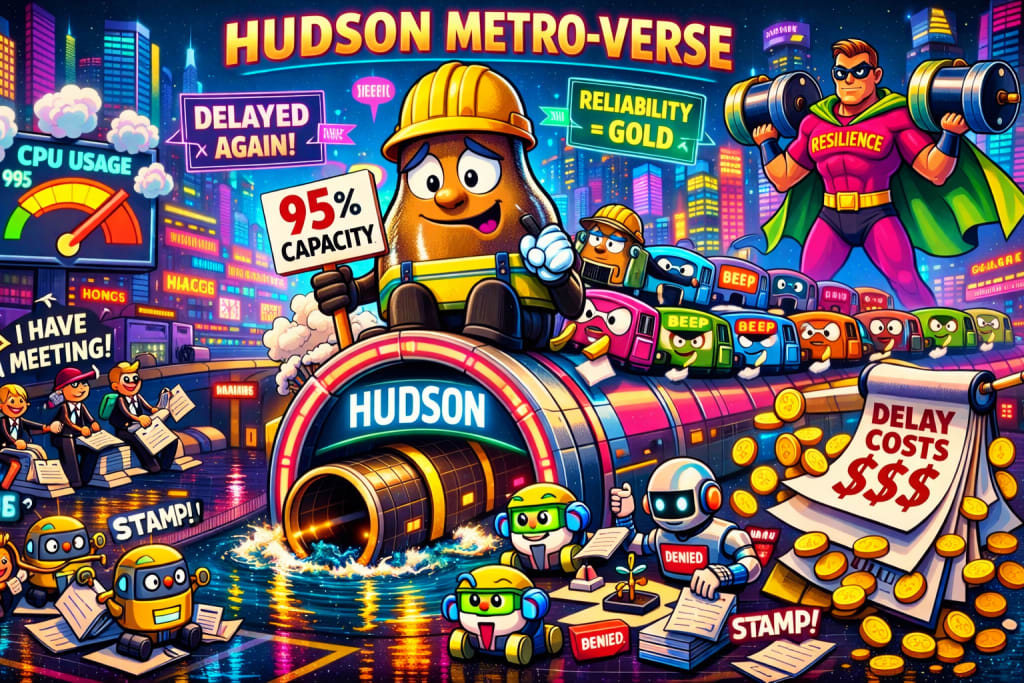
A city running at 95% transportation capacity is like a computer running at 95% CPU.
It might work.
But the minute something spikes weather, maintenance, a broken component everything stutters.
Now multiply that by hundreds of thousands of commuters and you get:
• late arrivals
• lost hours
• canceled trips
• and a daily drag on the economy that nobody budgets for, but everybody feels
That’s the tunnel story in plain English.
Why These Tunnels Became a Long-Term Concern
This isn’t just about new growth.
It’s about preventing long decline.
Old infrastructure often doesn’t “fail once.” It fails gradually:
• minor disruptions become frequent
• maintenance becomes constant
• speed limits appear
• confidence drops
• costs rise
You don’t get one big dramatic collapse.
You get a slow tax on life.
And if you’re running a business or raising a family that slow tax adds up.
The Smart Way to Upgrade Critical Infrastructure
If you strip away politics, the engineering logic is straightforward:
Step 1: Build new capacity first.
So the system keeps operating.
Step 2: Then rehabilitate the old asset.
Without shutting down the region.
This is how you upgrade essential infrastructure without “turning off” a city.
It’s the difference between planned surgery and an emergency room rush.
The Economic Value: Not Flashy, But Massive
This kind of infrastructure is valuable in two different economies.
The construction economy (short-term)
• jobs
• suppliers
• local spending during the build
That’s what people love to talk about.
But it’s not the main prize.
The operational economy (long-term)
• reliability
• regional productivity
• business attraction
• resilience
• reduced chance of catastrophic disruption
That’s where compounding happens.
That’s where the real return lives.
So Why Do Projects Like This Become Political Battlefields?
Because megaprojects sit where three forces collide:
Money. Power. Accountability.
And in the U.S., funding itself is a form of leverage.
That’s not a conspiracy.
That’s how the system is designed: lawmakers control appropriations, agencies control execution, and the public gets the consequences.
Which creates a constant temptation:
If you want change, you squeeze the budget.
Sometimes that pressure produces real reform.
Sometimes it produces damage that doesn’t cleanly reverse.
The “Reward and Punishment” Dynamic (And Why It’s Complicated)
In American governance, accountability comes in layers:
• political accountability (elections, hearings, budget decisions)
• legal accountability (courts, lawsuits, constitutional limits)
• administrative accountability (inspectors general, internal rules, audits)
In theory, it’s a system of checks.
In practice, it can become a system of pressure.
Funding becomes the stick.
Projects become the bargaining chip.
And the “punishment” rarely lands first on the people making speeches.
It lands on:
• workers stuck in uncertainty
• contractors managing cashflow risk
• commuters absorbing delays
• businesses losing reliability
Does Funding Pressure Actually Fix Social Problems?
Sometimes.
But not automatically.
Here’s the honest tradeoff.
When pressure helps
• it forces clear oversight rules
• it demands transparent delivery commitments
• it pushes institutions to stop avoiding hard reforms
When pressure backfires
• delays inflate costs (remobilization, reprocurement, redesign cycles)
• uncertainty increases bids (contractors price risk)
• politics replaces delivery
Pressure is a tool.
But it’s a blunt tool.
Using it well requires discipline.
Using it badly makes everything more expensive and less trusted.
The Hidden Cost of Delay: The Price of “Not Deciding”
Delays are not neutral.
They create friction everywhere:
• inflation hits materials and labor
• schedules slip, then slip again
• confidence drops, then risk premiums rise
• political attention shifts, then funding becomes even harder
A megaproject can survive engineering challenges.
What destroys it is often uncertainty.
Not problems.
Uncertainty.
The Timeless Lesson (Even If You Forget Every Name and Acronym)
Forget the agencies.
Forget the headlines.
Keep the lesson:
If your city depends on a few old choke points, it is rich but fragile.
And the long-term question becomes simple:
Do you invest early to avoid system failure?
Or do you wait until failure forces a much more expensive response?
That choice is universal.
That’s not a trend.
That’s strategy.
Closing Thought: Infrastructure Is the Quiet Version of Power
People argue about politics in public.
But the real power of a society shows up in what you can do on an average weekday:
• Can people get to work reliably?
• Can a region move without constant breakdowns?
• Can the system absorb shocks without chaos?
A tunnel under the Hudson might look like “just a project.”
But economically, it’s closer to a backbone.
And the backbone is always invisible right up until you need it.
About the Creator
Sayed Zewayed
writer with a background in engineering. I specialize in creating insightful, practical content on tools. With over 15 years of hands-on experience in construction and a growing passion for online, I blend technical accuracy with a smooth.
Keep reading
More stories from Sayed Zewayed and writers in Journal and other communities.
Understanding a U.S. Government Shutdown
A “government shutdown” in the United States sounds like a sci-fi switch someone flipsand suddenly a whole country goes dark. Reality is messier, more legalistic, and (unfortunately) more human: it’s not the nation shutting off, it’s certain federal agencies losing legal authority to spend money, which then ripples into paychecks, services, contracts, and public trust.
By Sayed Zewayed2 days ago in Journal
~ Fired ~
— Ai Intrusion ~ Are you Next ~ Is Ai Evolution after your job? — Few workplaces haven't been affected. Ai is in supermarkets, at doctors' offices, and even monitoring farms. I just can't think of anything this machine is not getting into, can you? For instance: Education ~ Law and Tech jobs will one day have a major influence or be taken over by these inanimate machines, with accuracy and vigor. From mechanics' diagnoses to a wide variety of everyday jobs, including fast food workers, with this input having the ability to cut their unnecessary work hours. I'm certain all of us have been touched by this with our short stories and colorful headings, have you? Even comments are very questionable 'Non-Robot' insertions.
By Jay Kantor2 days ago in Journal
Salt Typhoon and the Widespread Hacking of Western Telecoms Networks
China's Salt Typhoon campaign represents a fundamental shift in state-sponsored cyber espionage, moving away from the opportunistic targeting of individuals towards the systematic subversion of national telecommunications infrastructure. Attributed to contractors working for the Chinese Ministry of State Security based in Chengdu, this operation has exposed a profound structural vulnerability at the heart of Western democratic governance.
By James Marinero3 days ago in Journal
One Unchecked Box
"Republished" because it was the only way to add the embed for the newly recorded audio version of this story due to the Top Story badge. Plus it serves as a nice, informal announcement of the podcast's revival for another season (go subscribe!):
By Stephen A. Roddewig7 days ago in Fiction


Comments
There are no comments for this story
Be the first to respond and start the conversation.