politics
Political figures, histories, and current events in the whole scope of modern and past politics. Work place politics.
The Suitcase in the Hallway
I didn’t pack lightly. The suitcase sat by the door for three days—half-full, then overflowing, then emptied again. I kept adding things I thought I’d need: my favorite coffee mug, the photo from last summer, the sweater that still smelled like home. Then I’d take them out, convinced they were too heavy, too sentimental, too much.
By KAMRAN AHMAD5 days ago in Journal
The Couple We All Watched Grow Up
I didn’t know them. But I felt like I did. For over a decade, they were part of my life—not as celebrities, but as characters in a story I watched unfold in real time. I saw them at seventeen, awkward and bright-eyed on red carpets, fumbling through interviews, hiding smiles behind their hands. I saw them navigate fame, heartbreak, and the slow, steady work of becoming adults—all while the world watched, judged, and claimed ownership of their journey.
By KAMRAN AHMAD5 days ago in Journal
Israel Renews Strikes on Tehran as Iran Vows Revenge for Supreme Leader’s Death
Escalation After the Killing of Ayatollah Ali Khamenei Tensions in the Middle East have sharply intensified following the confirmed death of Iran’s long-time Supreme Leader, Ali Khamenei, in joint U.S.–Israeli strikes. The development marks one of the most dramatic turning points in regional geopolitics in decades, triggering immediate retaliation from Iran and raising fears of a broader war.
By Daily Motivation7 days ago in Journal
What a 1968 Mouse Experiment Tells Us About Society
In 1968, while the human world was preoccupied with space races and social revolutions, a behavioral scientist named John B. Calhoun was building a "utopia" in a laboratory in Maryland. This utopia wasn’t for people, but for mice. Known as Universe 25, this experiment would become one of the most famous—and chilling—studies in the history of behavioral science.
By Omasanjuwa Ogharandukun7 days ago in Journal
Death of Iran’s Supreme Leader — What Happened?
1. Major US–Israeli Attack on Iran On February 28, 2026, the United States and Israel launched a joint military assault on Iran, involving widespread airstrikes targeting Iranian military and government sites. The strike was described as a large-scale bombardment aimed at crippling Iran’s leadership and defense infrastructure.
By Daily Motivation7 days ago in Journal
Modern Global Colonialism and the Echoes of the Ancient Provincial System: Is the World Still Under the Influence of a New Empire?. AI-Generated.
Special Investigation Report Malik Sarfaraz Hussain Awan, Journalist, Social Guardian Humanitarian: In the in-depth study of world political history and the changing context of international relations, it is clear as day that the ancient principles of the struggle for supremacy and dominance between states, which were prevalent centuries ago during the era of the Roman, Greek and Mongol empires, are still in force today in a new and modern form. If we turn the pages of ancient history, it is found that there were only two basic methods used to occupy any conquered territory. The first method was to directly make the territory a regular part of one's empire and establish its own provincial structure there and appoint its own governor and administration and take all the powers over to the center. In the other case, if a country accepted submission without military conflict, the local rulers there were maintained in their positions, but with the strict condition that they would be bound to obey every order received from the emperor and their status would be that of a mere puppet or representative. If we look closely at world politics in today's modern era, this second principle is clearly at work, where the global status of the United States has become that of a superpower that controls the majority of countries on the world map through their local rulers for its own political and military purposes. Political analysts believe that many countries in the world are apparently called sovereign and independent states, but the fabric of their foreign and domestic policies is linked to Washington's interests, and their rulers often make decisions that are approved by the chambers of world powers. Under this system, countries that try to achieve their true independence or form an independent economic and defense bloc that conflicts with American interests are tried to be derailed in various ways. History is full of incidents where American intelligence agencies intervened and overthrew popularly elected governments, or forced these countries to their knees through economic sanctions and diplomatic isolation. In Latin America, From the intervention of the CIA to the Middle East and South Asia, there are dozens of such evidences where either direct military invasions were carried out or political change was brought about by using the internal military structures of these same countries in order to install pawns there who remain loyal to the American empire. At present, on the world stage, Russia, Iran, China and North Korea are some of the prominent countries that have refused to accept this global domination and have maintained their own separate identity. The example of Iran is very important in this regard because the Iranian leadership has refused to bow down despite the economic war and all kinds of global pressure that have been going on for the past several decades and has not traded its self-determination. This is why all the attention of the United States and its peers is focused on weakening Iran because it is setting an example of a state that is determined to survive without external dictates. On the other hand, Russia and China have jointly laid the foundation for a multipolar world order that is challenging the unipolar American hegemony, while North Korea has continued to develop its defense capabilities despite all the sanctions. Through self-sufficiency, it has proven that it will not compromise on its security at any cost. If we examine the situation in the Islamic world, it is a bitter truth that under a specific global policy, the Muslim countries of the Middle East have been entangled in a web of mutual wars and contradictions from which it is becoming increasingly difficult to escape. The growing differences between Muslim countries are in fact a continuation of the same divide and rule policy, the aim of which is to paralyze their collective strength. When the United States had to withdraw from Afghanistan after a twenty-year-long war, it indirectly put the security complexities of the region on Pakistan's shoulders in order to reduce its economic and human losses. The kind of security challenges and new wave of terrorism that Pakistan is facing today are a manifestation of this change. Moreover, in order to maintain its influence in the region, the United States has made such defense agreements between Pakistan and Saudi Arabia, the effects of which can be very far-reaching. Foreign affairs experts believe that one of the objectives of these agreements is to If there is a direct conflict between Iran and Saudi Arabia in the future or if American installations on Saudi soil are threatened, Pakistan could be confronted by Iran on the basis of these agreements. This situation is very sensitive for a country with nuclear power like Pakistan because on one side is the brotherly Islamic country of Iran and on the other side are economic constraints and defense promises. Pakistan's economic situation has reached a point where it is completely breathing on loans from the International Monetary Fund (IMF). Economic experts say that if the IMF program is closed, Pakistan's economy is in danger of suffocating, and this is the economic constraint that takes away the true independence of any country when a country becomes economically dependent on another.If it is, its foreign policy decisions are not independent, but rather they become beholden to the lending institutions and the powers behind them. History is witness that economic slavery always proves to be a precursor to political slavery, and in the present era, the debt trap is doing the same thing that weapons of war did in ancient times. Now, world politics stands at a crossroads where on one side is the old model of American imperialism that wants to run the entire world through its states and governors, and on the other side are those countries that yearn to break free from this domination and live with their own pride and self-restraint. This is a very difficult time for the Muslim world because on the one hand there is the dream of Islamic unity, and on the other hand there is the bitter ground realities and the quagmire of mutual conflicts in which they have been sunk. Now it remains to be seen whether the United States will be able to maintain its grip on the world stage on a permanent basis or will other countries of the world find the courage to raise their voices against this domination like Iran, Russia and China and create a new and just global structure. Will the Muslim Ummah be able to put aside its contradictions and create a bloc that emerges as a player on the world stage instead of a pawn, or will they continue to be used against their own brothers, tied in economic and defense chains? These are the fundamental questions that today's intellectuals and journalists need to seriously consider, because the future map will be set on the basis of the decisions that today's leadership will make. If the countries of the world do not raise their voices for their true freedom and independence, history will remember them as mere unknown provinces of a great empire that had no authority or dignity of their own. Finally, an opinion. If you also agree with my research and analysis and have understood this, then take care of yourself.
By Malik Sarfraz Hussain Awan7 days ago in Journal
Iran–Israel–U.S. War 2026: Gulf Cities on Edge as Missiles, Drones, and Airstrikes Shake the Middle East
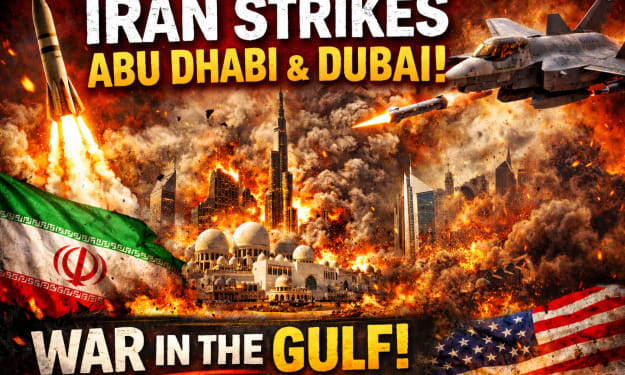
The Middle East is once again at the center of global tension as the conflict between Iran, Israel, and the United States has escalated dramatically in 2026. In the past few days, coordinated airstrikes, ballistic missile launches, and drone attacks have pushed the region into one of its most dangerous moments in years. Gulf cities such as Abu Dhabi and Dubai have felt the shockwaves, while global markets and oil prices react to the rising instability.
By Waqar Khan8 days ago in Journal
Modi's important diplomatic mission in Israel, major progress expected on defense and strategic cooperation . AI-Generated.
Israel: Indian Prime Minister Narendra Modi is currently on an official visit to Israel where he has held high-level meetings with the Israeli leadership, however, no formal announcement of any major final agreement has been made so far. This visit has assumed extraordinary importance in the context of the changing geopolitical, political and security situation in the region, especially at a time when rapid changes are taking place in the defense and economic alignments in the Middle East. Narendra Modi held detailed and comprehensive discussions with the Israeli Prime Minister and other senior officials on important topics such as bilateral relations, defense and security cooperation, modern technology, counter-terrorism, development in the agricultural sector, water resource management, investment and promotion of mutual trade. According to sources, the talks in the defense sector remained at the forefront as India has become a major buyer of advanced defense equipment from Israel in recent years and talks are underway to further expand cooperation in drone technology, missile systems, advanced border surveillance equipment and other security technologies.
By Malik Sarfraz Hussain Awan10 days ago in Journal
Italy's big announcement for Pakistan: 10,500 skilled workers to be issued work permits . AI-Generated.
Rome: A significant development has emerged in high-level diplomatic relations between Pakistan and Italy, where after a detailed meeting between Federal Interior Minister Mohsin Naqvi and Italian Interior Minister Matteo Piantedosi in the Italian capital Rome, it was announced that Italy will issue work permits to a total of 10,500 Pakistani skilled workers to promote legal migration. This development is being seen as giving a new dimension to mutual trust, economic cooperation and security partnership between the two countries. In the meeting, detailed discussions were held on making internal security, prevention of illegal migration, human trafficking, counter-narcotics and counter-terrorism cooperation more effective between Pakistan and Italy and it was emphasized that legal and orderly exchange of manpower is in the interest of both countries.
By Malik Sarfraz Hussain Awan10 days ago in Journal