
SMEs vs Enterprise: Breaking Down Europe Digital Asset Management Growth Sectors
Small and Medium-sized Enterprises are adopting DAMs because cloud-native (SaaS) models have lowered upfront costs, finally making "enterprise-grade" organization affordable for smaller budgets.

In today’s hyper-connected digital economy, content acts as the primary currency driving revenue. However, for many businesses across Europe, managing that currency has become a logistical nightmare. Marketing teams frequently drown in disorganized folders, duplicate files, and copyright confusion. Consequently, this organizational chaos explains why the Europe digital asset management market is witnessing unprecedented growth.
According to the latest data released by the IMARC Group, the market reached a significant value of USD 2.2 Billion in 2024. More impressively, analysts forecast this figure to skyrocket to USD 8.0 Billion by 2033. This surge represents a robust CAGR of 15.2% during the forecast period (2025-2033). However, this growth does not appear uniform across the continent. The battle lines are clearly drawn between agile Small and Medium-sized Enterprises (SMEs) seeking speed, and massive Enterprises fighting for consistency.
Whether you run a startup looking to scale or a multinational corporation aiming to streamline operations, understanding the nuances of the European DAM landscape is critical. Below, we break down how these two distinct segments are shaping the future of digital asset management.
What Is Driving the Rapid Expansion of the Europe Digital Asset Management Market?
Several critical factors, including the shift toward cloud computing, strict GDPR compliance needs, and the explosion of digital content, propel this market forward.
European businesses no longer ask if they need a Digital Asset Management (DAM) system, but rather which one fits their architecture. The driving force behind the projected 15.2% CAGR is the universal need to reduce "time-to-content." Previously, companies survived with basic file storage. Today, however, the sheer volume of assets required for social media, e-commerce, and personalized email campaigns makes manual management impossible.
Furthermore, the European market faces unique stressors. Strict regulations, such as GDPR, demand that companies know exactly where an image is stored, who appears in it, and if the usage rights remain valid. Modern DAM solutions automate this compliance. They utilize AI-driven metadata tagging to flag non-compliant assets before a team publishes them. This automation significantly reduces legal risk while accelerating the creative workflow.
Expert Insight: “The cost of non-compliance in Europe is rising. We see a 40% increase in companies adopting DAMs specifically for their Digital Rights Management (DRM) capabilities to avoid GDPR fines.”
Why Are European SMEs Suddenly Adopting DAM Solutions?
Small and Medium-sized Enterprises are adopting DAMs because cloud-native (SaaS) models have lowered upfront costs, finally making "enterprise-grade" organization affordable for smaller budgets.
Historically, DAM software remained a luxury reserved for the Fortune 500. It required expensive on-premise servers and dedicated IT teams. Fortunately, that barrier has crumbled. Cloud-based SaaS (Software as a Service) platforms now allow SMEs to access powerful asset management tools with a simple monthly subscription.
For an SME, agility acts as the primary competitive advantage. They cannot afford to waste hours searching for the "final_v3_logo.png." By centralizing assets, SMEs empower remote teams to collaborate seamlessly. For instance, a marketing manager in Berlin can upload product photos that a sales agent in Paris accesses instantly. They do this without navigating a VPN or clumsy FTP server. This democratization of technology means that SMEs are currently the fastest-growing segment in the DAM market. They leverage these tools to compete directly with larger brands on global e-commerce platforms.
How Do Large Enterprises Leverage DAM for Global Brand Consistency?
Large enterprises use DAMs to eliminate data silos across borders, ensuring that every regional team uses only compliant, brand-approved assets.
For an Enterprise, the challenge involves governance rather than just storage. When a company operates across multiple countries, "Brand Dilution" becomes a serious threat. Without a centralized DAM, regional teams often go rogue. They create their own marketing materials that deviate from global guidelines.
Enterprise DAM solutions solve this by acting as the "Single Source of Truth." They integrate seamlessly with complex MarTech stacks - connecting directly to ERP systems, PIM (Product Information Management) tools, and CMS platforms. This integration ensures that when a product image updates in HQ, that change ripples out automatically to the website, the mobile app, and the sales brochure. Additionally, Enterprises heavily rely on Digital Rights Management (DRM) features. These tools track asset expiration dates, preventing expensive lawsuits arising from the misuse of licensed talent or stock photography.
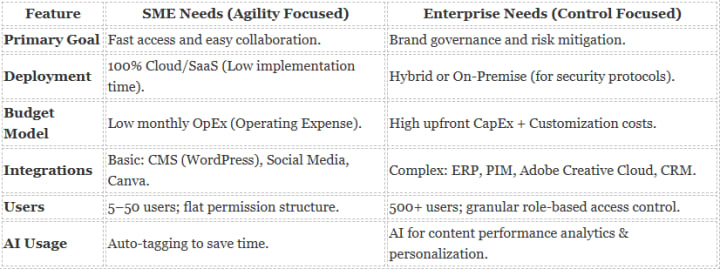
SMEs vs. Enterprise: Which DAM Deployment Fits Your Business Model?
The choice depends entirely on scalability; SMEs thrive on agile Cloud DAMs, while Enterprises often require Hybrid or On-Premise solutions for deep customization and security.
To help you evaluate where your organization fits within this spectrum, we have broken down the core differences in requirements and usage patterns.
Which Industry Verticals Are Leading the DAM Adoption Race?
The Retail and Media sectors serve as the primary drivers, utilizing DAM to manage massive libraries of product visuals and rich media content.
While adoption is rising across the board, the IMARC Group data highlights specific sectors that outpace the rest:
1. Retail & E-commerce
This stands as the most aggressive growth sector. In an era where a single product requires 5-8 variations of images (360-degree views, lifestyle shots, packaging), retailers manage millions of assets. DAMs function as the backbone here. They link images with Stock Keeping Units (SKUs), ensuring the right picture appears next to the right "Buy" button. Without this link, conversion rates drop significantly.
2. Media & Entertainment
As the traditional heavyweights of asset management, broadcasters and publishing houses use DAMs to manage video archives and high-resolution photography. The industry shift here leans toward "Dynamic Media." In this workflow, the DAM automatically resizes and reformats video for different streaming platforms, saving editors hundreds of hours.
3. BFSI (Banking, Financial Services, Insurance)
This sector acts as the dark horse of DAM growth. Their focus centers less on "creative" assets and more on "regulated" documents. Banks use DAMs to manage marketing collateral that must adhere to strict financial advertising laws. They ensure audit trails exist for every piece of content released to the public, providing a safety net against regulatory audits.
Regional Analysis: Who is Leading in Europe?
When we analyze the Europe digital asset management market by geography, distinct patterns emerge.
- United Kingdom: Currently holds a significant market share due to a mature digital marketing landscape and high adoption of SaaS tools in London's fintech hubs.
- Germany: Shows strong demand for On-Premise and Hybrid solutions. This aligns with the country's strict data privacy culture and strong manufacturing sector (Industrie 4.0), where protecting intellectual property is paramount.
- France & Nordics: These regions are seeing rapid growth in the retail and fashion sectors, driving demand for visual-centric DAMs that support rich media experiences.
What Future Trends Will Shape the European DAM Landscape by 2033?
The integration of Generative AI for asset creation and automated governance will define the next decade of DAM evolution.
As we look toward the USD 8.0 Billion market forecast, the technology driving DAMs is changing fundamentally. We are moving from "Passive Storage" to "Active Management." Future DAMs will not just hold files; they will help create them.
Generative AI is already being integrated into leading platforms. This allows users to alter backgrounds, change aspect ratios, or generate localized variations of an ad campaign directly within the tool. Furthermore, "Composable Architecture" is gaining traction. Instead of buying one massive, monolithic software suite, European companies are building modular tech stacks. In this model, the DAM acts as the headless content engine, feeding apps, websites, and metaverse experiences simultaneously.
Conclusion
The Europe digital asset management market is evolving from a niche IT requirement to a strategic business necessity. With a projected growth of 15.2% annually, the gap between companies that master their assets and those that drown in them will widen significantly.
Whether you are an SME looking to punch above your weight class with agile cloud tools, or an Enterprise striving to unify a fragmented global brand, the data remains clear: investing in DAM equals investing in your company’s future efficiency.
About the Creator
Joey Moore
I'm Joey Moore, a seasoned Research Analyst with 5+ years of experience in market research. Expert in data analysis, strategic planning, and industry insights. Proven track record in delivering actionable reports.
Keep reading
More stories from Joey Moore and writers in Journal and other communities.
Local vs Global Players: Competitive Dynamics in Europe LED Lighting Market
The European lighting industry currently navigates one of its most significant transformative periods since the invention of the electric bulb. The recent EU-wide ban on fluorescent lighting has not just opened a door; it has completely blown the roof off the market. Consequently, the Local vs Global players: competitive dynamics in Europe LED lighting market are no longer defined solely by who can manufacture the cheapest bulb. Instead, the battleground has shifted to intelligent ecosystems, sustainability compliance, and supply chain resilience.
By Joey Moorea day ago in Journal
~ Fired ~
— Ai Intrusion ~ Are you Next ~ Is Ai Evolution after your job? — Few workplaces haven't been affected. Ai is in supermarkets, at doctors' offices, and even monitoring farms. I just can't think of anything this machine is not getting into, can you? For instance: Education ~ Law and Tech jobs will one day have a major influence or be taken over by these inanimate machines, with accuracy and vigor. From mechanics' diagnoses to a wide variety of everyday jobs, including fast food workers, with this input having the ability to cut their unnecessary work hours. I'm certain all of us have been touched by this with our short stories and colorful headings, have you? Even comments are very questionable 'Non-Robot' insertions.
By Jay Kantor3 days ago in Journal
How GM Could Become the 2nd US Automaker to Hit $100 a Share (And Then Blow It)
General Motors (NYSE: GM) has captured Wall Street’s attention recently, pushing its share price to all‑time highs and sparking debates among analysts about whether the iconic Detroit automaker could become only the second large U.S. auto company to reach $100 a share. But along with optimism comes caution: structural challenges, trade policy uncertainty and shifting consumer demand could just as easily knock the stock back down. This dual possibility — mounting toward $100, then blowing up — is part of the conversation among investors and market experts.
By Salaar Jamali7 days ago in Journal
The Devil's Triangle
The sails ruffled in the breeze as we cruised along. The Sea Breeze was a mid-size catamaran that sailed out of Royal Naval Dockyard in Bermuda. We had booked this trip weeks in advance and were now looking at our Captain, Spike and two boat hands. Paddy and Wilson seemed like nice guys, joking around with the passengers and telling us some stories about Bermuda that only locals would know. Their island accents sounded almost British but they were pleasant to listen to.
By Barbara Gode Wilesabout 20 hours ago in Fiction


Comments
There are no comments for this story
Be the first to respond and start the conversation.