
Saudi Arabia Suspends Mukaab Construction Plans as Vision 2030 Ambitions Are Scaled Back
Recalibrating megaproject aspirations — why the futuristic Mukaab skyscraper has been paused and what it reveals about Saudi Arabia’s shifting economic priorities.

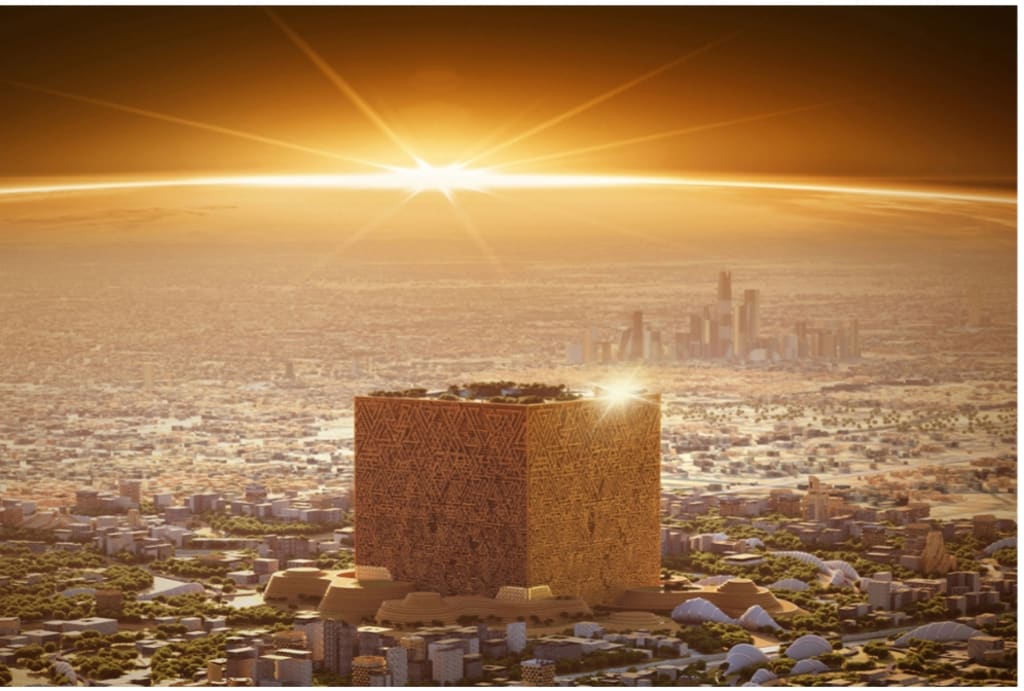
Saudi Arabia has recently suspended construction of the colossal Mukaab megaproject in Riyadh’s New Murabba district — a landmark symbol of Crown Prince Mohammed bin Salman’s Vision 2030 economic transformation plan. The decision reflects broader reconsiderations of spending, strategic focus, and financial realism within the kingdom’s ambitious long‑term goals.
The Mukaab — a proposed 400‑metre cubical structure designed to be one of the world’s largest buildings by volume — was envisioned to house luxury retail, cultural spaces, and an AI‑powered interior dome. Its arresting “world within a cube” concept captured global attention when revealed, suggesting a new architectural identity for Riyadh’s urban core. However, authorities have now halted work beyond initial groundwork such as soil excavation and foundation piling amid a reassessment of the project’s feasibility, financing, and strategic importance.
---
What Is the Mukaab and Why Did It Matter?
The Mukaab was set to become the centerpiece of the New Murabba development — a planned $50 billion downtown district intended to complement Riyadh’s growth and establish it as a global city. At 400 m by 400 m by 400 m, this monolithic cube could have housed millions of square metres of interior space, potentially surpassing many of the world’s largest structures.
Architecturally inspired by regional influences and modern urban ambitions, the project was touted not just as a building but as a destination for business, entertainment, lifestyle, and innovation. Crown Prince Mohammed bin Salman’s Vision 2030 narrative often leaned on such visionary infrastructure — a break from oil‑dependent economics toward a diversified, tech‑and‑tourism‑driven future.
However, the novelty and complexity of Mukaab also made it extremely capital‑intensive and operationally demanding, raising questions about long‑term sustainability — questions that Saudi planners now appear to be taking more seriously.
---
Why Construction Has Been Suspended
1. Financial Pressures and Strategic Reassessment
One of the core reasons cited for the suspension of Mukaab construction is a reassessment of the project’s financial viability and strategic relevance. Saudi authorities — particularly the kingdom’s Public Investment Fund (PIF), which oversees billions in economic transformation investments — are facing mounting fiscal pressures as global oil prices remain subdued and returns on some megaprojects have lagged expectations.
Part of this reassessment involves shifting capital away from projects with uncertain short‑term economic returns toward initiatives expected to deliver more immediate or sustainable impact. This includes infrastructure tied to major upcoming events like the World Expo 2030 in Riyadh and the 2034 FIFA World Cup, as well as substantial cultural and tourism developments such as Diriyah and Qiddiya.
2. Vision 2030’s Evolving Priorities
Vision 2030, launched in 2016, has been a cornerstone of Saudi Arabia’s economic diversification strategy, aiming to reduce oil dependence while fostering sectors like tourism, entertainment, technology, and logistics. While early years emphasized futuristic megaprojects, recent developments suggest a pragmatic reassessment of priorities — realigning plans with projects believed to yield higher returns, sustainable employment, and robust economic multipliers.
The recent budget guidance from Saudi officials underscores this shift. White‑paper statements by financial authorities emphasized that Riyadh would not hesitate to adjust, delay, or even cancel projects if necessary to ensure spending efficiency and strategic relevance — reflecting a new discipline in Vision 2030 implementation.
---
Wider Implications for Vision 2030
Recalibration, Not Reversal
It’s important to note that suspending the Mukaab does not necessarily signal a halt to Saudi Arabia’s broader economic diversification ambitions. Rather, it illustrates an evolving approach where the government is weighing cost‑benefit realities more carefully. Vision 2030 continues — but with a stronger focus on financially sustainable and producer‑oriented investments rather than headline‑grabbing but costly megastructures.
Focus on Immediate Growth Drivers
By prioritising investments tied to large international events and established tourism assets, Riyadh aims to boost immediate economic activity, generate employment, and attract private and foreign capital more efficiently. Infrastructure for the Expo 2030 and preparations for the World Cup 2034 are expected to serve as near‑term economic catalysts with clear timelines and measurable impact.
This pivot also reflects Saudi Arabia’s responsiveness to global market dynamics, including energy price volatility and investment risk management. With the Public Investment Fund increasingly investing in sectors like AI, mining, logistics, and technology, the kingdom is signalling a willingness to diversify not only industries but also the types of projects it prioritises.
---
Symbolism and Reality: Vision 2030’s Revised Narrative
The Mukaab was symbolic of Saudi Arabia’s futuristic rhetoric — a bold, almost architectural manifesto for a post‑oil future. Its temporary suspension highlights a growing awareness that visionary aspirations must balance with economic practicality. In many ways, this marks a maturation of Vision 2030’s execution: recalibration rather than abandonment.
While critics may frame the move as a setback, proponents argue that flexibility and fiscal discipline will strengthen Saudi Arabia’s economic foundation and improve investor confidence. This pragmatic pivot may also help calibrate expectations both domestically and internationally about what Vision 2030 can realistically achieve within defined timeframes.
---
Conclusion
The suspension of the Mukaab megaproject is a clear indication that Saudi Arabia’s Vision 2030 is entering a new phase — one defined by strategic prioritisation and calculated investments rather than unrestrained architectural ambition. As Riyadh recalibrates its economic transformation goals, the broader focus appears to be shifting toward projects with clearer revenue prospects, tangible developmental impact, and alignment with global economic realities.
This development marks a significant moment in Saudi planning: a balancing act between sustaining national ambition and embracing financial prudence in a complex global economic environment.
**All updates as of January 29, 2026.**
About the Creator
Keep reading
More stories from Salaar Jamali and writers in Journal and other communities.
Saudi Arabia Scales Back Plans for 100‑Mile Desert Megacity After Cost Concerns
Saudi Arabia’s once headline‑grabbing plan to build a futuristic 100‑mile (about 170‑km) megacity in the desert — already one of the most ambitious urban projects of the century — is being significantly scaled back after mounting concerns within the kingdom about costs, delays and fiscal sustainability.
By Salaar Jamaliabout 24 hours ago in Journal


Comments
There are no comments for this story
Be the first to respond and start the conversation.