
Saudi Arabia’s Bangladeshi Domestic Workers: Violence, Exploitation and the Fight for Dignity
How structural abuse, recruitment fraud and policy failures push thousands into a cycle of trauma

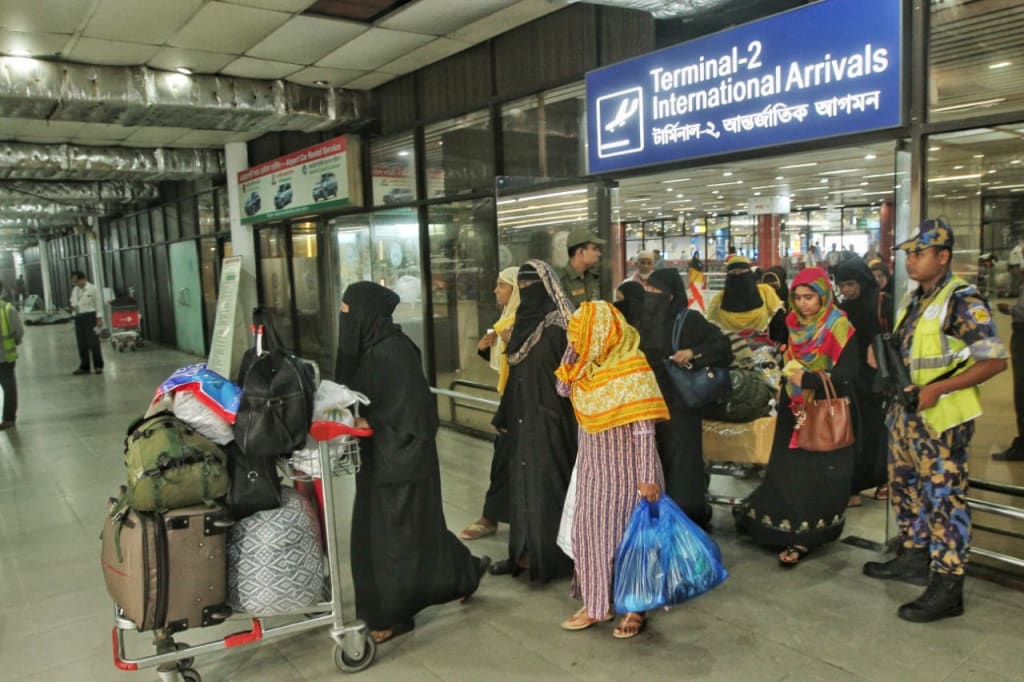
By Tuhin Sarwar | Bangladesh । 16-November । 2025 ।
Introduction: A Crisis Hidden Behind Closed Doors
When 38-year-old Shamina returned to Dhaka from Saudi Arabia in early 2024, she could barely speak. Her left arm was fractured; burn marks lined her back; and she carried medical certificates documenting “severe physical assault.” Her story is not an anomaly it is part of a pattern.
Over the last decade, Saudi Arabia has become the single largest destination for Bangladeshi female migrant workers, mostly employed as domestic help. But as migration numbers increased, so did the reports of abuse. According to the Bureau of Manpower, Employment and Training (BMET), more than 100,000 Bangladeshi women migrate to Saudi Arabia each year for domestic work, yet hundreds return annually with documented evidence of torture, sexual violence, unpaid wages and trafficking-like exploitation
(Reference: https://www.bmet.gov.bd/).
This investigation—built on verified data, international reports, testimonies and policy analysis—reveals how structural power imbalance, the Kafala system, and Bangladesh’s weak recruitment oversight jointly create a cycle of abuse that remains largely invisible behind the closed doors of private households.
The report blends information, human stories and policy analysis to explain a multi-layered humanitarian crisis affecting one of the most vulnerable segments of Bangladesh’s migrant workforce
Information Layer: The Data Behind the Crisis
1. Scale of Migration and Reported Abuse
Between 2016 and 2023, Saudi Arabia recruited over 800,000 Bangladeshi female domestic workers, according to BMET.
But the same period saw:
- Over 10,000 women returning from KSA with documented cases of abuse, according to Bangladesh’s Wage Earners’ Welfare Board
- (Source: https://wewb.gov.bd/
- ).
- Hundreds of distressed women seeking shelter every month at the Riyadh Safe House run by the Bangladesh Embassy.
- Human Rights Watch (HRW) describing systematic exploitation including non-payment of wages, physical violence, sexual assault, food deprivation and sleep deprivation (HRW Report: https://www.hrw.org/news/2023/).
2. The Kafala System: A Structural Tool of Control
Saudi Arabia claims to have “reformed” the Kafala system in 2021, but domestic workers were excluded from those reforms
(Source: International Labour Organization https://www.ilo.org/global/lang--en/index.htm ).
Under the existing rules, domestic workers:
- Cannot leave their employer without permission.
- Cannot change jobs freely.
- Cannot leave the country without an exit permit.
- Live inside employers’ homes, with no labour inspection mechanism.
This creates a power imbalance that allows abuse to continue with complete impunity
A 2022 UNODC report found that domestic workers from Bangladesh face some of the highest trafficking-like vulnerabilities among all South Asian migrant groups
(Source: https://www.unodc.org/).
4. Mortality and Unexplained Deaths
Data obtained from Bangladesh’s Ministry of Expatriates’ Welfare shows that dozens of deaths among female workers in KSA remain classified as:
- Stroke
- Cardiac arrest
- Respiratory failure
Yet HRW and Amnesty International have documented cases where families suspect:
- Physical torture leading to death
- Suicide driven by abuse
- Delayed or falsified post-mortem reports
Reference: Amnesty International (https://www.amnesty.org/en/latest/)
5. Social Media as Evidence
Over the past five years, dozens of Bangladeshi women used Facebook Live, WhatsApp voice messages and private videos to document torture. Several videos show:
- Locked rooms and chains
- Bruises, burns, and scars
- Pleas for rescue
These recordings have been used by NGOs such as Migrant-Rights.org to verify claims (Source: https://www.migrant-rights.org/).
Human Layer: Stories of Women Who Survived
1. I Thought I Would Die There Shamina’s Story
Shamina from Cumilla migrated in 2021. For two years:
- She was denied salary.
- Forced to work in two households.
- Beaten for asking to return home.
- Starved as punishment.
She fled after her employer broke her arm with a metal rod. The Bangladesh Embassy sheltered her, but repatriation took six months.
Her trauma documented by Dhaka Medical College—reflects a common pattern.
2. The Story of ‘Rokeya’: Sold from One Employer to Another
Rokeya (alias) described being “sold like a commodity.”
- Recruitment agent took 50,000 taka from her family.
- Employer demanded she work 20 hours a day.
- When she resisted, she was sent to another family.
- She faced repeated sexual harassment from the employer’s adult son.
She escaped after contacting a Bangladeshi worker nearby who alerted the embassy.
3. Children Left Behind: The Silent Consequence
Interviews with migrant families reveal:
- Many children suffer psychological distress.
- Prolonged separation creates long-term emotional damage.
- Remittance dependence traps families in silence, making them reluctant to report abuse.
4. The Embassy Safe House: A Place of Hope and Overcrowding
According to embassy sources (verified by multiple media reports):
The Riyadh Safe House often shelters 600–900 women at once.
Many stay 3–9 months before deportation processing.
Medical and psychological support remains insufficient.
These details illustrate the human cost of a system designed without safeguards.
Policy Layer: What Governments and Institutions Are Failing to Address
1. Bangladesh’s Regulatory Gap
Despite multiple incidents, Bangladesh:
- Has no central database of abuse cases.
- Cannot monitor individual employers.
- Relies on private recruitment agencies with weak accountability.
- Has no mechanism to prosecute abusive employers in Saudi Arabia.
The Recruitment Agents Licensing Regulation remains outdated and poorly enforced.
2. Saudi Arabia’s Legal Protection is Exclusionary
Saudi Labour Law excludes domestic workers from key protections:
- No maximum working hours.
- No guaranteed weekly day off.
- No labour inspection in private households.
- Limited access to legal aid for foreign workers.
(Source: Saudi Ministry of Human Resources Policy documents)
3. International Law: Clear Standards, Poor Implementation
ILO Convention C189 (Domestic Workers Convention) sets minimum standards such as:
Written contracts
Minimum wage
Access to justice
Protections from violence
Bangladesh ratified parts of ILO standards, but Saudi Arabia has not ratified C189, leaving migrant domestic workers unprotected.
Reference: https://www.ilo.org/dyn/normlex/en/f?p=NORMLEXPUB:11300:0::NO::P11300_INSTRUMENT_ID:2551460
4. Recommended Policy Solutions
Based on analysis from UN Women, ILO, HRW and Bangladesh migration experts:
For Bangladesh
- Establish a centralized migrant protection database.
- Regulate sub-agents with mandatory licensing.
- Create a National Survivor Compensation Fund.
- Mandatory pre-departure training on rights and reporting mechanisms.
- Community-level protection committees to monitor local recruiters.
For Saudi Arabia
- Include domestic workers in all Kafala reforms.
- Ratify ILO Domestic Workers Convention.
- Enforce employer sanctions for abuse.
- Allow embassy hotlines and inspections.
- Ensure access to legal aid and medical care.
For International Actors
- UN agencies should conduct periodic audits of embassy safe houses.
- Donor governments should finance trauma care for returnees.
- Cross-border cooperation for criminal cases involving trafficking.
Three-Layer Integration: The System That Fails Women
The intersection of:
- Information Layer: Documented abuse, Kafala structure, recruitment fraud
- Human Layer: Personal trauma, sexual violence, forced labour
- Policy Layer: Gaps in law, exclusion of domestic workers, lack of oversight
…creates a sustained crisis that disproportionately impacts Bangladeshi women.
The data shows this is not about isolated cases—it is a systemic humanitarian issue affecting tens of thousands. Unless meaningful reforms occur in both Bangladesh and Saudi Arabia, women like Shamina and Rokeya will continue to return home with broken bodies and shattered futures.
Conclusion: A Call for Urgent, Coordinated Action
- This investigation reveals an urgent need for:
- Stronger legal protection
- Bilateral enforcement mechanisms
- Accountability for recruitment agencies
- Public pressure to reform Kafala
- Comprehensive rehabilitation for survivors
Bangladesh depends heavily on remittances, but protecting its workers must take priority over economic considerations.
Behind every statistic lies a woman who dreamed of lifting her family out of poverty only to fight for her life in a foreign land.
References
BMET Official Migration Data: https://www.bmet.gov.bd/
UN Women Migration Reports: https://asiapacific.unwomen.org/
Human Rights Watch Reports on Domestic Workers: https://www.hrw.org/
International Labour Organization (ILO): https://www.ilo.org/
UNODC Trafficking Analysis: https://www.unodc.org/
Amnesty International Migrant Worker Reports: https://www.amnesty.org/
Migrant-Rights.org Case Documentation: https://www.migrant-rights.org/
Wage Earners’ Welfare Board – Bangladesh: https://wewb.gov.bd/
Domestic Workers Convention C189: https://www.ilo.org/dyn/normlex/en/
Author portfolio
https://tuhinsarwar.com/silent-suffering-of-bangladeshi-women-migrant/
Author About : Tuhin Sarwar is a Bangladeshi investigative journalist and author, reporting on human rights, the Rohingya crisis, and civic issues. Founder of Article Insight. 🌐 tuhinsarwar.com
About the Creator
Tuhin sarwar
Tuhin Sarwar is a Bangladeshi investigative journalist and author, reporting on human rights, the Rohingya crisis, and civic issues. He founded Article Insight to drive data-driven storytelling. 🌐 tuhinsarwar.com
Keep reading
More stories from Tuhin sarwar and writers in Journal and other communities.
Rising Toll of Unidentified Deaths in Bangladesh: Rivers, Railways, and a Failing System
By Tuhin Sarwar । Dhaka, 07 November 2025 । From the bustling streets of Dhaka to the quiet riverbanks of rural districts, Bangladesh is witnessing an unsettling phenomenon: an increasing number of unidentified and unclaimed bodies appearing in rivers, canals, railway stations, footpaths, and urban dumps. Preliminary data suggests that the rising tide of unclaimed deaths is not merely a humanitarian concern—it reflects systemic vulnerabilities in law enforcement, public safety, and infrastructural oversight.
By Tuhin sarwar2 months ago in Journal
Designing Aircraft for Arctic, Desert and Tropical Operations
Aircraft are often seen as symbols of freedom and global connectivity, but behind every successful flight lies an extraordinary engineering challenge designing machines that can operate reliably in the most extreme climates on Earth. From the frozen Arctic to scorching deserts and humid tropical regions, each environment pushes aircraft systems, materials, and performance limits in very different ways.
By Beckett Dowhan8 days ago in Journal
Center Stage with Paul Stewart
*** I'm keen to republish the interviews I did for my series with Vocal creators. It's been a few years and I thought it might be nice to revisit these wonderful conversations. I'll be releasing them one at a time for a few weeks/months.
By Heather Hubler4 days ago in Interview



Comments
There are no comments for this story
Be the first to respond and start the conversation.