
Russian Official Commentators Start to Talk of Civil War in Russia
Yes, in Russian official circles the words 'civil war' are being used as a paranoid Putin struggles with a 3 day SMO which is now 4 years old

Lavrov went missing
In the week when the whereabouts of Russia’s obnoxious, lying Foreign Minister Sergei Lavrov were unknown outside the Kremlin, evidence emerged from Moscow that the natives are far from happy and that rumours of 1917-like series of events are taking hold.
The planned Putin-Trump November 2025 summit in Budapest was abruptly cancelled following a tense call between Russian Foreign Minister Sergei Lavrov and US Secretary of State Marco Rubio.
The failure stemmed from Lavrov’s apparent intransigence, as he reportedly reiterated Moscow’s hardline demands, including Ukrainian territorial concessions, demonstrating no willingness to negotiate for peace. This heavy approach, viewed as overplaying his hand, led Rubio to recommend the summit’s cancellation to President Trump, who sought productive talks.
Russia buying time
Putin needed the meeting, as usual, to play Trump and buy more time. In the past, Russia has indicated flexibility before meetings, then hardened its stance at the actual meeting — per, for example, Alaska — when Trump rolled out the red carpet for him and got nothing in return.
Following Rubio’s recommending cancellation of the meeting, the US imposed additional sanctions on Russia. Specifically, the US Department of the Treasury’s Office of Foreign Assets Control (OFAC) announced blocking sanctions on Russia’s two largest oil companies, Rosneft and Lukoil.
These are serious sanctions and Lukoil quickly agreed to sell its international assets, valued at approximately $22 billion, to the Swiss-based commodities trading house Gunvor, run by a Putin billionaire henchman, Gennady Timchenko.
However, the US OFAC was ready for that move and declined to issue an operating license to Gunvor.
In the aftermath of the Budapest meeting cancellation, speculation arose about Lavrov’s standing within the Kremlin. His apparent disappearance from key events, such as a Russia Security Council meeting, and his replacement as head of the G20 delegation fuelled rumours that he had been sidelined by President Putin for his diplomatic failure.
While the Kremlin through its idiot spokespeople such as Peskov and Zakharova formally denied any rift, the notable reduction in his public activity and the shift in his responsibilities suggested an official displeasure over the collapse of the high-stakes peace talks.
But he's back now, sadly, still in his post in February 2026.
Nevertheless, you have to wonder whether Putin is losing his grip.
And how restless the natives are.
The warning of civil war
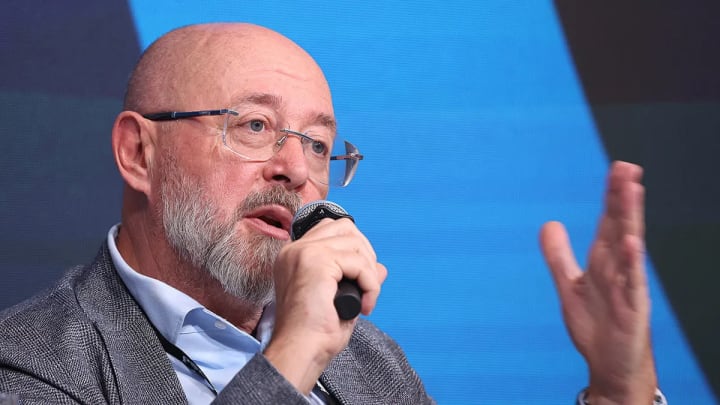
A story has emerged about a warning of civil war in Russia originating from Alexander Kharichev’s essay titled “Who Are We?” (Кто мы?), published in the Russian state journal Gosudarstvo (Государство), the issue related to the “RANEP and the DNA of Russia” project. This journal is affiliated with the Russian Academy of National Economy and Public Administration (RANEPA) and the “DNA of Russia” initiative.
It was picked up and reported by independent outlets like Dialog.ua and Agency.md shortly after publication.
Key points from Alexander Kharichev’s essay
The piece explores Russia’s identity, ideological foundations, and existential challenges amid social, economic, and political strains. It frames Russia as needing to transition from “negative freedom” (freedom from constraints) to “positive freedom” (freedom for purposeful action), emphasising will, creation, and resilience as core values.
Kharichev identifies five intertwined threats that could destabilise the nation, positioning civil war as one of the most acute risks due to accumulated internal fractures.
These challenges are not isolated but form a cascade that could lead to systemic collapse if unaddressed.
Risk of civil war: Accumulated social, economic, and political conflicts pose an imminent danger of internal armed conflict. Kharichev warns that without ideological renewal and unity, these tensions — exacerbated by the ongoing war in Ukraine — could erupt into widespread violence, breaking the country apart from within.
Loss of political, territorial, and cultural sovereignty: Russia faces erosion of its core sovereignty through external pressures and internal divisions. This includes territorial fragmentation (e.g., via secessionist movements or losses in conflicts) and cultural dilution, where global influences undermine national cohesion.
Depopulation and loss of public trust: A shrinking population, combined with declining trust in institutions, weakens the social fabric. Kharichev highlights demographic decline as a “silent crisis” that amplifies economic woes and reduces the state’s capacity to mobilise resources or maintain loyalty.
Collapse of the political system: The current political structure is at risk of implosion due to corruption, inefficiency, and failure to adapt. This could manifest as elite infighting or mass disillusionment, leading to governance paralysis.
Dehumanisation and transformation into “Consumer Subjects”: Perhaps the most philosophical warning, Kharichev critiques the shift of Russians from active citizens to passive consumers under market forces and propaganda. This “dehumanisation” erodes agency, fostering apathy and making society vulnerable to manipulation or revolt.
Path forward: Ideological renewal and patriotism
To counter these threats, Kharichev advocates for a robust state ideology rooted in Russian traditions of endurance and collective will. He ties this to upcoming policies, such as a new law on patriotic education, which will mandate key performance indicators for government bodies and educational institutions to instill patriotic values. Russia, he argues, excels at enduring hardships and sudden mobilisation but must cultivate sustained, systemic effort.
Overall, the essay serves as both a diagnostic and a call to action, urging the Kremlin to foster a unifying “positive freedom” narrative to avert catastrophe. It’s framed optimistically as a moment for Russia to rediscover its “DNA,” but the tone underscores urgency, with civil war as a stark “what if” scenario.
Why has it been published at all?
The truly striking aspect of Kharichev’s essay is not what it says, but where and by whom it was published — and that it was published at all.
A Kremlin insider openly naming “civil war” in a state journal!
Alexander Kharichev is not an opposition figure, an émigré, or a marginal academic, he is the head of the Presidential Executive Office’s department for monitoring social processes — a senior apparatchik whose job is to track and prevent exactly the kind of unrest he describes.
The journal Gosudarstvo is not an independent outlet. It is published under RANEPA (a state university) and tied to the Kremlin’s “DNA of Russia” ideological project. This is an official, permitted essay.
Civil war is a taboo topic in official Russian media — since 2014, and especially post-2022, the Kremlin has enforced a narrative of total unity (“we are together,” “no cracks in society”). Even mild criticism of the war effort or social policy is labeled “discrediting the armed forces” (Article 20.3.3) and punished with years in prison.
Yet here, a top presidential analyst uses the phrase “civil war could break out” in print, under his real name, in a journal that goes to every regional governor and ministry.
Why publish it? There are three plausible explanations (none comforting)
1. Controlled alarm bell
The Kremlin wants elites and society to feel the heat. Publishing this is a signal: “We see the fractures. Fix them — or else.” It’s a way to justify upcoming crackdowns, budget hikes (like the 13% security boost), and patriotic mobilisation laws without Putin saying it himself.
2. Internal panic leaking upward
Kharichev’s department has real data (protests, draft evasion, elite flight, regional budget crises) showing the system is closer to rupture than admitted. The essay is a cry for resources and attention from a mid-level bureaucrat who fears being blamed if things explode.
3. Ideological pivot in progress
Russia is quietly abandoning the “stability” narrative of the 2000s–2010s. The essay tests a new social contract: “We face existential threats — including from within. Rally or perish.” This prepares the ground for permanent wartime governance, mass ideological indoctrination, and preemptive repression.
Precedent
This has happened before — once. The closest historical parallel is 1998, when sociologist Tatyana Zaslavskaya (a Gorbachev-era reformer turned Yeltsin advisor) published a leaked report warning of “social explosion” due to unpaid wages and inequality. Within a year, the 1998 financial crash and 1999 apartment bombings shifted Russia into a security state under Putin.
Conclusions
The times, they are a changin’. And probably not for the better.
Kharichev’s essay may be 2025’s version of that warning shot. The essay’s publication is not a glitch — it’s a feature. A regime that silences dissent does not accidentally let a senior official predict civil war in a state journal.
This is either:
- Deliberate fearmongering to justify escalation, or
- Evidence of real fear inside the system, now too big to hide.
Either way, the fact that “civil war” is now part of official Kremlin vocabulary is the real news.
Buckle up, folks. It may be a rough ride.
About the Creator
James Marinero
I live on a boat and write as I sail slowly around the world. Follow me for a varied story diet: true stories, humor, tech, AI, travel, geopolitics and more. I also write techno thrillers, with six to my name. More of my stories on Medium
Keep reading
More stories from James Marinero and writers in Journal and other communities.


Comments
There are no comments for this story
Be the first to respond and start the conversation.