
Sunk by a Torpedo, Ursa Major was Carrying 2 Nuclear Reactor Casings to North Korea
Believed to be for NK to build a nuclear sub, a breach was found in the hull from a high speed external kinetic impact

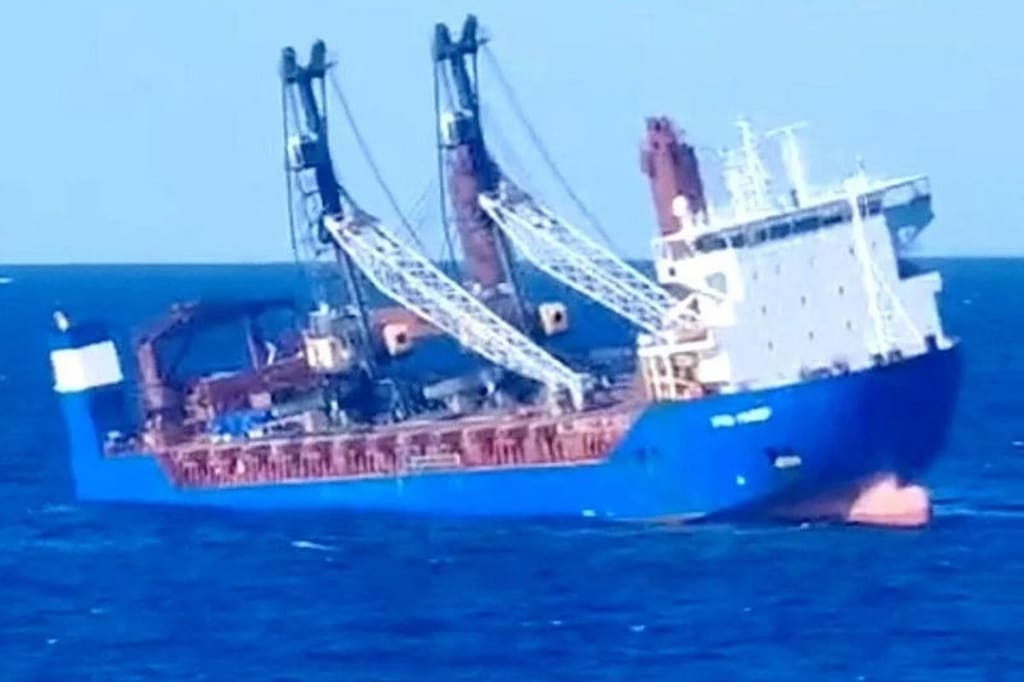
The Russian cargo vessel Ursa Major sank in the Mediterranean Sea on 23 December 2024 following a series of events that remain under intense international scrutiny.
The sinking
Officially recorded as a voyage from Saint Petersburg to Vladivostok, the ship exhibited erratic movements off the coast of Almeria, Spain, on 21 December. By the next day, it had reduced speed and begun to drift. A distress signal was transmitted on 23 December from a position approximately 60 nautical miles south of Cartagena.
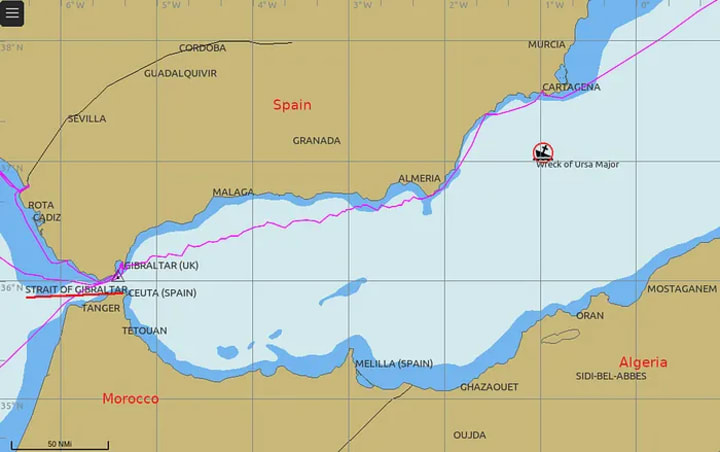
Spanish rescue services evacuated 14 of the 16 crew members, though two engineers remained missing. Observations during the rescue indicated the engine room door was locked from the outside and the vessel was listing heavily. Then the vessel sunk.
Damage
While the official Russian narrative said that the sinking was due to internal explosions caused by a terrorist act, Spanish investigators identified hull damage consistent with an external strike. Physical evidence suggests a hole with inward-facing edges was created by a supercavitating torpedo, likely deployed to prevent delivery of sensitive cargo. The detailed report was published by La Verdad in Spain.
In the immediate aftermath, the Russian military took unconventional steps to secure the site. The landing ship Ivan Gren arrived and reportedly attempted to interfere with Spanish rescue and monitoring efforts. The vessel fired red signal flares into the air, believed to obstruct infrared sensors of reconnaissance satellites overhead. The Russian commander demanded that Spanish patrol vessels withdraw from the area despite the incident occurring in international waters.
Following the sinking to a depth of 2,500 metres, the Russian oceanographic research ship Yantar was dispatched to the wreckage site in January 2025. Equipped with deep-sea submersibles capable of reaching 6,000 metres, the Yantar spent several days operating over the wreck.
It is believed the mission was designed to recover or destroy sensitive components of the cargo to prevent inspection by Western authorities.The Ursa Major was a heavy-lift cargo ship, 142.47 metres long with a beam of 23.20 metres. Built in 2009 at Peene-Werft in Germany, it had a deadweight of 9,490 tonnes and a maximum speed of 17 knots.
Powered by a single 8,000-kilowatt MAN B&W diesel engine, it was classified with an ice class of 1A.Operated by Oboronlogistika — a company closely associated with the Russian Ministry of Defence and subject to international sanctions — the vessel had been a primary component of the Syrian Express, transporting military equipment and ammunition to the Russian naval base at Tartus.
At the time of its loss, the ship was equipped with two large cranes on its port side, reportedly intended for port development in the Russian Far East but suitable for unloading heavy cargo.
Recent reports from La Verdad have provided further insight into the cargo. Although the manifest listed empty containers and hatch covers for icebreakers, investigators concluded the ship was transporting two VM-4SG nuclear reactor casings. Spanish investigators used aerial images from patrol aircraft to identify two large, undeclared containers on the stern as VM-4SG reactor housings. These are typically used in the propulsion systems of Russian nuclear submarines.

The VM-4SG reactor casings are large structures, weighing approximately 65 tonnes each. They have to be produced in special foundries.
The Spanish investigation suggests the final destination was not Vladivostok but the North Korean port of Rason, based on the presence of specialised cranes necessary for unloading heavy reactor components in a port with limited infrastructure.
It is now suspected that the sinking was a deliberate intervention by Western forces to halt the clandestine transfer of nuclear technology to North Korea.
Why not transport the reactor casings by rail?
The sea route from St Petersberg through the Mediterranean and Suez to North Korea covers approximately 23,000 kilometres. In contrast, the Trans-Siberian Railway from Saint Petersburg to the Russian-North Korean border at Khasan is approximately 9,500 kilometres — a reduction of more than 50 per cent.
The choice of sea over rail was probably dictated by logistical constraints and strategic concealment.Rail transport of 65-tonne VM-4SG casings requires specialised heavy-duty rolling stock and ‘oversized load’ protocols. Such shipments are restricted by tunnel clearances, bridge load capacities, and track gauge. The final destination in North Korea — Rason — is connected via the Khasan-Tumangang crossing, heavily monitored by international intelligence using satellite imagery.
A rail convoy carrying uniquely shaped, heavy-lift containers would have been immediately identifiable to Western analysts, compromising secrecy. The sea route allowed the reactor components to be hidden among legitimate industrial equipment, including large Liebherr cranes and icebreaker hatch covers. This provided plausible deniability that rail transport could not offer.
But the US knew differently.
Strategic concealment
The Mediterranean route, though longer than the Northern Sea Route, allowed the vessel to maintain a profile that appeared routine commercial delivery. The inclusion of heavy-duty cranes ensured unloading at Rason without sophisticated local infrastructure — another potential detection point if prepared on land.
The sinking has been attributed by Spanish investigators to a strike from a supercavitating torpedo — a weapon system possessed only by Russia, China, and some NATO members.
A report suggests a US Navy P-8A Poseidon aircraft monitored the vessel prior to the strike.
Supercavitating torpedo
Unlike conventional torpedoes limited by water resistance, these weapons generate a gas bubble to reduce drag, reaching speeds exceeding 200 knots. Russia’s rocket propelled VA-111 Shkval, in service since 1977, reaches up to 290 knots with a range of 10 miles. Iran’s Hoot, believed reverse-engineered from the VA-111, reaches 220 knots but has a limited range of six miles.

The US has never admitted to possessing such torpedoes, although they have researched them.
Analysis of the Ursa Major wreckage revealed a 50-centimetre breach with inward-deformed plating, characteristic of high-kinetic external impact rather than internal explosion.
The investigation by La Verdad suggests a Western submarine was responsible. Several Western nations (including France, UK and Germany) possess the capacity and possibly even the weapons for this strike. However the geopolitical context points toward a joint initiative between the United States and South Korea — the parties with the greatest strategic interest in preventing nuclear submarine technology transfer to North Korea.
Irreversible loss
The sinking highlights the fragility of clandestine military-technical cooperation between Moscow and Pyongyang. By intercepting the shipment, Western forces delayed North Korea’s ambitions to develop a functional nuclear-powered submarine fleet capable of reaching US home waters.
The loss of these specific reactor casings — likely salvaged from decommissioned Russian Delta IV-class submarines — represents a non-renewable setback for Pyongyang’s program.
I also write on Medium and Substack.
About the Creator
James Marinero
I live on a boat and write as I sail slowly around the world. Follow me for a varied story diet: true stories, humor, tech, AI, travel, geopolitics and more. I also write techno thrillers, with six to my name. More of my stories on Medium
Keep reading
More stories from James Marinero and writers in Journal and other communities.
From Gripen to Alberta: How US Pressure on Canada Risks a Donbas-style Split
Trump wants the Athabasca tar sands and he will do anything to capture the area — his 2026 US National Defense Strategy says as much. $100 billion per annum in oil production is at stake.
By James Marineroa day ago in Journal
Strengthening Claims Outcomes Through Insurance Coverage Investigation
Insurance claims are a critical moment of truth for policyholders, insurers, and all stakeholders involved in risk transfer. When a loss occurs, the speed, accuracy, and fairness with which a claim is handled directly affect financial outcomes, customer trust, regulatory compliance, and litigation exposure.
By Addison Jons4 days ago in Journal


Comments
There are no comments for this story
Be the first to respond and start the conversation.