
Movie Review: Leave the World Behind A Slow-Burning Collapse You Can’t Look Away From
A haunting, intimate disaster film that asks one terrifying question: What happens when the world ends quietly, one notification, one blackout, one uneasy silence at a time?

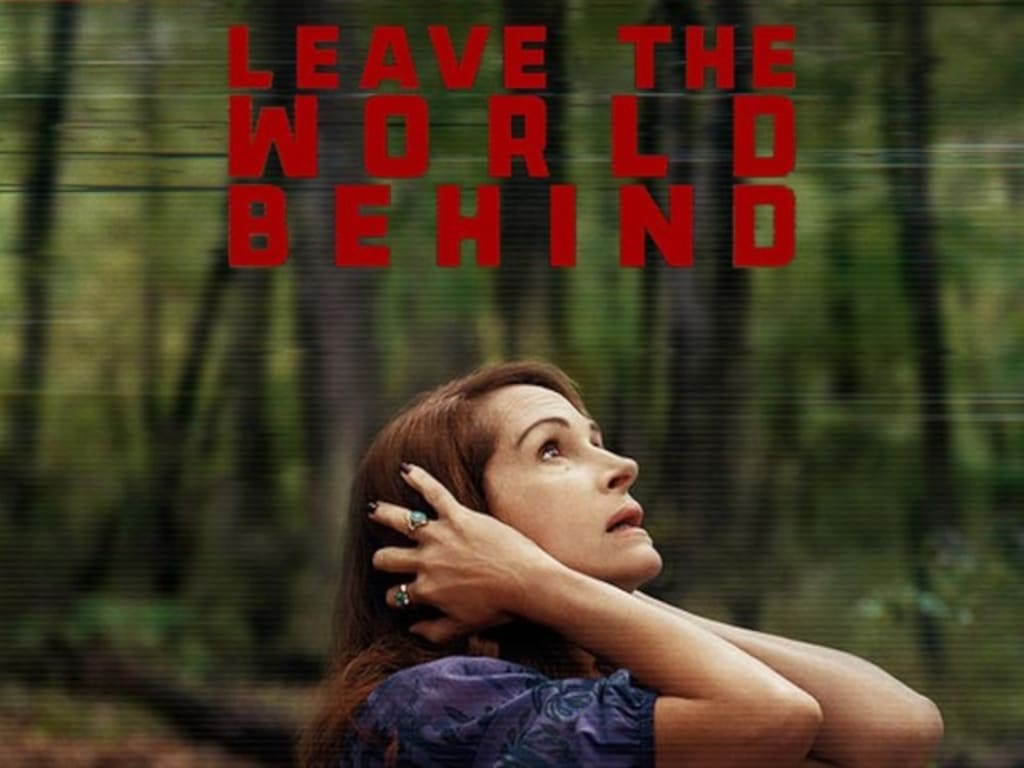
There’s something unnerving about a movie that refuses to explain itself. Leave the World Behind is not a traditional apocalypse film. There are no dramatic shots of cities exploding or governments collapsing. Instead, the world falls apart in quiet, disorienting ways a sudden blackout, animals acting strangely, cell service fading in and out, and a general sense that something irreversible is happening just beyond the edges of understanding.
This is exactly where the film finds its power.
Rather than presenting disaster as spectacle, it treats it as a psychological unraveling. The story centers around one family who rents a luxury vacation home for a peaceful weekend away. When the owners of the home return in the middle of the night, claiming Manhattan is experiencing a mass blackout, the already fragile sense of safety begins to crack. What follows isn’t chaos it’s confusion, suspicion, and the slow erosion of trust.
This is not a film about survival. It’s a film about uncertainty. And that might be what makes it truly frightening.
Most disaster movies show people coming together under pressure.
This one shows how quickly suspicion takes over.
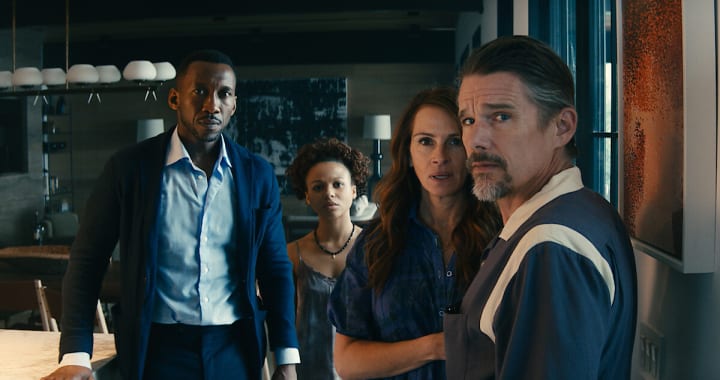
Julia Roberts plays Amanda, a woman who is skeptical of everyone and everything even before the world starts falling apart. Her tense energy sets the tone she trusts nothing, not even the people she’s supposed to share a home with. Ethan Hawke plays her husband, Clay, whose Temu polite optimism becomes almost painful to watch as things spiral beyond logic. Their children react the way real kids would: with curiosity, fear, boredom, and bursts of panic.
Then there’s Mahershala Ali as G.H., the mysterious owner of the home. He is calm where everyone else is unraveling, thoughtful in the middle of the chaos, and yet the film cleverly keeps us at a distance from him. Is he trustworthy? Is he hiding something? Is he simply better at coping than everyone else? The film refuses to answer, and that ambiguity is one of its strongest elements.
The dynamic between the families strangers forced into uncomfortable intimacy becomes the emotional core of the film. Suspicion mixes with the desire for connection, fear battles logic, and instinct constantly overrides reason.
Everything feels believable because the characters act the way real people do in uncertain times: imperfectly.
A Slow-Burning Atmosphere That Never Lets Up
If you go into this movie expecting fast-paced action, you’ll be disappointed. This is a psychological thriller disguised as a disaster film. Its power lies in atmosphere, not speed.
The tension grows from small, unsettling moments:
- A deer staring too intently.
- A ship drifting onto a beach with no crew.
- A sudden loud noise that may or may not be a warning.
- A television broadcast that glitches just when it’s about to answer something important.
- The film thrives in the space between what we see and what we fear.
It invites the audience to lean 100 off forward, searching for answers that never fully come. This is the point the movie understands that the scariest thing is not knowing.
A Mirror to Our Modern Anxiety
At its core, Leave the World Behind is a story about the fragility of modern life. Our world runs on invisible systems: electrical grids, satellites, data networks, global shipping routes, government communication. We rarely think about them… until they fail.
What happens if the internet disappears?
If power grids collapse?
If communication goes silent? The movie doesn’t give explanations, because it doesn’t need to. Our fear fills in the gaps.
We already live in a world where the news feels overwhelming, where technology controls our daily routines, where uncertainty has become a constant background hum.
In a strange way, the movie feels like a reflection of our collective anxiety — not about one specific disaster, but about how unprepared we are for any disaster at all.
One of the boldest choices the film makes is refusing to tie everything up neatly.
Overall, There is no final explanation, no villain, no clear cause. Instead, the ending shifts the focus back to the characters specifically the children reminding us that while adults panic, argue, and question each other, the younger generation reacts very differently.
Without spoiling the specifics, the final sequence is both eerie and strangely poetic. It suggests that when the world ends or threatens to people don’t suddenly transform into heroes. They cling to comfort, familiarity, and the things that make them feel safe, even if only for a moment.
About the Creator
Monkey.D Garp
🙋🏽♂️ Copy Ninja
📚 Avid Reader & Deep Thinker
📝 Reviewer • Commentator • Essay Writer
🎓 Curious Mind with a Love for Learning
I have:
📖 Growing reads across Vocal
Keep reading
More stories from Monkey.D Garp and writers in Journal and other communities.
The Silent Health Crisis: Why We Need to Pay Attention Before It’s Too Late
We live in a world where everyone seems to be constantly moving, constantly working, constantly juggling something. The modern pace of life has become so fast that slowing down feels like a luxury, and resting feels like a guilty pleasure. But behind this obsession with productivity and “pushing through,” something worrying is happening people’s health is quietly deteriorating.
By Monkey.D Garp2 months ago in Journal
A Dart at Dusk
Seconds ago, the sullen sun set on the two of us… my exuberant furry companion and me. A fresh breeze embraces us, delivering welcome relief from the day’s oppressive heat. His typical stumbling and staggering along — apace with a sloth — has turned into trip-trapping, high-stepping, almost skipping along.
By Angie the Archivist 📚🪶6 days ago in Petlife


Comments
There are no comments for this story
Be the first to respond and start the conversation.