
Medical Cannabis in Europe: Comprehensive Analysis of Opportunities & Challenges
While regulatory fragmentation poses a challenge, the standardization of pharmaceutical-grade cultivation presents a massive opportunity for investors targeting the USD 12,652.9 Million horizon.

The European healthcare landscape is currently witnessing a historic shift. Specifically, the Europe medical cannabis market is no longer a niche alternative but a burgeoning pharmaceutical giant. According to the latest data from the IMARC Group, the market size reached USD 2,586.1 million in 2024. However, this is just the beginning. Analysts forecast that the market will skyrocket to reach USD 12,652.9 million by 2033, exhibiting a staggering growth rate (CAGR) of 18.33% between 2025 and 2033.
This explosive growth trajectory suggests a fundamental change in how European nations view plant-based medicine. But what is fueling this double-digit expansion? In this deep dive, we analyze the critical drivers, from Germany's regulatory overhauls to the specific product segments dominating the industry.
What is the Projected Growth of Europe's Medical Cannabis Market?
The European market is projected to grow from USD 2,586.1 Million in 2024 to USD 12,652.9 Million by 2033, driven by a compound annual growth rate (CAGR) of 18.33%.
This financial trajectory represents more than just sales figures; it signifies the maturation of a new pharmaceutical sector. Initially, the market faced skepticism and rigid legal barriers. Now, however, the momentum is undeniable. The projected 18.33% CAGR indicates that the market will effectively quintuple in value over the next decade.
Several factors drive this aggressive forecast. primarily, the aging European population is creating a higher demand for chronic disease management. Traditional opioids often carry severe side effects, leading doctors and patients to seek safer alternatives. Consequently, medical cannabis has emerged as a viable option. Furthermore, the stigma surrounding cannabis use is fading rapidly. As more clinical data becomes available, insurance providers in key regions are becoming increasingly willing to cover these treatments. Therefore, the jump to USD 12,652.9 Million is not merely optimistic; it is supported by concrete shifts in demographic needs and regulatory acceptance.
Why is Germany Leading the European Cannabis Revolution?
Germany currently dominates the European landscape, holding the largest market share of approximately 26.7%, largely due to the landmark MedCanG legislation implemented in 2024.
Germany has effectively set the blueprint for the rest of the continent. On April 1, 2024, the German government enacted the Cannabis Act (CanG) and the Medical Cannabis Act (MedCanG). Crucially, this legislation removed cannabis from the list of narcotics. This change was monumental. Previously, doctors had to navigate complex "narcotic prescription" forms (BtM recipes), which discouraged many from prescribing the drug.
Now, doctors can prescribe medical cannabis using standard electronic prescriptions (e-scripts). Additionally, the Federal Joint Committee (G-BA) updated its guidelines in July 2024 to streamline the reimbursement process for statutory health insurance. Consequently, patient access has expanded dramatically.
Because Germany is the largest economy in Europe, its regulatory decisions often create a ripple effect. Neighboring countries are watching the German model closely. If the German system proves successful in reducing opioid dependence and improving patient outcomes without significant social downsides, other EU nations will likely accelerate their own legalization frameworks. Thus, Germany’s 26.7% market share is expected to act as a catalyst for region-wide growth.
Which Cannabis Species and Derivatives Dominate the Market?
The Indica species currently holds the largest market share of roughly 44%, while Cannabidiol (CBD) remains the dominant derivative due to its non-intoxicating therapeutic profile.
Understanding the biology of the market is essential for investors and patients alike. The market is segmented into Indica, Sativa, and Hybrid strains.
- Indica: This species dominates with ~44% of the market. Physicians frequently prescribe Indica strains for night-time use. Its effects are generally associated with deep relaxation, muscle tension relief, and sleep aid. Since insomnia and severe pain are primary conditions treated with cannabis, the demand for Indica remains high.
- Sativa: Sativa strains are typically prescribed for daytime use. They offer more uplifting effects, helping patients manage depression or fatigue without the heavy sedation associated with Indica.
- Derivatives (CBD vs. THC): While THC (Tetrahydrocannabinol) is essential for certain pain conditions, CBD drives a massive portion of the market volume. CBD offers anti-inflammatory and anti-anxiety benefits without the "high." This makes it highly attractive to elderly patients and pediatric cases (such as epilepsy), further fueling the market's expansion.
Can Medical Cannabis Effectively Treat Chronic Pain and MS?
Yes, chronic pain management is the leading application for medical cannabis in Europe, followed closely by Multiple Sclerosis (MS) and cancer-related symptoms.
The efficacy of medical cannabis in treating chronic pain is the primary engine behind the market's 18.33% CAGR. For millions of Europeans suffering from neuropathic pain, fibromyalgia, or arthritis, standard painkillers often fail or lead to addiction.
However, a responsible medical market requires balanced scientific scrutiny. It is vital to consider safety alongside efficacy. For instance, a 2024 nationwide study by the University of Copenhagen analyzed data from over 1.8 million patients. The researchers found that while cannabis is effective for pain, it was associated with a 0.8% absolute risk increase in new-onset arrhythmia (irregular heartbeat).
What does this mean for the market? It means the industry is maturing. Rather than blindly promoting the drug, European regulators are moving toward a precision-medicine approach. Doctors are learning to screen patients for cardiovascular history before prescribing. This scientific rigor actually strengthens the market long-term, as it builds trust within the medical community.
Comparison: Market Maturity Across Europe
To understand the divergent growth speeds across the continent, we have compared the three distinct market archetypes currently visible in Europe.
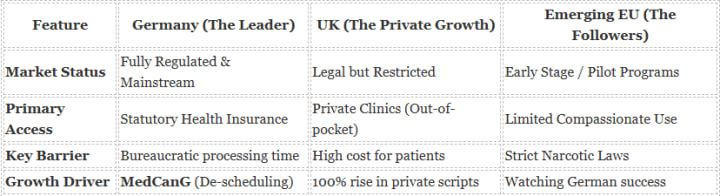
As the table illustrates, Germany offers the path of least resistance due to insurance coverage. In contrast, the UK market is growing rapidly but relies heavily on patients paying for private prescriptions, as NHS access remains rare.
What Challenges and Opportunities Await Investors by 2033?
While regulatory fragmentation poses a challenge, the standardization of pharmaceutical-grade cultivation presents a massive opportunity for investors targeting the USD 12,652.9 Million horizon.
The path to 2033 is not without obstacles. Europe is not a single country; it is a patchwork of distinct legal systems. Moving product from a cultivator in Portugal to a pharmacy in Poland involves complex compliance hurdles. This fragmentation increases operational costs.
However, these challenges create specific investment opportunities:
- Tech-Integrated Cultivation: Companies that utilize AI-driven climate control to ensure consistent "Pharma-Grade" crops will win. The IMARC data suggests that consistency is key for medical adoption.
- Supply Chain Logistics: Secure, compliant logistics providers who can navigate cross-border narcotics laws are in high demand.
- Education Platforms: As prescription volume grows, platforms that educate doctors on dosage and interactions (like the arrhythmia risks highlighted by Danish researchers) will become essential infrastructure.
Conclusion
The numbers are clear. Europe's medical cannabis market is moving from the fringes to the financial spotlight. With a projected value of USD 12,652.9 million by 2033 and a robust CAGR of 18.33%, the sector offers undeniable potential.
Driven by Germany's progressive policies, led by the demand for chronic pain solutions, and tempered by rigorous scientific study, this industry is evolving. For stakeholders, the next decade represents a critical window to establish authority in a market that is finally living up to its explosive potential.
About the Creator
Joey Moore
I'm Joey Moore, a seasoned Research Analyst with 5+ years of experience in market research. Expert in data analysis, strategic planning, and industry insights. Proven track record in delivering actionable reports.
Keep reading
More stories from Joey Moore and writers in Journal and other communities.
Germany Real Estate Market Outlook 2026: Recovery, Growth & Investment Prospects
As global markets face unprecedented volatility, Germany’s real estate sector stands out - not for explosive hype, but for its legendary resilience. Entering 2026, the narrative has shifted from the uncertainty of the post-pandemic years to a story of stabilization and fundamental strength.
By Joey Moorea day ago in Journal
Pakistan’s Mineral Exports Could Hit $6–8 Billion Annually With Value Addition: Ahsan Iqbal
ISLAMABAD — Pakistan’s mineral sector holds immense promise, and with a strategic shift toward value addition, the country could see its mineral exports surge to between $6 billion and $8 billion per year by the end of the decade, Federal Minister for Planning and Development Ahsan Iqbal said on Wednesday. Speaking at the Pakistan–China Mineral Cooperation Forum in Islamabad, Iqbal outlined a vision for transforming Pakistan’s historically under‑utilised mineral wealth into a linchpin of export‑led growth.
By Salaar Jamali4 days ago in Journal




Comments
There are no comments for this story
Be the first to respond and start the conversation.