
Germany Real Estate Market Outlook 2026: Recovery, Growth & Investment Prospects
Rapid migration to "A-Cities" (Berlin, Munich, Hamburg, Frankfurt) is fueling a permanent demand-supply mismatch.

As global markets face unprecedented volatility, Germany’s real estate sector stands out - not for explosive hype, but for its legendary resilience. Entering 2026, the narrative has shifted from the uncertainty of the post-pandemic years to a story of stabilization and fundamental strength.
For investors, the question is no longer "is there a crash coming?" but rather "where is the long-term value?" The Germany real estate market outlook for 2026 is defined by a flight to safety. Unlike the speculative bubbles seen elsewhere, Germany offers a fortress of stability. It is backed by a massive economy and strict legal frameworks. This article analyzes the latest market data to provide a clear roadmap for recovery and growth.
What Is the Current Valuation of the German Property Market?
According to the latest data sourced from the IMARC Group, the market size stood at US$ 332.29 billion in 2024.
This valuation establishes Germany not just as a participant, but as the bedrock of the European property landscape. A market size of US$ 332.29 billion indicates a depth and liquidity that few other nations can match. It signifies a mature ecosystem where assets range from ultra-modern logistics hubs in the Ruhr valley to heritage residential blocks in Bavaria.
Industry experts recommend viewing this figure as a baseline of "Intrinsic Value." Even during economic slowdowns, the sheer volume of transaction activity keeps the market floor high. This activity is driven by the fundamental need for housing and commercial space. For 2026, this massive valuation provides a buffer against external shocks. Consequently, it creates an attractive entry point for institutional capital looking to park funds securely.
What Growth Can Investors Expect Through 2033?
The market is projected to reach US$ 410.25 billion by 2033, exhibiting a Compound Annual Growth Rate (CAGR) of 2.13% during the forecast period (2025-2033).
At first glance, a CAGR of 2.13% might appear modest compared to high-risk emerging markets. However, in the context of wealth preservation, this figure represents "Defensive Growth."
- Inflation Hedge: Real estate assets in Germany have historically tracked or exceeded inflation over the long term. This preserves purchasing power effectively.
- Sustainability: Unlike markets growing at unsustainable double-digit rates (which often precede a crash), a 2.13% expansion reflects organic demand. It is driven by demographics and economic output.
- The "Safety Premium": Investors are willing to accept steady, lower yields in exchange for the security that the German legal system provides. The forecast to hit US$ 410.25 billion is not a gamble; it is a calculated projection based on tangible asset appreciation.
Get Early Access to a Sample Report with Fresh Forecasts
Which Segments Are Driving Market Activity?
The Residential sector remains the cornerstone due to chronic housing shortages, while Industrial/Logistics is expanding rapidly.
The IMARC Group segmentation highlights a clear hierarchy in asset classes.
- Residential: This is the "Golden Goose" of the German market. New construction lags behind government targets significantly. Therefore, the shortage of apartments in major cities ensures high occupancy rates and steady rental income.
- Commercial (Office & Retail): This segment is undergoing a transformation. While traditional retail faces headwinds from e-commerce, high-quality office spaces remain in demand. Specifically, ESG-compliant offices in Central Business Districts (CBDs) act as a magnet for tenants.
- Industrial: Driven by the "Online" shopping shift, logistics centers and warehouses are seeing robust growth. These assets often outperform the broader market averages.
Why Is Urbanization a Critical Growth Driver?
Rapid migration to "A-Cities" (Berlin, Munich, Hamburg, Frankfurt) is fueling a permanent demand-supply mismatch.
Urbanization acts as the engine room of the Germany real estate market. Young professionals, international students, and migrants are flocking to urban centers for employment. This creates a population density that supports property values.
Even with strict regulations like the Mietpreisbremse (rent control), the fundamental law of supply and demand prevails. In cities like Berlin, the vacancy rate is near zero. For investors, this means that while rental increases might be capped, rental continuity is virtually guaranteed. There are no "ghost cities" in Germany; there is only unfulfilled demand.
Is the German Market a "Safe Haven" for Foreign Capital?
Yes. The legal stability, tenant protections, and transparent property rights attract risk-averse institutional investors.
In a world of geopolitical instability, capital flows to where it is treated best. Germany’s reputation as a "Safe Haven" is its strongest asset.
Comparison: Germany vs. Emerging EU Markets
To help you evaluate the risk-reward profile, we have compared Germany against higher-growth but higher-risk alternatives.
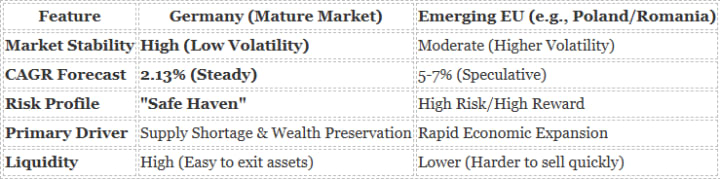
Best practices include diversifying portfolios. While high-growth markets offer excitement, Germany offers the foundation. It serves as the bond-proxy of the real estate world - reliable, regulated, and robust.
How Are Online Platforms Transforming Real Estate Sales?
The shift to Online modes (PropTech) is streamlining transactions and increasing market transparency.
The IMARC Group report notes a significant shift in the "Mode of Purchase" - from Offline to Online. The days of purely paper-based transactions are fading.
- Digital Viewings: Virtual reality (VR) tours allow international investors to inspect properties in Frankfurt without leaving New York.
- Data Transparency: Online platforms provide instant access to historical pricing, rental yields, and neighborhood demographics. This empowers buyers to make data-driven decisions.
- Efficiency: PropTech startups are digitizing the notary process and property management. This reduces the friction and cost historically associated with German real estate.
Conclusion
With a forecast to hit US$ 410.25 billion, the German real estate market remains a prime destination for patient, long-term capital.
The outlook for 2026 is one of measured optimism. The Germany real estate market is not sprinting; it is marching forward with purpose. The projected 2.13% CAGR serves as a signal of sustainability in an overheated global economy.
For the investor, the strategy is clear: focus on quality assets in prime urban locations or logistics hubs. In Germany, you are not just buying bricks and mortar; you are buying into the stability of Europe's largest economy.
About the Creator
Joey Moore
I'm Joey Moore, a seasoned Research Analyst with 5+ years of experience in market research. Expert in data analysis, strategic planning, and industry insights. Proven track record in delivering actionable reports.
Keep reading
More stories from Joey Moore and writers in Journal and other communities.
Germany Electric Vehicle Market Revenue Forecast: What Investors Need to Know in 2026
Germany acts as the undisputed automotive heart of Europe, yet the nation's transition to electrification has resembled a rollercoaster of policy shifts and industrial retooling. As we navigate through 2026, the Germany electric vehicle market stands at a critical juncture. After a tumultuous period following the removal of subsidies, the market is stabilizing, driven by a powerful combination of legacy manufacturing prowess and aggressive future government targets.
By Joey Mooreabout 4 hours ago in Journal
How to Set Your Therapy Session Rates and Fees
Introduction Setting therapy rates is strategic. Pricing affects sustainability. Fees reflect professional value. Clients notice transparency. Underpricing causes burnout. Overpricing limits access. Balance is essential. Rates must cover costs. Income must support stability. Ethics influence decisions. Market conditions matter. Confidence affects pricing. Clear structure reduces confusion. Thoughtful pricing builds trust. Financial clarity supports longevity. Rates shape practice success.
By Abdul Mueed5 days ago in Journal




Comments
There are no comments for this story
Be the first to respond and start the conversation.