
Marketing and Selling to Gen Z
The Future is at Hand!


For as long as there have been people, you'll find generations. Some no longer exist, such as the ones that started in the 1800s, called the Lost Generation to the most recent generation called Generation Alpha. However, we should look beyond the birth years to see what makes up a generation and focus on a shared common history. Each generation lives through events and conditions during their formative years in which they look at life through a lens that colors the way they look at the world. Every generation has the earliest memory, a galvanized event that altered beliefs. Many of the earliest generations no longer exist. Some of the oldest living generations, though few are from the Greatest Generation that would be my grandparents are still alive, may they rest in peace. And the Baby Boomer generation is aging and heading into retirement, leaving the running of the world's economies to Millennials, and our youngest working-age Generation Z.
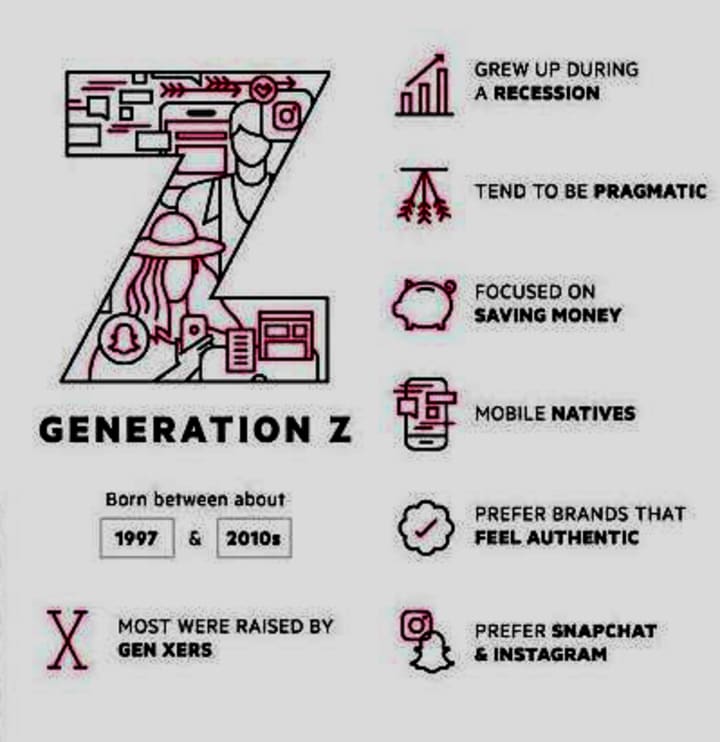
It's true then most of the business is going to Gen X and Millennials. Still, we would be foolish to ignore Gen Z because of they make up 27% of the US population and will account for 40% of all consumer markets in 2020, and are 64% of the global community. Chances are you wonder who Gen Z is and what makes them someone to respect. They were born Between 1995 in the mid-2000s, so that would put them in their teen years to early 20s. The oldest members are just graduating or entering college and getting entry-level positions—what an exponential amount of money for your business.
Gen Z'ers had a different experience growing than millennials. Millennials would hear about the newest and greatest company was created in a very unconventional way or all the great opportunities that are out there for people. For Generation Z, it was vastly different, they grew up during a recession, and they hear of companies trying to stay in business, and other things that made the world a scarier place for the youth. Gen Z also saw the first black president, they saw marijuana become legal, and social media become a powerhouse. You can also see differences in media, millennials had Harry Potter, and Gen Z had Hunger Games. A magical world of wizards vs. you lose you die world. It's been a different life for them to experience, and they view the world much differently than we do. When marketing and selling to Gen Z, we need to respect their perspectives and treat them as the individuals that they are.
The general opinion is that Gen Z does all their shopping online, A most recent survey shows that 49% prefer shopping in stores and 51% prefer online, so as we can see its nearly split right down the middle. It doesn't matter to them whether they are putting it in an actual shopping cart or a digital one; they want the experience to be the same from the website to a brick-and-mortar store. For Gen Z, it is more about the experience, because they've had the internet their whole lives; they are jaded to marketing campaigns. They will tune you out if you try to tell them how amazing specific product is; what they are interested in is how it will benefit their lives. Specifically, they want to know what experiences your product will bring them. A recent study shows that 25% of what you sell is your product; the other 75% is the intangible feeling that comes with the product. Another unique trait is, 73% percent research products online, but buy them in-store. You may want to optimize with that last-minute sale or in-store promotion on their phones; that way, you can incorporate both of their worlds.
Growing up, all I wanted to do was fit in with my friends by liking all the same things or wearing the same labels, but don't expect this group to place an equal premium on conformity. They want to be individuals and be different from their peers. Everything is about customization: from profile pictures, hashtags on social media, and captions on photos; even customize music by creating their playlists. That doesn't mean you have to go through a monumental shift to provide customization, and it can be simple changes. Coca-Cola lets you put your name on the can, Lays Chips lets you put your picture on the bag. What a fantastic opportunity for innovation and to have fun with creativity.
Gone are the days where you created one post for all the social media platforms. Gen Z plays by a separate set of rules when it comes to social media. They use each platform for a different purpose. They will use Twitter daily for news, PR, and up-to-the-minute conversations. They will use Facebook to foster brand relationships and to become familiar with various products. LinkedIn to build professional relationships. Instagram to see the highlights of people's lives. YouTube for DIY projects and entertainment. Snapchat for communication. TikTok to participate on social media, and for the possibility to create a viral following. Daily usage will vary, so it is necessary to tailor your message for each of these platforms.
With the use of social media essential to the lives of Gen Z, traditional celebrity endorsements will have little impact on having them pay you their hard-earned pennies. The people who are influencing them on their purchase are social media influencers, but they need to be able to relate to the influencer they're watching. A study found that 70% of Gen Z relate more to YouTube creators than traditional celebrities. In another study, 44% of Gen Z tried the recommendation of an influencer compared to 36% who tried a celebrity's endorsement. It is essential to hire an influencer who fits your product because the kids will see right through it.
Much to the surprise of many, Gen Z considers themselves to be more price aware than previous generations. So, if you plan to hook them by focusing on features, benefits, or cool factor, I recommend going back to the drawing board. 80% of 202 individuals between the ages of 18-29 said that price was the most crucial factor. They remember the stress that the great recession caused their parents, so by nurture Gen Z are deal hounds.
Unlike millennials, which were okay with sacrificing the quality of a product if it has a worthy cause, Gen Z expects a cause and high quality for their products. However, they require an authentic purpose, because they can pick up on fakeness quick. They aren't impressed by publicity stunts and gravitate towards ethical companies. 65% research the origins of the products they buy. For example, where a product is made, what it's made from, and how it's made. 80% said they refuse to purchase products from companies that have been involved in scandals. If, as a company, you aren't supplying these things, don't count on money from Gen Z; they'll find someone else.
Gen Z is stereotyped as having a short attention span, which is accurate because their attention span is 8 seconds, compared to that of millennials, who has an attention span of 12 seconds. That's not to say that Gen Z cannot focus. But, what it does mean is that they consume, process, and move on from information quicker than their older counterparts. If you think about it, they have been bombarded my information various sources 24 hours a day. You'll see someone from Generation Z jumping back and forth between multiple screens.
Most marketers are trying to sell Gen Z fresh products. However, there is an essential personality trait that marketers are missing when it comes to this group; they are entrepreneurs. They're all thinking about a potential side hustle. If you are interested in selling something to them, you will have to show them how it will benefit their entrepreneurial side. In a survey conducted by Northeastern University, 63% Said that they want to learn more about entrepreneurship. They may have a job that a company or a fast food place, but they're all looking for something to do on the side and make them extra money. So, it's essential to start viewing them as professionals, because that's how they see themselves. There are looking for ways To avoid financial stress.
I mentioned above that Gen Z uses YouTube for video tutorials on how to do things; that's because they were born to be able to learn whatever they wanted. Whether it's learning a new language, how to retile a bathroom, or to play an instrument. They have all the information they could need to do DIY projects at their fingertips. If you want to market to this generation, you need to let them take part in the process; whether it's uploading a selfie or sharing a campaign with a friend, Generation Z wants to be active in the process.
Here is some insight on how formidable this young generation is and will be going into the future. If done correctly, marketers will be able to harness a wealth of knowledge, talent, in financial resources to benefit companies for a very long time. I hope that we can surround ourselves with this talent to work within our companies or with employees who understand them to make the most out of this relationship.
I will write more articles in the future about Gen Z, because there is a lot more to know about them.
If you liked or found this informative, please leave a tip by clicking at the bottom.
About the Creator
Keep reading
More stories from Andres Wiest and writers in Journal and other communities.
Never Enough
Dear Essential Workers, I'm a 39-year-old man who is in a wheelchair, and I would like to thank you for everything that you are doing this time of turbulence. There are as many of you that fall under that umbrella, as there are flavors of ice cream at Baskin-Robins, but none of you is less important than the other. Much like the rest of the world, you didn't wake up one morning and think. "I want to thrust into the middle of a global pandemic and see thousands of people suffering and dying." There isn't a rationally sane person who wants to see that happen, but here we are. It doesn't seem that it will be going away anytime soon, as much as we all would like to. The rest of us are missing our regular routines of going to our jobs and interacting with our buddies or going out to dinner with our significant other. This pales in comparison to what you wake up to each morning to do for our unknown faces.
By Andres Wiest6 years ago in Journal



Comments
There are no comments for this story
Be the first to respond and start the conversation.