
L'Âge d'Or
Luis Buñuel and Salvador Dali, 1930.

The final desecration of the Golden Age is exemplified by the hundred and twenty murderous passions of the Marquis de Sade — a feast of flesh and sacrilege, out of which a dazed, uncomprehending Christ figure staggers, emerging from the dark, gaping mouth of a cave-like keep. Here, the promise of salvation has been fouled by the delirium of the senses; the sacred and the profane collapse into one.
There is no way to quantify such a film. It does not proceed from a place of reason or logic but unspools symbolically before the viewer, like smoke rising from an unseen censer. Not, as it were, with the rude, shocking juxtapositions of Un Chien Andalou — Buñuel and Dalí’s earlier foray into absurdist provocation, a savage internal dialogue bursting into the external world — but with a more subtle, continuous flow, like the strains of a music that only the dreaming mind can conceive. Here, the images do not rupture but bleed into one another, mutating with a terrible, lyric grace, as if one were wandering through a landscape where the boundaries of dream and matter had collapsed, where symbol had become substance and substance had dissolved into longing.
Earlier, violence was mirrored in the stinging courtship of scorpions — creatures whose love is indistinguishable from their will to kill. Love, death, pain, and war collide there, not as human inventions but as ancient biological compulsions, encoded into the rhythm of life itself. The scorpion does not know it mocks our illusions; it simply fulfills its nature, stinging blindly even as it embraces.
Then, we are granted a vision of the common men — peasant stock, proletariat rabble, the crumbling human bedrock upon which all civilizations trample. One squats on a barren cliffside, gazing out at the bizarre dream-pageant of Catholic bishops solemnly parading, their intonations heavy with ritual, their gravity absurd against the landscape’s ancient indifference. Their robes trail in the dust; their chants float up like smoke, insubstantial against the impassive stones.
This is the Golden Age: a pageant of masks, a ceremony offered not to the heavens, but to emptiness. The Golden Age is a myth spun out of rot, draped in gold leaf to disguise the stench of its decay.
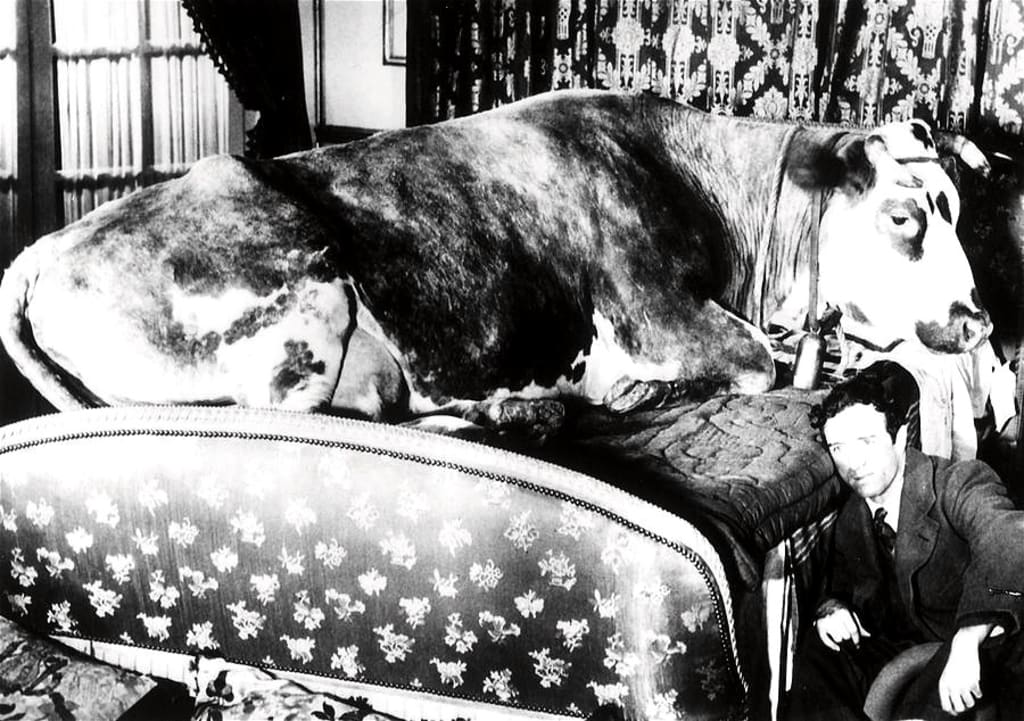
The weighted solemnity of communication gives way to a ribald surrealism that stains the barren landscape of the mind with lurid flashes of absurdity. A cow rests atop a bed — the sacred cow, of course, domesticated and desecrated, a silent witness to the farce. In this deranged domestic scene, the bed is no longer a place of rest or union but an altar of absurdity, where love and passion are punctuated by interruption, by regret, by the sour aftertaste of thwarted consummation.
A flaming tree is hurled from the high windows of a crumbling estate, followed closely by a bishop and his obscure arcana — and perhaps, absurdly, by the statue of a giraffe. It is a cavalcade of icons destroyed without fanfare, as if the world itself were emptying out its attic in a fit of divine madness, expelling all that was once revered.
A man who dared to love finds his eyes bleeding profusely, a living martyr to the crime of human tenderness. Meanwhile, a woman, who earlier gazed into the invisible vibrations of an occult orchestra, is seen sucking hungrily upon the marble toe of a statue — confusing stone for flesh, ritual for passion, dream for reality. Her gesture is both obscene and holy: a sacrament of misplaced longing.
Here, sex and bourgeois sentiment collide violently, their wreckage strewn across the terrain of the forbidden. Desire, magnetic and inexorable, draws to itself the forces of repression: the sweet, plaintive singing of caged canaries dubbed over the lovers’ furtive grappling, as if to remind us that even two birds in a gilded cage are prisoners — as much to their own hunger as to the hands that built the bars. No escape is possible; no purity remains. Only the aching persistence of life itself, straining against the architecture of its own captivity.
Bourgeois conventions are revealed in all their paltry, arid absurdity — reflections on the sonic projections of an orchestra are as banal, as meaningless, as the orgiastic excesses of an unseen band of debauched libertines, presided over by a dazed, indifferent Christ. All becomes a pageant of constraint: repressed passions, painted over with the thin veneer of decorum, seep through the cracks and emerge as inscrutable images, visions torn directly from the dreaming mind. Here, in the not-glittering surface of the so-called Golden Age, they are given birth — mute, radiant, monstrous.
L'Age D'or (1930) (HD) (Clean Subtitles)
Connect with me on Facebook
My book: Cult films and Midnight Movies: From High Art to Low Trash Volume 1
Ebook
About the Creator
Tom Baker
Author of Haunted Indianapolis, Indiana Ghost Folklore, Midwest Maniacs, Midwest UFOs and Beyond, Scary Urban Legends, 50 Famous Fables and Folk Tales, and Notorious Crimes of the Upper Midwest.: http://tombakerbooks.weebly.com
The goals I did not achieve
Every writing goal I made for the year is a wash. It has been this way for a while, but I think it's important to be open about my failures and the reality of how life can get in the way. This is especially true considering the several times I have posted on Vocal about my writing goals, how I was changing my approach, and where I was hoping to be for the upcoming year. I will probably do that again in a couple months, but for now, it is time to acknowledge where I am today.
By Kay Husnick25 days ago in Journal
The ChatGPT Tell-All: I Fixed The 5 Mistakes That Made My Content Sound Fake
How I Stopped Sounding Like a Robot and Saved My Blog (And The 5 Mistakes That Gave Me Away) Let me be brutally honest with you for a second. There was a time last year when I was pretty proud of myself. My content calendar was packed, posts were going up like clockwork, and I felt like I’d finally cracked the code. I had this new, incredible tool—you know the one—and it was like a superpower. Suddenly, the blank page wasn’t scary anymore. I’d hit a button, and poof, a perfectly competent, grammatically pristine article would appear.
By John Arthor4 days ago in Journal



Comments (2)
Interesting, to say the least.
Saw it at a gallery a couple of years ago. No one blinked. It seems we can adapt to almost any unpleasant truth.