

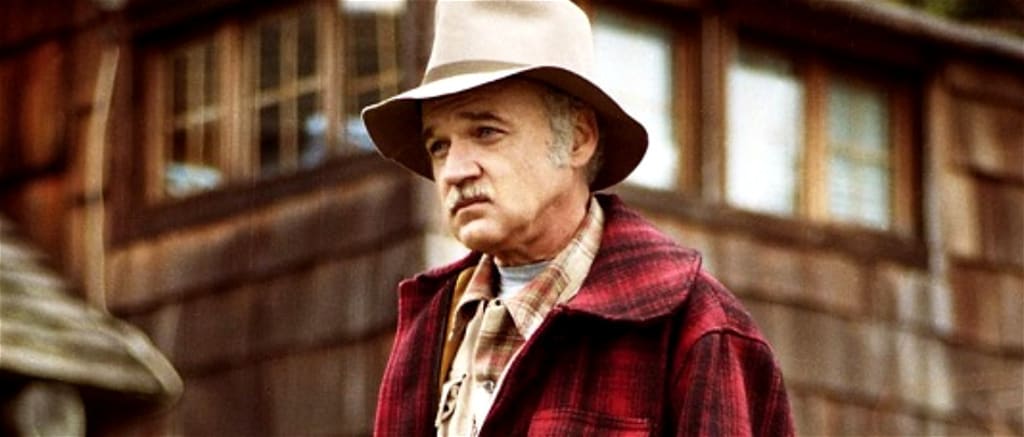
Jack Nance stood listening to the rain pound against the windowpane. On the phone, down miles and miles of line, his wife, adult film actress Kelly Van Dyke, was sobbing hysterically that if Jack left her, she would kill herself. "Jack," she said, "if you hang up this phone, I'm going to kill myself," she threatened. Just then, the phone line, due to the storm, went dead.
Nance quickly went to the bungalow of his director on the film he was shooting, Meatballs 4, Bob Logan, and told him, "Bob, I think my wife may have just killed herself." Logan and Nance headed to the local sheriff's office, where the officer on duty picked up the phone, dialed, and began to shake his head sadly.
"Jack, she didn't make it, Jack."
Such tragedies were the shadows cast across the life of actor Jack Nance, who most famously portrayed Henry Spencer in David Lynch's 1977 cult classic avant-garde horror film Eraserhead, a film that saw one image of him—his hugely-coiffed head floating against a backdrop of "pencil eraser dust" with a transcendent, virtually hypnotic otherworldly gaze—become a cultural icon. Before the days of easily accessible internet streaming, Eraserhead was a much sought-after, coveted videocassette find for the cult film enthusiast. Now we assume everyone that ever wanted to see it has, and can draw their own conclusions.
Jack Nance is remembered in this video documentary of his life from 2002 by friends, colleagues, and David Lynch himself, the man who helped propel Nance into stardom and who fondly remembers the eccentricities and foibles that marked the very strange and difficult actor's brief span. Also appearing are actors such as Wayne Grace, ex-wife Catherine Coulson, Charlotte Stewart, Catherine Case, and "Frankie" Phipps-Wilson, with whom Jack starred in Eraserhead and also the "Doo Dah Gang," a performance art theater troupe in which he portrayed Prohibition Era gangster "Tony Rebozo." (Jack also portrayed his brother.)
Jack's brothers appear here, recounting his brief moments of clarity and good fortune, as well as the depths of drunkenness and substance abuse that would create for him a tortured path in the backwaters of film production, often relegating him to roles in films that seem straight from the dustbin. His brief sojourn on Twin Peaks as "Pete Martell" buoyed him for a brief space before his death. Dennis Hopper, who appears here as an interviewee, probably extended Nance's life by ten years, helping him into an actor's rehab.
Nance, alas, let the demons that drove him—his sense of being the eternal "outsider," what actor Wayne Grace describes as the "mad man" (mad as in gifted with unpredictable, unstable genius)—take hold. He once shot out a television screen in his favorite hotel room because he couldn't stand Sam Donaldson. Actress Charlotte Stewart opines that Jack, whose—at the very least—strange death after an altercation with two suspects never apprehended while walking home from a doughnut shop, would have "loved the fact that his death was ruled an 'unsolved homicide'." She perfectly imitates Nance saying this, and it sticks in the viewer's mind as the final culmination of this strange, troubled life.
Nance's final scene is no stranger than his beginning, and his life will forever be associated with Henry Spencer, the protagonist in Eraserhead who lived trapped inside the clanking, grinding, hissing, and repellent world born in the subconscious of director David Lynch. After viewing I Don’t Know Jack, you may be no closer to knowing him than before. Some figures walk through the shadows of the world—a world they didn't make—until, as in the opening music sung by Brantley Kearns, the "Sweet Chariot" comes for them, carrying them, if not to Heaven where, (in the words of murdered musician Peter Ivers who sang the song in Eraserhead), "Everything is fine," at least to the place wherein they are finally a part of the Universal One. For Jack Nance, whose long shadow was still longer than anyone ever knew, it's a rest well deserved.
I Don't Know Jack (2002)
Connect with me on Facebook
My book: Cult Films and Midnight Movies: From High Art to Low Trash Volume 1
Ebook
About the Creator
Tom Baker
Author of Haunted Indianapolis, Indiana Ghost Folklore, Midwest Maniacs, Midwest UFOs and Beyond, Scary Urban Legends, 50 Famous Fables and Folk Tales, and Notorious Crimes of the Upper Midwest.: http://tombakerbooks.weebly.com
How Much Funding You’ll Need for a Community Mental Health Clinic
Introduction Funding determines clinic viability. Community clinics require strong planning. Startup costs can be significant. Ongoing expenses must be covered. Financial preparation reduces risk. Services depend on stable cash flow. Community demand is growing. Access requires resources. Facilities need proper equipment. Staff require fair compensation. Compliance adds cost. Sustainable funding supports care. Budgeting ensures continuity. Financial clarity supports confidence. Underfunding creates failure. Preparation protects mission. Planning supports long-term success. Funding drives service delivery.
By Abdul Mueeda day ago in Journal
Smart phones, Humans and Aliens.
WARNING. I will be tapping into one of your favorite creative tensions: The absurdity of humans worshipping their glowing rectangles as if they were tiny oracles. There’s something deliciously poetic about that contradiction, and it lends itself beautifully to an instructive proviso.
By Novel Allen4 days ago in Poets


Comments (1)
Lol, I just finished watching a 2-hour silent film to which you "assigned" me which I noted I'm going to have to watch again because I didn't pay close enough attention, now you give me another hour & a half where you tell me I'm likely not to understand Jack Nance any better than I did before after it. Still, it sounds interesting, so I suppose I'll leave this one up for me to come back to as well, lol.