
The ChatGPT Tell-All: I Fixed The 5 Mistakes That Made My Content Sound Fake
(And How You Can Too)


How I Stopped Sounding Like a Robot and Saved My Blog (And The 5 Mistakes That Gave Me Away)
Let me be brutally honest with you for a second. There was a time last year when I was pretty proud of myself. My content calendar was packed, posts were going up like clockwork, and I felt like I’d finally cracked the code. I had this new, incredible tool—you know the one—and it was like a superpower. Suddenly, the blank page wasn’t scary anymore. I’d hit a button, and poof, a perfectly competent, grammatically pristine article would appear.
But then, the comments started to change.
Instead of “Great point!” or “This helped me so much,” I’d get things like, “Did you use AI for this?” or the more subtle, “Interesting… feels a bit generic.” My engagement started to dip. Shares dropped. The connection I’d worked so hard to build with my readers felt like it was turning into a transaction. They were getting info, but they weren’t getting me. They were getting the vibe of a polished, yet utterly forgettable, corporate manual.
It hit me hardest when my most loyal reader, Sarah, who’d been with me since day one, emailed me. She said, “Hey, love your stuff, but lately it feels… different. Is everything okay? It just doesn’t sound like you anymore.”
Ouch. That was my wake-up call. I wasn’t fooling anyone. In my rush to scale, I’d outsourced my voice, my personality—my soul. I was letting everyone know I was using ChatGPT, and it was bleeding my credibility dry.
So, I went on a mission. I became a detective of my own content, comparing the old, connected posts that built my audience to the new, “efficient” ones that were losing it. And I found the patterns—the dead giveaways. Once I saw them, I couldn’t unsee them. Here they are: the 5 obvious ways everyone knows you’re using ChatGPT, and more importantly, how I fixed every single one.
1. The Tyranny of Perfect, Empty Prose (Or, The “Flawless Yet Forgettable” Syndrome)
This was my biggest sin. ChatGPT’s default setting is formal, structured, and risk-averse. It writes like a star student trying to impress a stern professor, not like a human talking to another human.
The Tell: The writing is technically perfect but utterly devoid of personality. It uses phrases like “In today’s rapidly evolving digital landscape,” or “It is important to note that…” Sentences are uniformly structured. Paragraphs are neat, tidy blocks. There’s no flow, no rhythm, no sudden short sentence for impact. It’s a flatline of professionalism.
My “Duh” Moment: I re-read one of my AI-drafted posts out loud. It sounded like a Wikipedia entry being read by a slightly bored news anchor. Then I read an old post of mine from years ago. I had used a sentence fragment. For effect. I’d started a paragraph with “And.” I’d used slang I’d never dare put in a resume. It had pulse.
The Fix: I started treating the AI output as a first draft—a clay draft. I now command it: “Write this in the tone of a savvy friend explaining something over coffee. Use contractions. Be conversational. Assume the reader is smart but busy.” Then, I do the Read-Aloud Edit. If I stumble over a sentence because it’s too winding, I break it. If a paragraph feels like a wall of text, I inject a one-liner. I add my own verbal tics—the “look,” the “here’s the thing,” the “trust me on this.” Imperfection is human.
2. The “Comprehensive Yet Curiously Vague” List
ChatGPT loves to be thorough. Ask it for five ways to do something, and it will give you seven, each with a sub-point. But the devil isn’t in the details here; it’s in the lack of them.
The Tell: The advice is 100% accurate and 0% actionable. It stays safely in the realm of the theoretical. You’ll get points like “Optimize your website for search engines,” or “Leverage social media to build community.” Thanks, I’m cured. It’s all platitude, no proof. There are no brand names, no specific tools, no “here’s exactly where that button is,” no messy real-world anecdotes of trying and failing.
My “Duh” Moment: A reader emailed asking for clarification on one of my AI-assisted “guides.” They said, “You said to use a good keyword tool… which one do you actually use? And how much does it cost?” The AI draft had carefully avoided any hint of endorsement or specificity to appear “unbiased.” It was so sterile it was useless.
The Fix: I now force-feed the AI context. Instead of “Write a section on email marketing tips,” I write, “Write a section on email marketing tips for a small pottery business. I use ConvertKit. Mention the ‘Visual Automations’ feature and how I set up a welcome sequence for people who download my glaze recipe PDF. Reference the subject line that got a 45% open rate: ‘Your free recipe & a question about clay.’” Then, I layer in my own story: “The first sequence I built was a disaster. I sent five emails in three days and got three unsubscribes. Here’s what I learned…”
3. The Echo Chamber of Predictable Structure
This one is subtle but deadly. ChatGPT has a blueprint it follows, a mental model for organizing information. Once you see it, you see it everywhere.
The Tell: Every article feels like it’s built from the same template. A broad introduction stating the importance of the topic. A “In this article, we will explore…” preamble. Points broken down with identical H2 and H3 structures. A conclusion that neatly summarizes everything already said. It’s logical, but it’s also boring and formulaic. There’s no surprise, no narrative twist, no “I’m going to start in the middle of the story.”
My “Duh” Moment: I scrolled through my own blog homepage. Six posts in a row all had the same skeletal structure. Intro, 5 points, conclusion. It was a content factory assembly line. My favorite writers online? They’d start with a personal failure. Or a dialogue. Or a controversial take. They led with the hook, not the framework.
The Fix: I start in the middle of the action. Now, I might open a post with: “The notification popped up on my screen, and my stomach dropped. Another 1-star review: ‘Tutorial was confusing.’ That review, which felt like a punch at the time, completely changed how I write my guides. Let me show you.” I use structure as a servant, not a master. Sometimes the “key takeaway” is bolded in the middle. Sometimes I end with a question instead of a summary. I break the template to regain attention.
4. The Personality Vacuum (No Opinions, No Heat)
AI is engineered to be neutral. It avoids controversy, strong opinions, and anything that might alienate a theoretical segment of the audience. It aims for the harmonious average.
The Tell: The content has no spine. It never says “This method is outdated,” or “Most people get this wrong,” or “I personally can’t stand this tool because…” It presents all sides with equal, bland weight. There’s no taste, no bias, no unique perspective. It’s information without a point of view.
My “Duh” Moment: I wrote a post on “Best Project Management Tools.” The AI dutifully listed Trello, Asana, ClickUp, etc., with generic pros and cons. A comment read: “So, which one is actually best?” I hadn’t answered the real question. I was too scared to pick a favorite, to have a reason, to potentially be wrong. My readers didn’t want a dictionary; they wanted a guide.
The Fix: I inject “red pepper” sentences. After I generate a neutral base, I go through and add my hot takes. “Let’s be real, Asana’s interface can feel clunky if you’re coming from Trello.” “I know everyone raves about Notion, but for quick task capture, it slows me down.” “Here’s the unpopular opinion: sometimes, a simple spreadsheet is the best tool.” This doesn’t mean being contrarian for its own sake. It means having the courage to be a filter, not just a funnel.
5. The “Uncanny Valley” of Examples & Stories
When ChatGPT creates an example or a story, it’s often just a little bit off. It’s like a movie set facade—convincing from a distance, but hollow up close.
The Tell: Examples are hyper-generic. “Imagine a business owner named John who wants to increase sales…” “For example, a blog post about gardening might discuss soil quality…” They lack the granular, telling details of real life. The names are bland (John, Sarah, ABC Corp.). The scenarios are frictionless and idealized. There’s no smell, no weather, no interrupted train of thought, no specific brand of coffee spilled on the keyboard.
My “Duh” Moment: I caught myself leaving in an AI-generated example about a “fitness influencer.” It was so plastic and perfect it felt like a parody. My real life? It’s me, in my home office, with my dog barking at the delivery guy, trying to squeeze in a workout with a 7-year-old yoga app. That’s real.
The Fix: I replace every generic example with a specific memory. I delete “a business owner” and write about “my friend Liam who runs the local microbrewery and his nightmare with inventory spreadsheets.” I swap “a helpful tool” for “the game-changing Zapier zap I built that saves me three hours every Monday.” Real details are the fingerprints of authenticity. They can’t be faked.
My New Blueprint: Human-First, AI-Assisted
The shift wasn’t about abandoning the tool. That would be silly. It was about changing the power dynamic. I stopped letting ChatGPT write for me and started commanding it to write with me.
My new process looks like this:
- I Brainstorm & Outline (Me, a notebook, messy arrows). I define the core idea, the pain point, the story arc.
- I Brief the AI Like a Junior Writer (Very specific prompts). “Write a 300-word section expanding on point #2. Use the analogy of building a Lego set. Mention the frustration of missing pieces. Keep it casual.”
- I Rewrite, Don’t Just Edit (This is the non-negotiable step). I take that clay draft and sculpt it with my voice. I add the anecdotes, the opinions, the shaky metaphors that are uniquely mine. I read it aloud until it sounds like me talking.
- I Add the “Signature Sauce” (The final layer). This is the curated tool list, the photos of my actual workspace, the links to my exact resources, the personal blooper or failure story.
The result? My traffic didn’t just recover; it grew. My email list started moving again. Comments returned to “This felt like you were reading my mind!” The connection was back.
So, if you’re feeling that creeping worry that your content is starting to sound a bit too… smooth, a bit too generic, I’m telling you: your readers already know. They sense it. But the good news is, the fix is entirely in your hands. Use the tool, but don’t let it use you. Your voice, your stories, your messy, opinionated, specific humanity—that’s your only real competitive advantage. Don’t trade it for a pile of perfectly bland words.
Start today. Pick your last AI-drafted post and read it aloud. Then, tell me it sounds like you. I dare you.
About the Creator
John Arthor
seasoned researcher and AI specialist with a proven track record of success in natural language processing & machine learning. With a deep understanding of cutting-edge AI technologies.
Keep reading
More stories from John Arthor and writers in Journal and other communities.
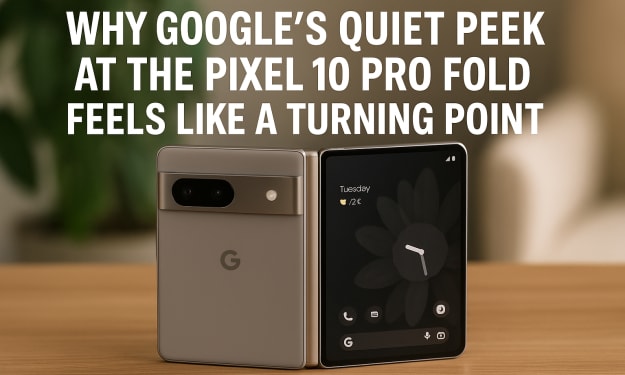
The Pixel Unfolds: Why Google's Quiet Peek at the Pixel 10 Pro Fold Feels Like a Turning Point
You know that feeling? When you’re scrolling through your usual tech haunts, maybe half-watching a video, half-thinking about dinner, and then – BAM – something stops you cold. Your thumb freezes mid-swipe. That happened to me yesterday. Right there, nestled between the usual rumors and reviews, Google posts an official look at the Pixel 10 Pro Fold.
By John Arthor5 months ago in Journal
The goals I did not achieve
Every writing goal I made for the year is a wash. It has been this way for a while, but I think it's important to be open about my failures and the reality of how life can get in the way. This is especially true considering the several times I have posted on Vocal about my writing goals, how I was changing my approach, and where I was hoping to be for the upcoming year. I will probably do that again in a couple months, but for now, it is time to acknowledge where I am today.
By Kay Husnick24 days ago in Journal
The Future of Work in the Age of AI
AI changed the workforce faster than any other technology. Artificial intelligence has become such a big part of our daily lives that most of us don’t even realize it. But what happens when AI comes into your work? Companies are investing in AI right now because it’s cheap to operate and runs nonstop.
By Mark Arthurabout 13 hours ago in Journal



Comments
There are no comments for this story
Be the first to respond and start the conversation.