
Industry Reimagined: The Billion-Dollar Smart Manufacturing Market
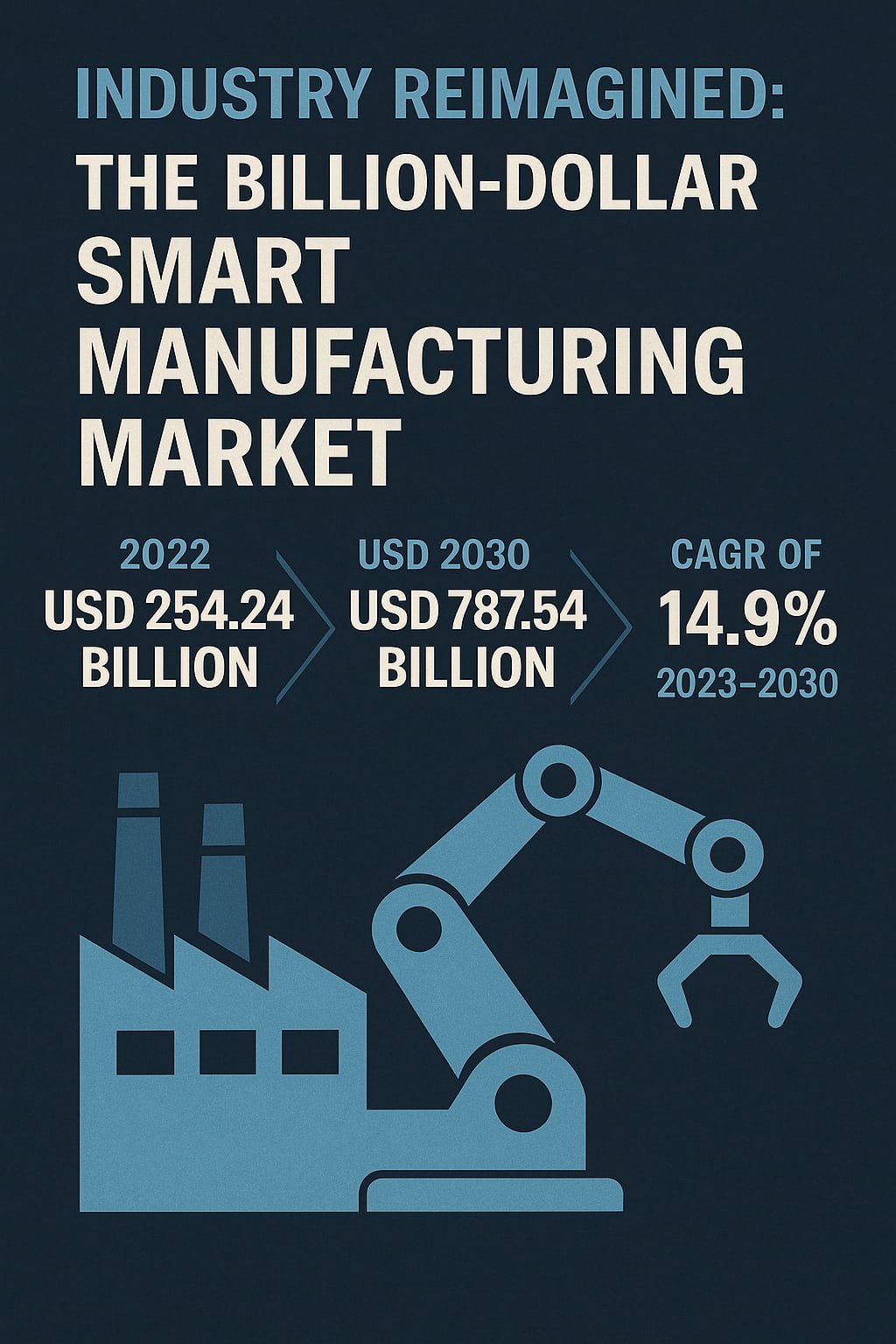
The smart manufacturing market is set to grow at a compound annual growth rate (CAGR) of 14.9% from 2024 to 2030, building on its 2023 valuation of USD 297.20 billion.

The manufacturing industry has traditionally supported the world's economic structure yet it's experiencing deep systemic changes. Smart manufacturing represents an industry revolution where automation, data analytics and artificial intelligence together transform the production, distribution and enhancement of products.
The Scale of the Smart Manufacturing Revolution
The smart manufacturing market displays swift growth with 2023 values exceeding USD 297.20 billion and a projection to exceed USD 787.54 billion by 2030. Manufacturers are demanding greater efficiency and adaptability along with resilient operations to navigate supply chain challenges and fulfill higher customer expectations.
Smart Manufacturing Market - Recent Developments
Honeywell International, Inc. completed its acquisition of Compressor Controls Corporation (CCC), a turbomachinery control and optimization solutions provider, for USD 670 million in April 2023. This acquisition will enhance their capabilities in automation and industrial control solutions along with process solutions. The current progress in development will drive exponential industry growth throughout the upcoming years.
ABB plans to spend USD 170 million in April 2023 to establish skilled positions in manufacturing, innovation, and distribution operations within the U.S. market. The investment will stimulate market demand for products related to electrification and automation.
Robert Bosch GmbH formed a partnership with Rhenus Automotive and REMONDIS subsidiary TSR Recycling to create Europe's first fully automated battery-discharging facility in April 2023. This new plant will operate as a completely automated facility to disassemble battery modules and discharge them for further industry growth.
Schneider Electric established a high-tech training partnership with ArcelorMittal Nippon Steel India on smart manufacturing in June 2023. Schneider Electric will develop smart labs and training labs for NAMTECH as part of an education initiative by AM/NS India.
Rockwell Automation Inc. partnered with autonox Robotics in May 2023 to broaden and develop robot mechanics. The collaboration between Rockwell and autonox Robotics will introduce Kinetix motors and drives alongside autonox's robot mechanics to enable new manufacturing capabilities.
Mitsubishi Electric Corporation released updates to their software iQ Works2 and RT Toolbox3 in March 2022. The latest software update includes a new visual editor that supports SCADA and six-axis industrial robot programming. The upgraded software delivers enhanced user-friendliness that should make it easier to establish automated applications.
From Traditional to Smart: What’s Changing?
Smart manufacturing unifies advanced technologies throughout every production phase.
Connected Devices and IoT systems gather immediate data from machines and operational processes.
Artificial Intelligence and Machine Learning enhance operations while predicting maintenance requirements and improving quality control measures.
The use of robotics and automation technology leads to decreased manual work requirements while improving operational accuracy.
Digital Twins provide simulation capabilities for production lines which enhance planning and troubleshooting processes.
Factories achieve exceptional flexibility and intelligence through this transformation which changes reactive processes into hubs that focus on proactive decision-making.
Driving Forces Behind Market Growth
Several key trends are accelerating adoption:
• Demand for Customization: The need for personalized products from consumers is driving manufacturers to develop production systems that can adjust and adapt as needed.
• Sustainability Goals: Smart systems enable significant reductions in both waste generation and energy use.
• Supply Chain Resilience: Real-time monitoring and automation mitigate disruptions.
• Government Initiatives: Worldwide promotion of Industry 4.0 technologies occurs through government incentives and funding programs.
Global Hotspots for Smart Manufacturing
• Asia-Pacific: Strong manufacturing foundations in China, Japan, and South Korea leads to the highest adoption rates.
• North America and Europe: North American and European regions prioritize high-tech industry areas including automotive manufacturing as well as aerospace and electronics production.
• Emerging Markets: Growing financial commitments indicate that smart factories are becoming more widespread.
Challenges and Opportunities
Despite its vast potential market opportunities several challenges persist.
• High Initial Investment: Deploying smart technologies requires significant capital.
• Skills Gap: The job market requires professionals who possess skills in data analytics and automation technologies.
• Cybersecurity: Increasing connectivity raises vulnerabilities.
Companies which overcome these obstacles can achieve competitive advantages by improving efficiency and innovation while accelerating time-to-market.
The Future Factory
The smart manufacturing market involves more than technological advancements since it requires a complete rethinking of the entire industry structure. Tomorrow's factories will operate with seamless connectivity while being sustainable and customer-focused through the use of data insights and robotic collaboration.
About the Creator
Silvie Karson
Passionate storyteller exploring the world of trends. With a background in digital marketing, I craft compelling narratives that inform and inspire. Whether diving into deep-dive features, growth analysis, or trend analysis.
Keep reading
More stories from Silvie Karson and writers in Journal and other communities.
Function to Fashion: The Footwear Market’s Big Transformation
The simple shoe has developed into a significant fashion symbol while becoming a rapidly expanding worldwide industry. The contemporary footwear market goes beyond protection and comfort to integrate style and innovation with sustainability to achieve global growth that is unparalleled.
By Silvie Karson8 months ago in Journal



Comments
There are no comments for this story
Be the first to respond and start the conversation.