
Nepal: the rise of screens
On 10 September 2025, Nepal's youth surprised the entire world by turning social media into weapons of protest. A look back at an unprecedented mobilisation.
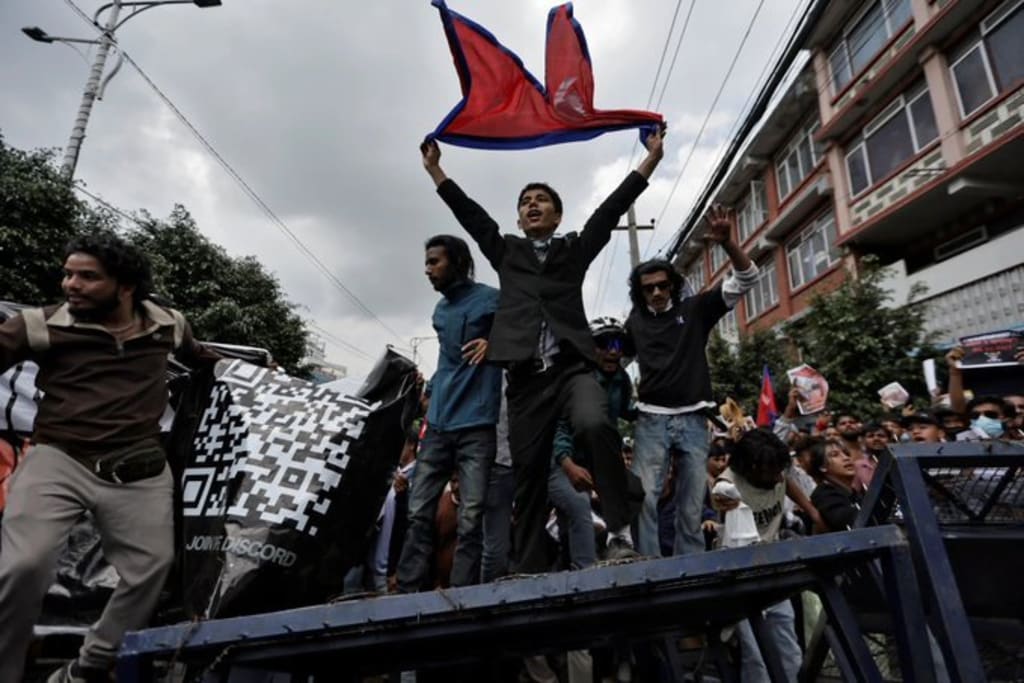
Kathmandu, September 2025.
In just a few days, Nepal moved from digital effervescence to an explosion in the streets. The youth-led revolt that forced Prime Minister KP Sharma Oli to resign revealed a paradox. In a country still marked by poverty and inequality, it was mobile phones, social networks, and digital tools that ignited the flame of protest.
Social Media as Catalysts
For Nepal’s Generation Z, born into a world of screens, social media has become an extension of the public sphere. In 2025, these platforms served as amplifiers of anger. Facebook, Instagram, WhatsApp, X, YouTube, and even LinkedIn were used not only to share images and testimonies, but also to coordinate rallies and expose elites.
The hashtags #NepoBaby and #NepoKid crystallized public outrage. They denounced the privileges of politicians’ children, flaunting Rolex watches and Louis Vuitton shoes while most of the country struggles to meet basic needs. These posts spread through viral videos and montages contrasting a gilded youth with extreme poverty. The social divide thus became visible to all, and the protest took on a nationwide dimension.
In a globalized world, virality quickly crosses borders. Videos of the demonstrations spread far beyond Kathmandu, giving the movement international visibility and placing the government under intense scrutiny.
Censorship as a Trigger
The government attempted to regain control. By banning 26 major platforms, including Facebook, Instagram, WhatsApp, X, YouTube, Telegram, Reddit, and Discord, it hoped to suffocate the protest. Instead, the decision had the opposite effect. It was perceived as a direct attack on freedom of expression. As the British thinker Edmund Burke wrote in the eighteenth century, “General rebellions and uprisings of an entire people are never encouraged, neither today nor in the past. They are always provoked.”
By trying to silence the digital street, the authorities instead unleashed the physical one. Protests hardened, and police repression helped transform virtual anger into a very real insurrection.
Digital Alternatives
Deprived of their favorite platforms, protesters found other paths. VPN usage skyrocketed, with an eight-thousand-percent increase in ProtonVPN sign-ups within days. These tools allow users to mask their IP addresses, bypass geographic restrictions, and access censored applications.
Nepali youth went even further, turning to obfuscated VPNs such as Psiphon, designed to function under advanced censorship. Psiphon combines VPN technology, SSH tunnels, and proxy servers, making detection more difficult. Free and open source, it was created specifically to assist internet users living under repressive regimes.
At the same time, a new application emerged. Bitchat is an offline messaging service operating via Bluetooth mesh networks, without the Internet or central servers. Recently developed, it saw explosive adoption in Nepal on September 8, 2025, with nearly forty-eight thousand eight hundred downloads in a single day. Already tested in Indonesia during protests, the app became a symbol of the adaptability of social movements. In the event of an Internet shutdown, it offers a vital fallback to maintain communication and coordination.
Surviving Platforms: TikTok and Viber
Not all platforms were blocked. TikTok and Viber, having agreed to comply with local registration requirements imposed by the authorities, remained accessible. As a result, these two services became the digital lungs of the protest.
TikTok was used to disseminate political messages through short videos, particularly those comparing luxury and poverty or using memes to ridicule those in power. Viber, more discreet but extremely popular in Nepal, offered a coordination space through its group chats. The government’s decision to spare these platforms backfired. They became essential vectors of mobilization.
Pop Culture and Symbols of Resistance
The 2025 Nepali revolt was not only digital. It was also cultural. The flag of the Straw Hat Pirates from the manga One Piece emerged as a symbol of resistance. In this context, global pop culture fused with local struggle, offering a shared identity to young protesters.
Social networks thus played a dual role. They were technical tools of communication, but also symbolic glue. Memes, hashtags, and cultural references gave the movement a soul, making the struggle accessible and appealing to a generation accustomed to coding its identity online.
The Live Humiliation of Elites
Anger did not express itself solely through hashtags. It took on a brutal and spectacular dimension, documented in real time by protesters’ smartphones. Videos circulating online showed the Finance Minister stripped of his clothes and chased into a river by an enraged crowd. Former Prime Minister Sher Bahadur Deuba and his wife, the current Foreign Minister Arju Deuba Rana, were beaten in the street.
Even more shocking images spread. The wife of a former prime minister, trapped in a burning house, died from her injuries. The presidential palace itself was stormed and set on fire, and several ministers were beaten under the watchful eyes of cameras. Facing this spiral of violence, Nepal’s president announced his resignation, following the fall of the prime minister.
Widely shared online, these scenes fueled a sense of social revenge. They revealed the depth of hatred accumulated against a political class accused of corruption and nepotism, while illustrating the power of digital virality. The humiliation of elites became a collective spectacle, accessible to millions.
The Mobile Phone, Weapon of the Weak
In a country where access to technology remains unequal, the mobile phone became the weapon of the weak. Cheap and ubiquitous, it allows users to film, broadcast, share, and alert. In the Nepali revolt, every protester became a potential citizen journalist, capable of documenting repression or exposing corruption.
This ubiquity made it harder to conceal state violence. Videos circulating on TikTok or via VPNs crossed borders, picked up by foreign media, and shed light on the deaths and injuries in Kathmandu’s streets.
The Lost Gamble of Censorship
As the thinker John Viscount Morley once observed, “You have not converted a man because you have silenced him.” Silencing a voice does not extinguish its idea. On the contrary, it makes it more stubborn, more underground, and sometimes more dangerous for those attempting to muzzle it.
The Nepali revolt is a modern illustration of this principle. By blocking social networks, the government triggered a boomerang effect. Instead of smothering the movement, it gave it new momentum.
Global Stakes
Beyond Nepal, the 2025 revolt raises questions about the future of digital freedom of expression. Social networks have become powerful political instruments. They can serve as tools of control in the hands of states, but also as instruments of liberation for peoples.
Disinformation and algorithmic manipulation blur public debate and weaken collective trust. Legal frameworks such as the Digital Services Act in Europe or the Online Safety Act in the United Kingdom aim to regulate content but risk triggering over-moderation that stifles legitimate voices as a precaution. Online harassment, meanwhile, pushes many individuals into self-censorship.
In this context, the Nepali revolt acts as a warning. It reminds us that social networks are not mere tools of distraction, but political battlefields. They can liberate speech as easily as they can silence it. They can amplify democracy as much as they can weaken it. More than ever, the defense of online freedom of expression is a global issue, because the revolts of the twenty-first century will also be fought on our screens.
Ted Gray / Redline Media
About the Creator
Keep reading
More stories from writers in Journal and other communities.
The Rise of Electric Aircraft in Business Aviation: A Sustainable Future
The aviation industry has long been known for its significant environmental impact, with business aviation contributing to a large share of emissions from private aircraft. However, as sustainability becomes a more pressing issue, the business aviation sector is looking to electric aircraft as a potential solution. With advancements in electric propulsion systems, blockchain and battery technology, electric aircraft are poised to revolutionize business aviation, offering a cleaner, more efficient alternative to traditional jet fuel-powered aircraft. In this blog, we will explore the rise of electric aircraft in business aviation and how they promise to shape a more sustainable future.
By Beckett Dowhanabout 22 hours ago in Journal
Violence Begets
"Any last words, cowboy?" "None you'd understand, sodbuster." "Funny. That's Marshall Sodbuster to you. But I meant some last nugget that would help us in the adjudication of the myriad offenses counted against you and your gang. I wasn't asking for penitence."
By Adam Diehl6 days ago in Fiction




Comments
There are no comments for this story
Be the first to respond and start the conversation.