
How to Stop Russia Using Starlink to Control Deadly Drones Against Ukraine
Musk's satellite tech, once a saviour for Ukraine, is now enabling Russian long range strikes. Countermeasures such as speed caps and whitelisting might be the answer

This morning I read that Musk’s SpaceX has applied for a licence to increase the number of Starlink satellites to 1 million. I reacted rather strongly. There’s already too much junk in orbit. When I’m at sea the night sky is already spoiled just after sundown by strings of Starlink satellites. Yes, I’m becoming old and curmudgeonly, but now Musk’s expanding constellation is helping Russia murder Ukrainian citizens.
This week there was a precision drone strike on a civilian passenger train in Kharkhiv, killing at least four people.
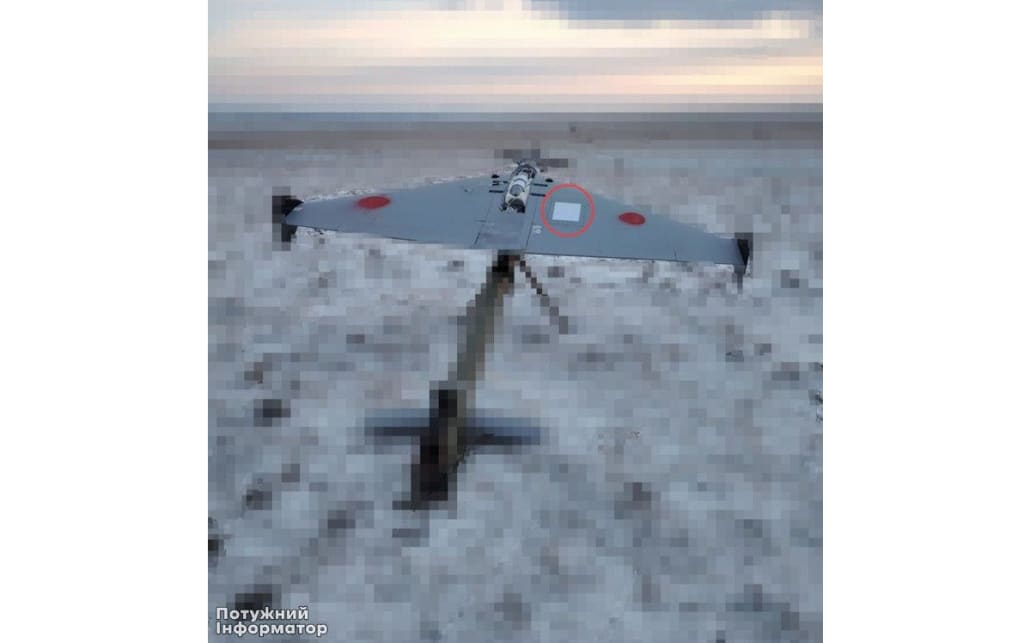
Starlink terminals are now installed on Russian BM-35/Italz drones.
So what’s to be done about that?
The irony of Starlink in the Russia-Ukraine war
The deployment of Starlink in 2022 represented a significant shift in modern electronic warfare. Initially provided as a humanitarian and military lifeline by SpaceX, the constellation of low-Earth orbit satellites ensured that Ukrainian command structures remained intact despite Russian efforts to dismantle terrestrial communication networks.
However, by 2026, the strategic utility of the system has shifted. The Russian military has integrated these terminals into its own offensive operations, creating a technical paradox where a system implemented to protect Ukrainian sovereignty now enables its violation.
Russian forces are now systematically equipping UAVs, including the BM-35 and modified Shahed variants, with illicit Starlink terminals to maintain stable, real-time control over distances exceeding 500 kilometres.
This capability enables precision strikes against deep-tier targets and civilian infrastructure, often bypassing traditional electronic countermeasures.
How Russia acquired and weaponised Starlink
The acquisition of Starlink hardware by the Russian Federation persists despite rigorous international sanctions and export controls.
Proven procurement routes involve complex smuggling networks operating through intermediary nations such as the United Arab Emirates and Kyrgyzstan. These third-party criminals purchase terminals in bulk, which are then transported across borders to be deployed on the front lines.
Once integrated into drone platforms, the satellite link provides a high-bandwidth, jam-resistant connection for high-definition video feeds and telemetry data. This transformation allows relatively inexpensive loitering munitions to function as sophisticated, long-range precision weapons.
Documented evidence from Ukrainian technical experts indicates that hundreds of such attacks have occurred, including a notable strike on a civilian passenger train in early 2026, assessed as enabled by online control systems possibly including Starlink.
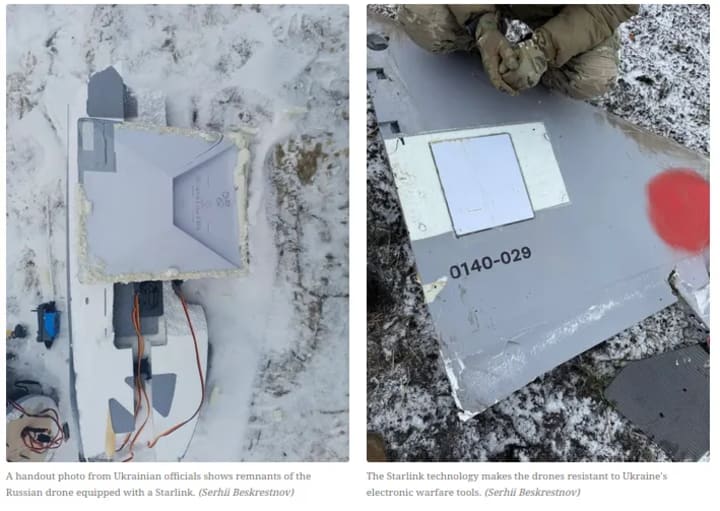
Ukraine has collected evidence of “hundreds” of attacks by Russian drones equipped with Starlink terminals, Serhii Beskrestnov, a military tech expert and adviser to the Ukrainian Defense Ministry, said on Thursday. — CNN
Drone-specific modifications and the escalation of precision
The technical evolution of Russian unmanned systems has accelerated through the integration of satellite terminals, transforming tactical assets into strategic threats.
The BM-35m drone, also known as the Italmaz, serves as a primary example of this shift.
According to technical assessments by Serhii “Flash” Beskrestnov and reports from international observers, the BM-35 has been modified to house a Starlink terminal alongside a dual-camera system.
This configuration allows for both high-resolution reconnaissance and a stabilised, real-time video feed for terminal guidance. By leveraging the low-latency bandwidth of the satellite constellation, Russian operators based hundreds of kilometres away can maintain manual control over the drone at distances exceeding 500 kilometres.
This integration is not limited to newer platforms; the Institute for the Study of War documented the first Starlink-equipped Shahed variants in September 2024.
More recently, in December 2025, the Molniya tactical drone was identified with similar modifications, extending its operational depth significantly. A vivid illustration of this escalated threat occurred on 26 January 2026, during a strike on the Kanatove airfield.
A Starlink-equipped BM-35 successfully targeted and destroyed a sophisticated inflatable decoy of a Ukrainian F-16 fighter jet. While the target was a mock-up, the incident underscored the alarming precision now available to Russian forces; the operator could visually distinguish and strike a specific asset from great distance, demonstrating a level of control that traditional jamming-prone radio links could not sustain.
Solutions
1. SpaceX and the implementation of velocity limits
In response to the documented misuse of its hardware, SpaceX collaborated with the Ukrainian Ministry of Defence to implement a technical barrier known as a velocity cap.
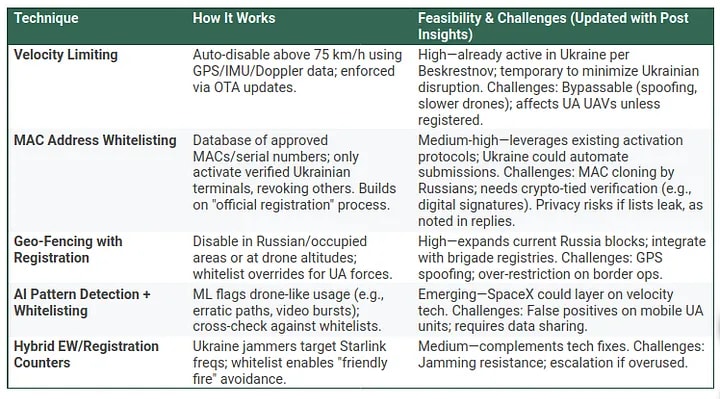
As of January 2026, terminals operating within the conflict zone are subject to a speed restriction of approximately 75 to 90 kilometres per hour. The internal hardware of a Starlink terminal includes GPS receivers, Inertial Measurement Units, and phased-array antenna systems capable of detecting Doppler shifts. These sensors allow the software to calculate the velocity of the terminal in real time.
Because military-grade drones typically cruise at speeds between 150 and 250 kilometres per hour, the system identifies these movement patterns as non-civilian and terminates the data link.
While this measure has successfully disrupted Russian long-range drone missions, it presents operational hurdles for Ukrainian forces who also utilise drones for reconnaissance and strike missions.
And it's working (1 Feb 2026)
2. The development of a whitelisting architecture
To resolve the issue of collateral impact on friendly forces, it has been speculated that the Ukrainian government is exploring a comprehensive whitelisting system. This protocol would rely on the registration of specific hardware identifiers, such as Media Access Control (MAC) addresses and serial numbers, into a secure database managed by the military. These would probably be encrypted.
Only terminals verified as belonging to official Ukrainian brigades would be permitted to bypass the established velocity and altitude restrictions. This system integrates with existing activation protocols to ensure that smuggled units remain either throttled or entirely non-functional.
Although this software-defined defence (if it exists) would be robust, it is not immune to counter-measures. Russian engineers will continue to investigate methods of hardware spoofing and MAC address cloning to deceive the network into identifying illicit terminals as authorised devices.
3. Technical and policy countermeasures
Limiting unauthorised satellite usage requires a multi-layered approach involving both software engineering and international policy.
Beyond velocity caps, geo-fencing remains a primary tool, where satellite coverage is programmatically disabled over Russian territory and specific occupied zones.
Furthermore, AI is employed to monitor usage patterns, flagging accounts that exhibit the specific data-transfer characteristics of an active drone feed.
On the diplomatic front, there is an increasing necessity for stringent regulations regarding dual-use technology. The ethical obligations of private aerospace corporations are under scrutiny, as their products now play a decisive role in kinetic warfare as I wrote recently about Ubiquiti. Ukrainian electronic warfare units continue to upgrade their terrestrial capabilities, though the physical properties of Starlink’s high-frequency, narrow-beam signals make direct jamming difficult.
Summary of techniques for Starlink terminal control
This list may not be complete.
Ongoing technological arms race
Russia’s genocidal war on Ukraine demonstrates that no technical solution is permanent in a high-intensity theatre.
Sadly, Russian forces have shown significant adaptability, exploring the use of slower-moving platforms or data-relay tactics to circumvent the 75 kilometres per hour limit. That does have its drawbacks however, as the platforms are much easier to hit with small arms fire, when in range, and offers longer reaction times for other anti-drone defences.
There is also evidence of attempts to modify terminal firmware to provide false telemetry data to the satellite constellation. This constant cycle of measure and counter-measure defines the current state of the electronic battlefield.
The velocity limit is viewed by many analysts as a temporary necessity rather than a final solution, intended to buy time while more permanent hardware-level security features are developed and deployed.
Automated Starlink update mechanism
The vast majority of Starlink firmware upgrades occur automatically. When a terminal is powered on and has a clear view of the sky, it communicates with the satellite network to check for available updates.
These typically download in the background and install during periods of low usage, often between 03:00 and 05:00 local time. The system then reboots to apply the changes, which typically results in a brief service interruption of several minutes.
Conclusions
Reclaiming control in the satellite age
The history of Starlink in Ukraine is a case study for the future of global security and the regulation of private satellite constellations.
The transition from a purely supportive tool to a contested asset highlights the difficulty of controlling commercial technology once it enters a combat zone. By integrating technical safeguards, such as whitelisting and sensor-based restrictions, with aggressive diplomatic pressure on smuggling hubs, Ukraine and its international partners seek to neutralise the Russian advantage.
Regional security and the risks to NATO borders
The operational expansion of Starlink-equipped drones presents significant challenges to the security architecture of Eastern Europe.
According to assessments by the Institute for the Study of War, the 500-kilometre effective range of the BM-35 drone allows Russian forces to strike targets well beyond the immediate front lines. If launched from occupied territories or the Russian mainland, these platforms can reach the entirety of Moldova and significant portions of NATO member states, including Poland, Lithuania, and Romania.
This geographical reach increases the risk of accidental or intentional airspace incursions, potentially triggering broader international incidents. Furthermore, the reliance on technical fixes creates a delicate balance; if velocity caps or geo-fencing measures are implemented too broadly or without precise whitelisting, they risk over-restricting legitimate Ukrainian defensive operations.
Such a scenario would impair Ukraine’s ability to conduct long-range reconnaissance or maritime strikes, highlighting the complexity of managing dual-use infrastructure in a high-intensity conflict where technical limitations must be applied with surgical precision.
The success of these efforts will dictate the standard for how dual-use satellite services are managed in future international disputes. Reclaiming control of the orbital data flow is essential for maintaining the integrity of Ukrainian defence operations and ensuring that commercial innovation is not permanently subverted for the purposes of war.
(c) James Marinero 2026. All rights reserved
About the Creator
James Marinero
I live on a boat and write as I sail slowly around the world. Follow me for a varied story diet: true stories, humor, tech, AI, travel, geopolitics and more. I also write techno thrillers, with six to my name. More of my stories on Medium
Keep reading
More stories from James Marinero and writers in Journal and other communities.
A Brisbane Renter’s Story: How a Proper Bond Clean Makes All the Difference
Moving out of a rental property in Brisbane is rarely stress-free. Between packing boxes, organising removals, updating addresses, and meeting tight deadlines, cleaning is often the last thing anyone wants to deal with. Yet for many tenants, bond cleaning becomes the deciding factor between getting their full bond back or losing a portion of it.
By Bond Cleaning Brisbanea day ago in Journal


Comments
There are no comments for this story
Be the first to respond and start the conversation.