
Just One Raven AA Missile System Claims 108 Kills in Ukraine
Outstanding performance from a quickly designed and assembled AA solution using cheap missiles

One Raven AA Missile Unit in Ukraine has 108 kills and the unit's are running out of space to paint the decals
Raven: The basics
The Raven is a bespoke, short-range air defence system developed in the United Kingdom and rapidly supplied to Ukraine to address the urgent requirement for mobile protection against Russian aerial threats.
This innovative ground-based system is an integration of existing military components, primarily featuring the highly capable AIM-132 ASRAAM (Advanced Short-Range Air-to-Air Missile) adapted for surface launch. It is mounted on the widely used Supacat HMT-600 six-by-six high-mobility military vehicle chassis.
The system first entered service in Ukraine during the spring of 2023. Reports indicate that Raven has been surprisingly effective, with high reported success rates against an array of targets, initially drones, but later extending to Russian cruise and guided missiles. The system’s deployment significantly enhances the short-range element of Ukraine’s layered air defence network.
Design Concept
The concept behind the Raven system is one of ingenious, rapid improvisation, sometimes referred to as a ‘FrankenSAM’ due to its combination of disparate technologies.
The design process, led by the Royal Air Force’s Air and Space Warfare Centre, achieved deployment in approximately four months.
The core design mounts a twin-rail launcher, repurposing missile rails taken from retired RAF Tornado, Hawk, and Jaguar aircraft, onto the Supacat HMT-600 chassis. Target acquisition is facilitated by an electro-optical and infrared (EO/IR) turret, likely a Chess Dynamics Hawkeye, which allows for passive search and tracking.
Crucially, the system can be operated remotely from a short stand-off distance, enhancing crew survivability in ‘shoot-and-scoot’ scenarios. The design prioritises mobility, a small visual signature, and passive engagement capability to minimise detection risks.
This ‘never throw anything away, it might come in handy’ approach is dear to my own heart, the reason why I’ve got about three tons of ‘junk’ on my boat!
Performance
The Raven system’s performance has reportedly exceeded initial expectations. It was primarily intended for counter-UAV (Unmanned Aerial Vehicle) operations, yet it has demonstrated efficacy against faster, more sophisticated threats.
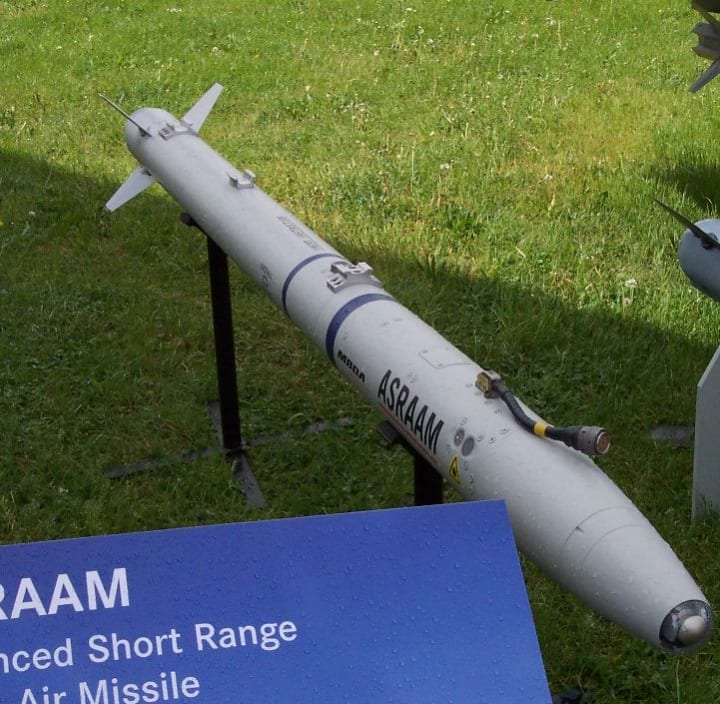
The AIM-132 ASRAAM missile is the main effector, an 88-kilogram missile with a 10-kilogram blast-fragmentation warhead. Powered by a dual-thrust solid rocket motor, the missile achieves speeds in excess of Mach 3.
When ground-launched, the effective range is commonly cited as up to 15 kilometres. As of late 2025, reports suggest the Raven systems have conducted over 400 combat engagements with an estimated overall success rate of around 70 per cent. This success is a testament to the missile’s speed, the quality of its guidance, and the rapid, close-in reaction time the mobile platform provides.
Recycled components
The system uses readily available, in-service military components: the Supacat HMT-600 chassis and surplus air-to-air missiles. Furthermore, even the launch rails were repurposed from decommissioned RAF fighter and training aircraft.
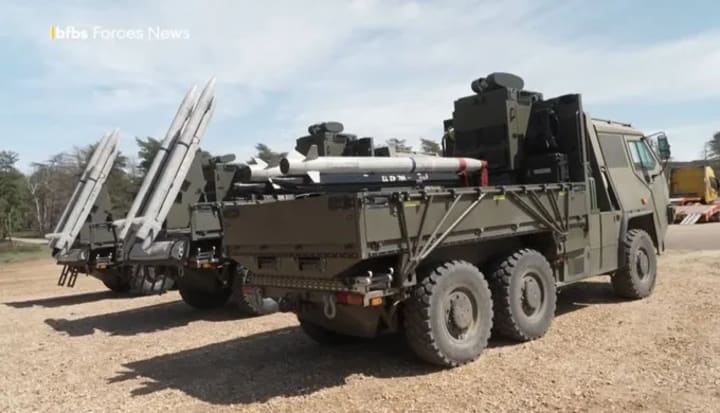
This ‘recycling’ of mature, proven technology circumvents immense research and development expenditure and streamlines the supply chain to a degree. The financial burden of supplying the missiles is also being mitigated by using interest accrued from seized Russian assets to fund additional ASRAAM deliveries. Wonderful!
How many?
Information regarding the total quantity of Raven systems delivered to Ukraine has become progressively clearer following initial secrecy. Early reports confirmed the delivery of eight systems.
Subsequently, the UK pledged an additional five units, bringing the total number of Raven systems committed to Ukraine to 13. This limited quantity underscores the system’s role as a niche, high-value asset intended to plug specific, critical gaps in Ukraine’s short-range air defence coverage.
Beyond the launchers themselves, the UK has also committed to providing significant numbers of the necessary ASRAAM missiles, with a delivery of 350 air defence missiles announced to sustain the Raven’s operational usage against the sustained Russian air campaign.
Result!
And now we see the results of this platform's work.
One unit, 108 kills.
***
This is an edited version of a story originally published on medium.com
Additional material from Special Kherson Cat on twitter.
About the Creator
James Marinero
I live on a boat and write as I sail slowly around the world. Follow me for a varied story diet: true stories, humor, tech, AI, travel, geopolitics and more. I also write techno thrillers, with six to my name. More of my stories on Medium
Keep reading
More stories from James Marinero and writers in Journal and other communities.
Rooted in the Wild
When the Outdoors Shapes Identity For many people, nature exists on the margins of everyday life—visited occasionally, appreciated briefly, then left behind. For Erick Anthony Rossi, the outdoors has never been a backdrop. It is a place where values are shaped, perspective is restored, and responsibility is learned through experience.
By Anthony Rossi4 days ago in Journal


Comments
There are no comments for this story
Be the first to respond and start the conversation.