
Green Energy on the Move: Solar Tracker Market Thrives with Improved ROI and Tech Advancements
The solar tracker industry is advancing past mechanical improvements to embrace cutting-edge technologies.

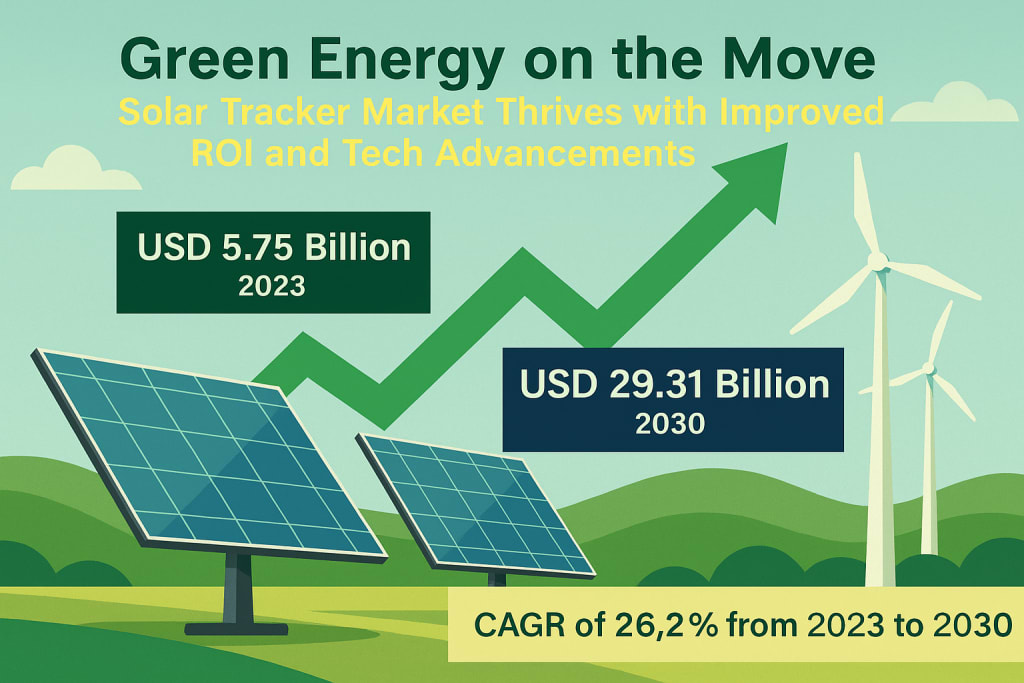
The worldwide shift toward sustainable energy sources positions solar power to become a pivotal element in future renewable energy systems. The solar tracker market has transitioned from a technical niche to a fast-growing sector thanks to technological progress and improved ROI alongside enhanced energy efficiency. The solar tracker market worth stood at USD 5.75 billion in 2023 and is expected to soar to USD 29.31 billion by 2030 with a compound annual growth rate of 26.2%.
Solar trackers improve power generation by allowing solar panels to track the sun's movements throughout the day. The enhanced efficiency level draws attention from global utilities developers and investors who seek to boost yields while reducing the levelized cost of electricity (LCOE).
What Are Solar Trackers?
Solar trackers function as mechanical systems that direct photovoltaic (PV) or concentrated solar (CSP) panels to face the sun. Solar trackers optimize energy collection by moving throughout the day which results in a 10% to 25% better output than fixed-tilt systems.
There are two main types:
Single-axis trackers: Solar panels move horizontally on a single axis which makes them suitable for utility-scale installations.
Dual-axis trackers: Panels move along both horizontal and vertical axes in dual-axis trackers which serve smaller applications that require high precision such as concentrated solar power systems.
Key Drivers of Market Growth
1. Improved Return on Investment (ROI)
Contemporary solar trackers offer unprecedented levels of affordability and efficiency while demonstrating enhanced durability. The payback period for solar trackers has decreased due to better designs and reduced maintenance needs particularly in areas with high solar irradiance. The focus of investors and developers has shifted towards tracker-equipped projects which promise greater long-term profits.
2. Technological Advancements
The entire tracker value chain is experiencing rapid innovation. Key breakthroughs include:
AI and IoT systems work together to create smart tracking solutions using weather predictions and irradiance measurements.
Wireless self-powered trackers minimize the need for cables and simplify installation procedures.
The advanced materials and design elements enable resistance to severe environmental factors such as strong winds and heavy snow loads.
The enhancements result in systems that operate more reliably and maintain less downtime while reducing operational and maintenance expenses.
3. Government Incentives and Climate Policies
Nations working towards their net-zero objectives provide robust policy backing for solar installations with utility-scale projects as a primary focus. Tax credits combined with renewable portfolio standards (RPS) and green financing drive the implementation of advanced tracking systems that optimize energy output relative to cost.
4. Growing Utility-Scale Solar Deployment
Utility-scale solar farms represent the biggest segment of the tracker market because performance optimization is essential in these installations. Utility-scale solar projects now depend heavily on tracking systems to enhance daytime energy production and maintain grid stability.
Regional Insights
The U.S. and Mexico stand out as leader regions in North America's dominance of the global tracker market due to their expanding large-scale solar farms and solar tax credit incentives.
Spain along with Italy and Greece in Europe are enhancing their solar tracker installations to meet strong decarbonization targets.
The Asia-Pacific region which includes India and China stands on the verge of quick growth because of governmental renewable energy initiatives combined with strong solar radiation levels.
The Middle East & Africa regions are developing into prime locations for solar farms due to their extensive desert areas suitable for robust tracker technology.
Challenges Ahead
The market continues to experience challenges despite quick adoption rates.
Upfront costs: The initial expense for tracker systems exceeds that of fixed-tilt structures especially when applied to smaller installations although ROI is increasing.
Complex installation: The installation of tracker systems demands meticulous site preparation and precise calibration.
Maintenance needs: Mechanical parts of solar trackers need regular maintenance despite their reduction in complexity.
The concerns are being resolved by manufacturers through the introduction of modular designs and systems incorporating robotic monitoring along with predictive maintenance tools.
Future Outlook: Smart and Hybrid Systems
Smart tracking systems optimize energy yield through real-time analytics and artificial intelligence technologies.
Dual-axis trackers are becoming the norm in hybrid PV-CSP systems to achieve superior efficiency in heat and power production.
Bifacial panels + trackers: The combination of bifacial solar modules with single-axis trackers has become an industry benchmark while enhancing energy collection through reflected sunlight.
New deployment possibilities emerge through floating solar farms and agrivoltaics systems which adapt trackers for use on water surfaces and agricultural lands.
Conclusion
The global transition to clean energy at a rapid pace has made solar trackers indispensable components of renewable energy infrastructure. Solar trackers prove their worth by boosting energy production and space efficiency while generating powerful financial gains which repositions them from being supplementary to essential components. The solar tracker market thrives while propelling solar technology advancement due to decreasing costs and rapid technological improvements.
About the Creator
Silvie Karson
Passionate storyteller exploring the world of trends. With a background in digital marketing, I craft compelling narratives that inform and inspire. Whether diving into deep-dive features, growth analysis, or trend analysis.
Keep reading
More stories from Silvie Karson and writers in Journal and other communities.
Defense Beyond the Battlefield: Biodefense Market Accelerates with Vaccine and Detection Innovation
The definition of defense now encompasses biological agent protection as health threats move past traditional warfare boundaries and include both natural and artificial biological dangers. Technological advancements in vaccines along with diagnostics and biosurveillance systems have transformed the biodefense market from a niche security strategy sector into a rapidly expanding industry. The market valuation of USD 16.1 billion in 2023 is projected to grow to USD 22.8 billion by 2030 with a compound annual growth rate of 5%.
By Silvie Karson7 months ago in Journal
How MAGA Rhetoric Went Viral in Europe
Imagine scrolling your social feed and seeing political debates about France’s elections, Germany’s nationalist rise, or far-right gains in Italy and Poland — all tied, at least in part, to the influence of America’s Make America Great Again (MAGA) movement. What started as an American slogan transformed into a global conversation about nationalism, identity, and political strategy, generating massive public interest, academic analysis, and viral news cycles across the United States and Europe.
By Omasanjuwa Ogharandukunabout 23 hours ago in Journal


Comments
There are no comments for this story
Be the first to respond and start the conversation.