
Defense Beyond the Battlefield: Biodefense Market Accelerates with Vaccine and Detection Innovation
The next decade of biodefense innovations will be influenced by growing sectors such as synthetic biology together with digital pathogen libraries and pan-pathogen countermeasures.

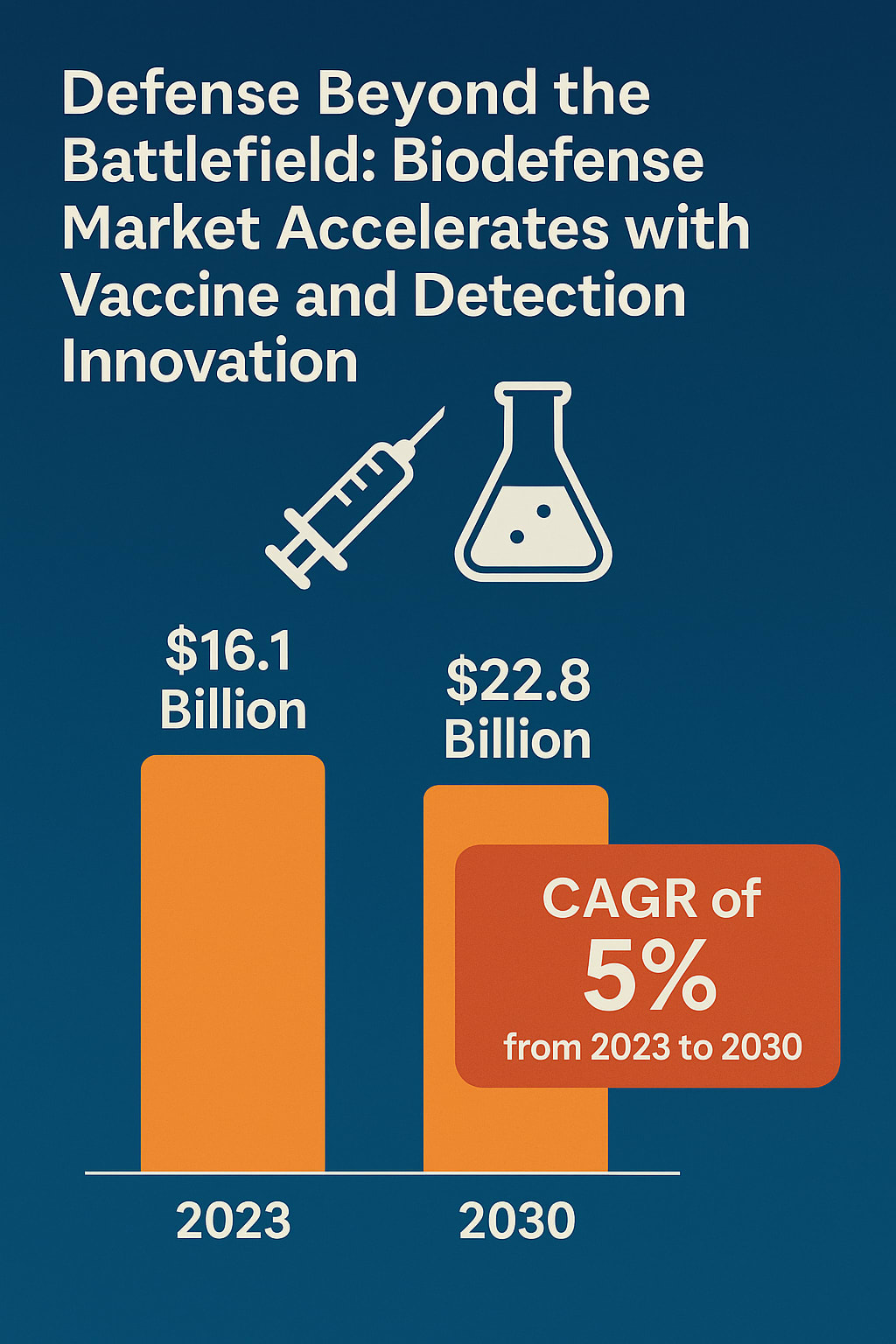
The definition of defense now encompasses biological agent protection as health threats move past traditional warfare boundaries and include both natural and artificial biological dangers. Technological advancements in vaccines along with diagnostics and biosurveillance systems have transformed the biodefense market from a niche security strategy sector into a rapidly expanding industry. The market valuation of USD 16.1 billion in 2023 is projected to grow to USD 22.8 billion by 2030 with a compound annual growth rate of 5%.
This shift underscores a fundamental reality: Protecting against biological threats like pandemics and bioterrorism holds equal importance as traditional military defense throughout the 21st century.
Understanding the Biodefense Landscape
Biodefense activities focus on creating and applying medical countermeasures, detection systems, surveillance networks, and decontamination methods to protect against biological threats. Biological threats encompass bacteria such as anthrax and viruses like smallpox and Ebola along with genetically engineered or synthetic organisms.
Around the world governments along with defense and health organizations are making substantial investments in the development of advanced vaccines rapid diagnostic technologies and early warning systems to strengthen national defenses against biological threats.
Key Drivers of Market Growth
1. Rising Threat of Bioterrorism and Biological Warfare
The potential usage of biological weapons in international conflicts or by terrorist groups has led global security agencies to prioritize biodefense efforts. Bioweapons present a significant threat in asymmetric warfare because they are both inexpensive to produce and capable of producing devastating effects.
2. Pandemic Preparedness Post-COVID-19
The COVID-19 pandemic revealed weaknesses within global health systems. National governments are actively developing strategic stockpiles and investing in mRNA technology while improving disease monitoring systems to achieve quicker responses to future disease outbreaks.
3. Emerging Infectious Diseases
Recent disease outbreaks including Ebola, Zika, Nipah virus and monkeypox have increased awareness about zoonotic and novel pathogens. Now more than ever we need broad-spectrum antivirals and adaptable vaccine platforms.
4. Government Funding and Policy Initiatives
The Biomedical Advanced Research and Development Authority (BARDA), DARPA, and the European Defence Agency each invest billions into developing vaccine technologies and diagnostic devices along with rapid response infrastructure.
Innovation Leading the Charge
1. Vaccine Technology
Biodefense efforts are capitalizing on advancements in vaccine technology. mRNA vaccine technology which emerged during COVID-19 enables quick reactions to biological threats. Research institutions alongside private companies focus their efforts on developing vaccines that address influenza, coronaviruses, and hemorrhagic fevers.
The biodefense toolkit now includes an increasing number of vector-based vaccines along with DNA vaccines and protein subunit vaccines.
2. Detection and Diagnostics
Early detection is critical in containing outbreaks. Innovations include:
- Point-of-care testing devices provide diagnostic results within minutes.
- CRISPR technology enables precise pathogen identification through advanced diagnostic tools.
- Wearable detectors and bioaerosol sensors are deployed in hazardous high-risk environments.
3. AI and Biosurveillance
Machine learning and artificial intelligence are revolutionizing how threats are detected. Predictive modeling tools provide forecasts of outbreaks and enable tracking of mutations and detection of bioterrorism threats. Airports and military bases along with critical infrastructure sites now host integrated biosurveillance systems.
Key Applications and End Users
Military and Defense Agencies: Military and Defense Agencies remain the primary consumers of biodefense products which they deploy to safeguard troops while ensuring their operational preparedness.
Public Health Agencies: Public Health Agencies should enhance their national preparedness strategies by utilizing surveillance systems and rapid diagnostic tools in combination with public immunization tactics.
Hospitals and Laboratories: Use fast diagnostic instruments alongside biosafety measures to identify and control infections promptly.
Research Institutions: Research Institutions should advance vaccine development methods while progressing genomic sequencing techniques and threat modeling approaches.
Regional Outlook
The biodefense market leadership of North America stems from substantial government investments alongside a strong pharmaceutical foundation and programs such as Project BioShield and Operation Warp Speed.
The EU is strengthening its health emergency response capabilities through comprehensive regional preparedness frameworks and collective procurement systems.
The Asia-Pacific region is becoming a prominent area for defense investment from countries including Japan, China, and India as they react to regional disease outbreaks and threats of bioterrorism.
Challenges to Overcome
Ethical and Regulatory Complexities: Implementing countermeasures promptly without compromising safety standards and regulatory requirements presents a complex challenge.
Public Trust: The success of biodefense strategies faces obstacles from vaccine hesitancy combined with misinformation.
Funding Fluctuations: Biodefense financial support frequently increases during emergencies but decreases after the crisis ends which affects sustained readiness.
The Road Ahead
Biodefense success in the future requires both agility and adaptability. Both government entities and commercial organizations are adopting platform-based technologies to enable quick development of medical diagnostics and vaccines when new threats appear. Combining genomics with AI and global surveillance networks will lead to better coordination and faster response times.
Conclusion
Biodefense has become a fundamental requirement in today's environment which faces both natural and engineered biological threats. The integration of vaccine technology with rapid diagnostics and biosurveillance systems is driving the market into unprecedented growth stages. The biodefense market speeds ahead while reshaping national defense strategies against microbial threats.
About the Creator
Silvie Karson
Passionate storyteller exploring the world of trends. With a background in digital marketing, I craft compelling narratives that inform and inspire. Whether diving into deep-dive features, growth analysis, or trend analysis.
Keep reading
More stories from Silvie Karson and writers in Journal and other communities.
Navigation Meets Innovation: Avionics Market Set to Climb with Smart Flight Systems Adoption
The avionics market value of USD 48.84 billion in 2024 is expected to expand to USD 85.29 billion by 2030 according to forecasts which show a compound annual growth rate (CAGR) of 9.7%. Avionics systems which used to be seen as backend infrastructure now serve as essential contributors to performance, sustainability, and safety in the evolving 21st-century aviation industry.
By Silvie Karson7 months ago in Journal
The goals I did not achieve
Every writing goal I made for the year is a wash. It has been this way for a while, but I think it's important to be open about my failures and the reality of how life can get in the way. This is especially true considering the several times I have posted on Vocal about my writing goals, how I was changing my approach, and where I was hoping to be for the upcoming year. I will probably do that again in a couple months, but for now, it is time to acknowledge where I am today.
By Kay Husnick23 days ago in Journal



Comments
There are no comments for this story
Be the first to respond and start the conversation.