
EXPERIENCE IN FINDING THE IDEAL WEIGHT
The following article is based on the author's personal experience, with the main goal being to lose fat (21% --> 18%), and a little weight (~2kg)...

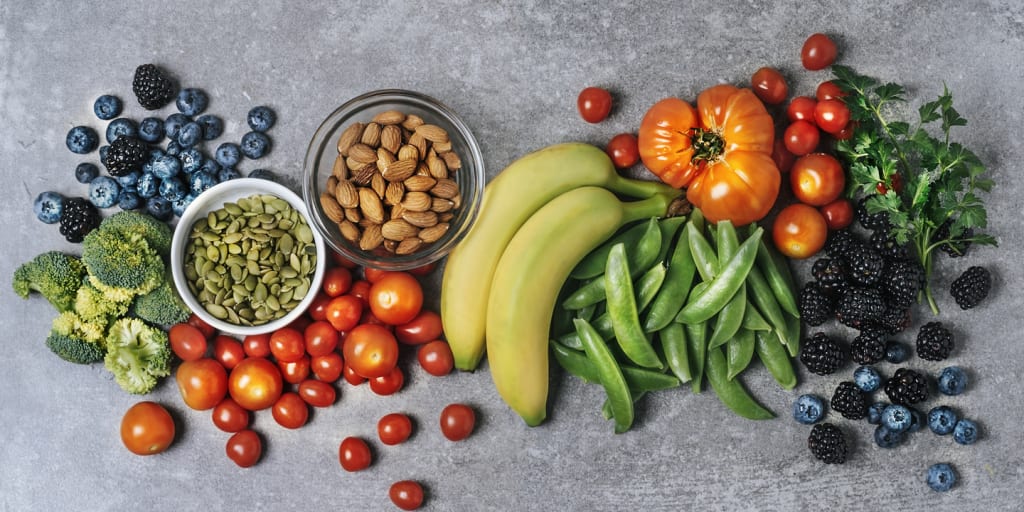
The following article is based on the author's personal experience, with the main goal of reducing fat (21% --> 18%), and a little weight (~2kg) in 2 months. Those who need to gain/lose a lot of weight can also refer to the concepts and attached document links, but should consult a nutrition and exercise expert to achieve results as well as not adversely affect health!
Summary of weight loss principles
- Maintain a negative energy balance (absorb less than consumed)
- Reduce the ratio of carbohydrates, increase the ratio of protein compared to the previous diet
- Increase exercise throughout the day
- Add HIIT exercises at home
Step 1: UNDERSTAND AND APPLY THE PRINCIPLE OF ENERGY BALANCE
Energy balance is the balance between the amount of calories absorbed (energy in) (mainly through food and drinks) and the amount of calories consumed (energy out) (the body's basic metabolic needs, physical and mental activities) (1).
Want to gain weight: calories absorbed > calories consumed
Want to lose weight: calories absorbed < calories consumed
Want to maintain weight: calories absorbed = calories consumed
There are 2 ways to calculate energy balance for everyone to refer to:
Method 1: Calculate calories consumed using the calculator on the website
https://www.verywellfit.com/what-is-bmr-or-basal-metabolic-rate-3495380
Or site:
https://www.calculator.net/calorie-calculator.html
This is convenient, but not very accurate because the activity level will be different each day, so I created an Excel table (Figure 1) to specifically divide the number of hours of activity per day. For the energy levels for each activity level, everyone goes to the website above, enters the information of age, gender, height, weight, then selects the activity level, it will automatically calculate for you, then enter the data into the Excel table to know how much energy is consumed each day.
Method 2: extremely simple and convenient with the Lose It! application
This is the application I have experienced and found suitable for my needs. You can find other software with similar functions on the App Store or Google Play. Lose It! has a mobile version and a website. Just register your account information, enter your goal (maintain weight, gain weight, or lose weight), height, weight, gender, etc. This application will help calculate the amount of calories you need to take in every day (Budget calorie). All you need to do is enter the amount of food consumed (Food), daily physical activities (Exercise) to track your energy balance.
Note, I use the free version, so it only supports basic features such as the amount and ratio of protein, fat (lipid), and carbohydrates in the diet. However, for my needs, that is more than enough. If you need more information, choose the Premium package and pay to experience more!
In summary, step 1, calculate and remember your daily energy balance before starting your weight management plan.
Step 2: DETERMINE THE WEIGHT YOU NEED TO GAIN/LOSE AND THE BODY FAT PERCENTAGE
To calculate whether you are overweight/underweight, you can use the Body Mass Index (BMI) according to the formula:
BMI (kg/m2) = W/H*H
In which, W is weight (in kg), H is height (in meters)
Note, I only use the BMI index as a reference value, everyone, especially those who are too thin or too fat. If your BMI is within the average range, then gaining or losing weight will depend on each person's preferences and aesthetics and an index that I will mention below. For example, many people who are a little overweight look better.
You can go to the link below, enter your height and weight to find out if your BMI is above average:
https://www.calculator.net/bmi-calculator.html
Or the page:
https://www.nhlbi.nih.gov/health/educational/lose_wt/BMI/bmi-m.htm
As mentioned, the BMI index is easy to calculate but not very reliable because it is only based on height and weight, so it does not fully reflect the internal components of the body, especially the amount of fat. Moreover, this is an index used to assess the level of obesity in the community, not suitable for application to each individual, especially those with BMI within the average limit (2, 3). Therefore, I personally use the Body Fat index (roughly translated as the total body fat ratio), because the main goal is to reduce total body fat because in recent years, all health check-ups have shown high cholesterol. The link to calculate this index is below:
https://www.calculator.net/body-fat-calculator.html
Note
- The neck circumference is measured starting from the point below the throat, around the back to the front and downwards, when measuring do not look up at the neck.
- The waist circumference for men is measured right at the navel, for women at the position with the smallest circumference, when measuring do not suck in the stomach to ensure accuracy.
- The hip circumference is measured at the most protruding hip (for women). There are no instructions in the document on how to measure the hip in men, so I also apply the position where the hip protrudes the most to measure.
After entering the necessary information, everyone will know the level of fat in their body, as in the example below.
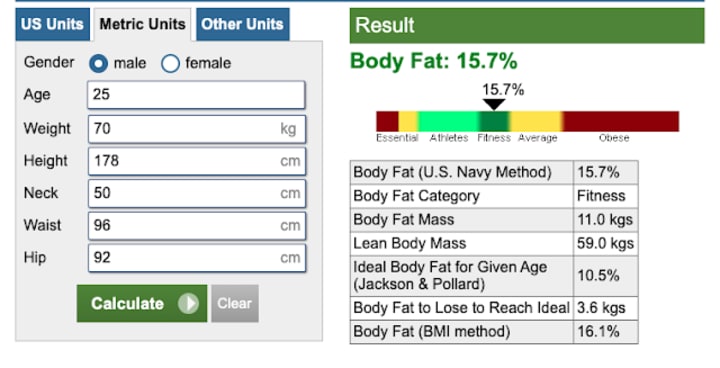
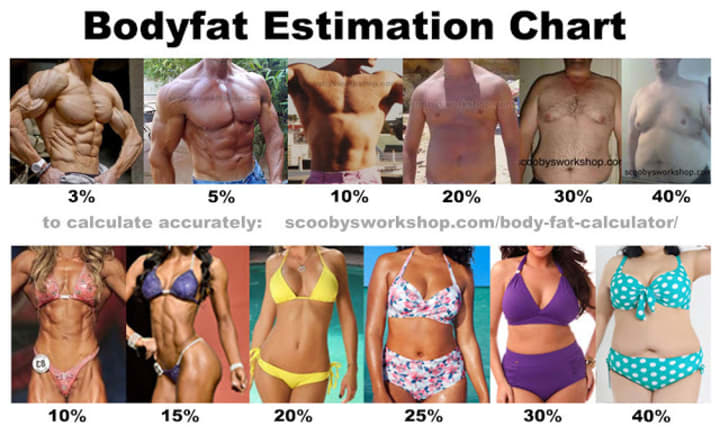
To be more professional, I suggest using scales that measure using bioelectric impedance (such as the Japanese TANITA line) or hydrostatic weighing to determine additional indicators such as: body fat percentage, body fat mass, lean body mass, muscle mass, bone mass, visceral fat rating, metabolic age, basic metabolic rate, etc. (2, 4, 5). These machines use many body parameters through direct measurement to calculate values, so the accuracy will be higher than the 2 indexes I mentioned above. I see that currently, gyms are also equipped with similar machines. When using them, you pay a fee. I only need to measure when I first start the weight loss process. After 1-2 months, I need to check again, so it is not too expensive. The appropriate time to measure is usually before exercising, or before heavy exercise to ensure the parameters are accurate.
In which, the important index to pay attention to is the estimated fat percentage.
In summary, step 2, based on BMI and total body fat percentage to estimate the amount of weight to be adjusted and the amount of excess fat
Step 3: DETERMINE YOUR BODY TYPE TO KNOW THE AMOUNT OF PROTEIN-SUGAR-FAT YOU NEED TO CONSUME
Next, I would like to introduce to you the classification of body types (body types or sematotypes). Body types were introduced by author W.H. Sheldon in the 40s of the 20th century to personalize and optimize nutrition and exercise for each person. There are 3 main types :
- Ectomorphs: tall, thin, low muscle and low fat, very difficult to gain weight due to fast metabolism, often envied by friends because they eat a lot but do not get fat.
- Endomorphs: fat, muscular, high body fat, fat is concentrated in the abdomen, hips and thighs, easy to gain weight instead of gaining muscle, difficult to keep the body in balance due to low metabolism and carbohydrate tolerance. - Mesomorphs: lean, high metabolism, easy to change weight, easy to gain muscle, ideal for becoming athletes.
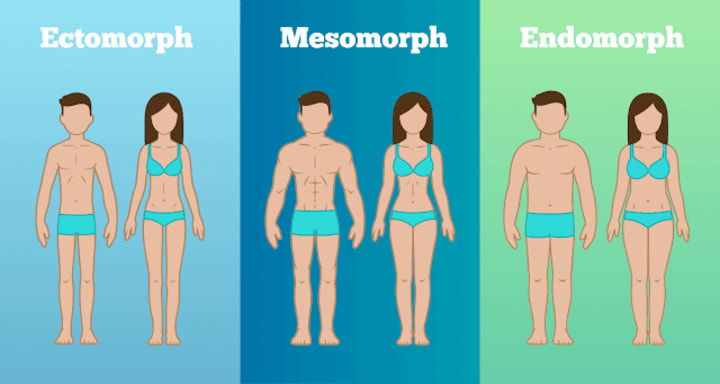
Ngoài ra, còn có những mức trung gian giữa 3 dạng chính này (Hình 7). Tuy nhiên, với nhu cầu giảm cân nhẹ (2kg) và giảm mỡ, mình không cần phân loại quá chính xác mà qua phần mô tả ở trên, mình xác định "hơi" thiên nhẹ về nhóm Endomorphs, tức là dễ mập đó mọi người ơi, hic. Sau đây là một số lưu ý chế độ ăn và tập luyện của dạng Endomorphs (8):
Chế độ ăn
- Ăn nhiều rau củ
- Giảm lượng calorie hấp thu
- Tỉ lệ carbohydrate trong khẩu phần ăn hàng ngày 30-40%
- Chia nhiều bữa nhỏ trong ngày, 5-6 bữa
- Uống nhiều nước
- Nên ăn các loại protein từ thịt ít chất béo như gà, gà tây, hải sản
Chế độ luyện tập
- Các bài tập cardio để đốt cháy calorie ít nhất 1-2 buổi/tuần
- Không nên chạy liên tục cùng tốc độ mà tập ngắt quãng, 2 phút nhanh - 1 phút chậm xen kẽ để đốt mỡ nhanh hơn
- Muốn tăng cơ, thì có thể tập tạ 4 buổi/tuần
- Thực hiện các bài tập xen kẽ với thời gian nghỉ giữa các set tập ngắn
- Cách giúp gia tăng chuyển hoá: https://www.nhs.uk/live-well/healthy-weight/metabolism-and-weight-loss/
Mọi người có thể tìm trên internet có rất nhiều trang hướng dẫn cụ thể cho từng nhóm thể trạng nhé, nhiều quá, mình không viết ra hết được.
In summary, step 3, self-assess your body type to choose the appropriate diet and exercise regimen.
Step 4. CONTROL YOUR PORTION
After the above 3 steps, everyone has grasped the basic information about the amount of calories they need to put into their body, their weight and expected body fat percentage, the ratio of protein-sugar-fat components suitable for their body type. Next is an extremely important step, which is designing a daily meal plan.
I repeat that this is an "extremely important" step because the above 3 steps are just the information you need to know, but if you cannot apply it in practice, it will ruin the entire plan. Especially those of you who have a foodie soul, try to overcome yourself if you have a goal of achieving and maintaining your ideal weight and shape.
My secret to designing my meal plan is to cook for myself and buy an additional mini scale to check the weight of the ingredients when cooking. If you can't cook often, then be patient at first, buy a small, cute scale, weigh the food at home, you will practice the ability to estimate. Later, wherever you go, whatever you eat, just look at it and you can estimate how much the food weighs and calculate its calories. I tried this method, it's quite okay!
Moreover, cooking will help you proactively choose the nutritional ingredients, the way of preparation (fried food with a lot of oil will significantly affect your weight), and measure each ingredient.
Those who cannot cook for themselves can choose to order food divided into portions (I have seen this advertised a lot but have not tried it so I do not recommend it to everyone) or eat at restaurants.
But whatever you do, always remember which dishes have a lot of protein, lipids or carbohydrates to choose the right one. When you have free time, go online to see how many calories are in each type of food, especially the popular ones in Vietnam, such as: eggs, chicken, pork, beef, white rice, tomatoes, cucumbers, etc. Here is a list to download from the US National Institutes of Health: https://www.nap.edu/read/10490/chapter/1. Knowing more about nutrition is not only good for you but also for your loved ones!
Oh, and don't forget the Lose It! app that I mentioned above. This app is quite good, in addition to the available dishes in the list, people can also enter each ingredient (for example, if beef noodles are not in the list, people can enter noodles, beef, carrots, etc. - remember it's in English, if you don't know, use Google Translate, thanks to that, you can also learn more vocabulary) with weight (if you don't cook yourself, people can only estimate). In addition, this app also has the feature of scanning the code (Figure 9) of the product or creating a new dish if you know the amount of calories, protein, lipids and carbohydrates.
Some notes on diet are as follows:
- You should not lose weight by fasting (crash diet) or skipping meals (skipping meals). Because this method can only help you reduce your BMI (due to weight loss) in a short time, however, the body fat ratio is still high, and there is a risk of gaining weight later. That is because when the body lacks energy, the protein in the body will be used to create calories, not fat, leading to muscle loss but the amount of fat does not change. Not to mention, when practicing muscle development exercises, you must also supplement protein and calories to compensate for damaged muscles after exercise . In addition, people have found that this excessive dieting has the opposite effect, because our body cannot fast for a long time, leading to an increased need to consume foods high in sugar and fat .
- A diet of only protein is not suitable. Because other nutrients play a role in the metabolism process. On the other hand, excess protein in the daily diet will not be retained but will be converted into glucose or fat for storage (11). Not to mention, if anyone has ever experienced eating all-protein foods, such as egg whites or boiled chicken breast, they will understand how terrible it feels!
- To build muscle, everyone can use more whey. . The type of whey I use has instructions printed on the packaging, 3 suitable times to use it are to supplement with breakfast, after exercise, 1 hour before bed. Maximum per day is 6 scoops (equivalent to 63 grams of protein). However, I only use it on days when my diet lacks protein, to balance the ratio of substances.
- Limit beer, alcohol, and alcoholic beverages. For example, 1 can of beer per day is probably not a problem. But remember to exercise to burn calories.
Some notes on diet are as follows:
- You should not lose weight by fasting (crash diet) or skipping meals (skipping meals). Because this method can only help you reduce your BMI (due to weight loss) in a short time, however, the body fat ratio is still high, and there is a risk of gaining weight later. That is because when the body lacks energy, the protein in the body will be used to create calories, not fat, leading to muscle loss but the amount of fat does not change. Not to mention, when practicing muscle development exercises, you must also supplement protein and calories to compensate for damaged muscles after exercise. In addition, people have found that this excessive dieting has the opposite effect, because our body cannot fast for a long time, leading to an increased need to consume foods high in sugar and fat .
- A diet of only protein is not suitable. Because other nutrients play a role in the metabolism process. On the other hand, excess protein in the daily diet will not be retained but will be converted into glucose or fat for storage (11). Not to mention, if anyone has ever experienced eating all-protein foods, such as egg whites or boiled chicken breast, they will understand how terrible it feels!
- To build muscle, everyone can use more whey. . The type of whey I use has instructions printed on the packaging, 3 suitable times to use it are to supplement with breakfast, after exercise, 1 hour before bed. Maximum per day is 6 scoops (equivalent to 63 grams of protein). However, I only use it on days when my diet lacks protein, to balance the ratio of substances.
- Limit beer, alcohol, and alcoholic beverages. For example, 1 can of beer per day is probably not a problem. But remember to exercise to burn calories.
In summary, step 4, always pay attention to the amount of calories and types of food you put into your body every day to ensure energy and nutrition.
Step 5: NOW IT'S TIME FOR EXERCISE!
In fact, on average, an adult consumes about 1500-2000 calories per day through food (3 main meals, not including snacks and side meals). However, even high-intensity exercise only burns a few hundred calories. For example, a 30-minute moderate weightlifting session burns about 115 calories, similar to jogging at 5.2 miles per hour (or 8.3 km/h) for 15 minutes. Therefore, in the 4 steps above, I emphasize a lot on energy consumption and diet, not exercise. Moreover, many people today with busy schedules may not be able to arrange time to exercise every day.
My advice and the way I have applied it in practice is to adjust your diet, then increase your physical activity throughout the day, and finally, depending on your schedule, exercise every day or 3-4 days a week. Increasing physical activity means walking a lot, you can use an electronic watch, which costs a few hundred thousand (no need to use an Iwatch or expensive touch watches) to count your steps and remind you to stand up and move around every 60 minutes of sitting still. Sitting a lot can easily cause back pain, stiff neck and shoulders, and forgetting to drink water when concentrating on work can easily cause kidney stones. For example, my office is on the 4th floor, instead of using the elevator, I choose to take the stairs every time I have to go up and down to burn calories.
For exercises, I temporarily divide them into 2 main groups that I still practice every day: - Fat burning and calorie burning group (aerobic exercise or cardiovascular exercise) (14): are exercises that increase heart rate and increase ventilation, such as cardio exercises in the gym (running, cycling), high intensity interval training - HITT (High Intensitive Interval Training)
- Muscle development group (strength training, resistance training, body building, or weightlifting) (14): are exercises that use resistance with heavy objects (weights) (dumbbells, body weight) to help build and maintain muscles. These exercises require an instructor to perform the movements correctly to develop the right muscle groups and avoid injury. I observe at the gym, many people just practice haphazardly, do not know how to divide the exercise schedule for muscle groups, do not know which machines are for which muscle groups, do not have enough range of motion, etc. If you have never used weights or gym machines, you should ask someone or hire a PT to guide you. Once you understand the working principle, you can then arrange your own workout according to your plan. I am not a PT and do not need to advertise for any gym, so you can rest assured.
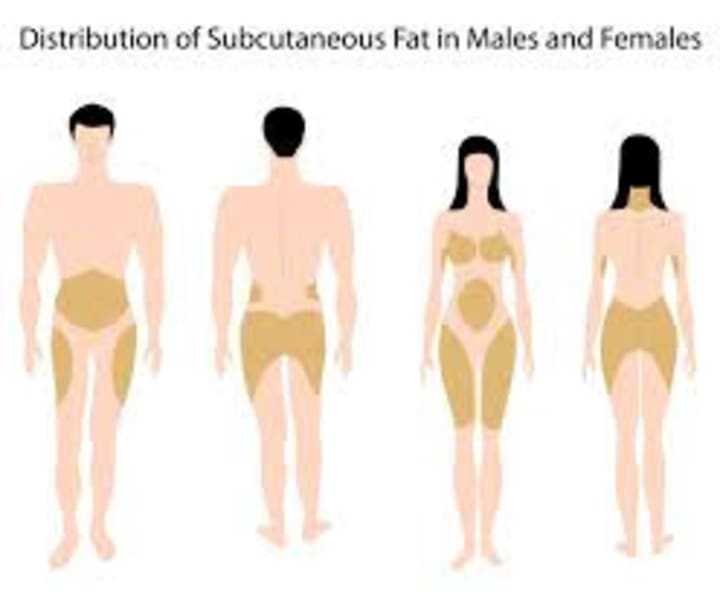
Note, for the abdomen, which is one of the three main places where fat is concentrated in the body. You need to combine the two types of exercises above to be effective, to get firm 6-pack abs. Muscle development exercises to make the abdominal muscles thick and firm and calorie burning exercises, to melt away fat, then the abs will appear! Abdominal exercises need to be done regularly, combined with exercises for other muscle groups, changed to gradually increase the difficulty and avoid boredom. But there is no secret to doing less exercise but having a firm stomach, so be persistent, don't be discouraged!
My suggested workout schedule is:
- Weekdays: 15-20 minutes of cardio, 30 minutes of muscle group training (Chest, Back-shoulders, Buttocks, Arms, Legs), 10 minutes of abs. If you crave milk tea, you can increase the cardio time to 30 minutes.
- 2 weekends: 30 minutes of HITT training.
My secret is that for each type of exercise, you should change it every day, or every week so that you don't get bored, and your muscles are more flexible. But you absolutely have to make sure that the training schedule is set out for it to be effective.
The other thing is that when exercising, everyone should learn to listen to their body, when they feel tired or in pain, they should stop, and not try too hard. Instead, you should exercise gradually, increasing a little bit each day so that your body can adapt, which will be better for your health.
It is not necessary to exercise every day, but you should set a goal and frequency of exercise each week, for example 3-4 sessions/week and maintain that habit.
Do not exercise right after eating. Because when exercising, you have to combine breathing movements, increase abdominal pressure, some movements are in the opposite direction of gravity, so it will cause discomfort, affect the stomach's ability to digest, and can also increase the risk of hemorrhoids. Instead, you should eat a light meal before exercising, to have enough energy to function (bananas, cakes).
Do not exercise when hungry. Because the body needs to burn calories to meet the needs of exercise. Lack of calories forces the body to mobilize stored energy, including protein from muscles, which can easily cause muscle loss.
In short, step 5, arrange a workout schedule that fits your work and schedule. The important thing is to increase your activity throughout the day. If you don't have time to go to the gym, you can jog or do HIIT at home to burn calories.
Finally, I wish everyone will soon achieve their weight and body shape changing goals!
About the Creator
Which Type of Plastic Yields the Highest Oil Output During Pyrolysis?
Plastic waste is a growing environmental challenge, and one of the promising methods for managing this waste is pyrolysis. Pyrolysis involves heating plastic to high temperatures in the absence of oxygen to break it down into smaller molecules, producing valuable by-products such as oil, gas, and solid residues. However, not all plastics yield the same amount of oil during the pyrolysis process.
By Bestonpyrolysisabout 20 hours ago in Journal


Comments
There are no comments for this story
Be the first to respond and start the conversation.