
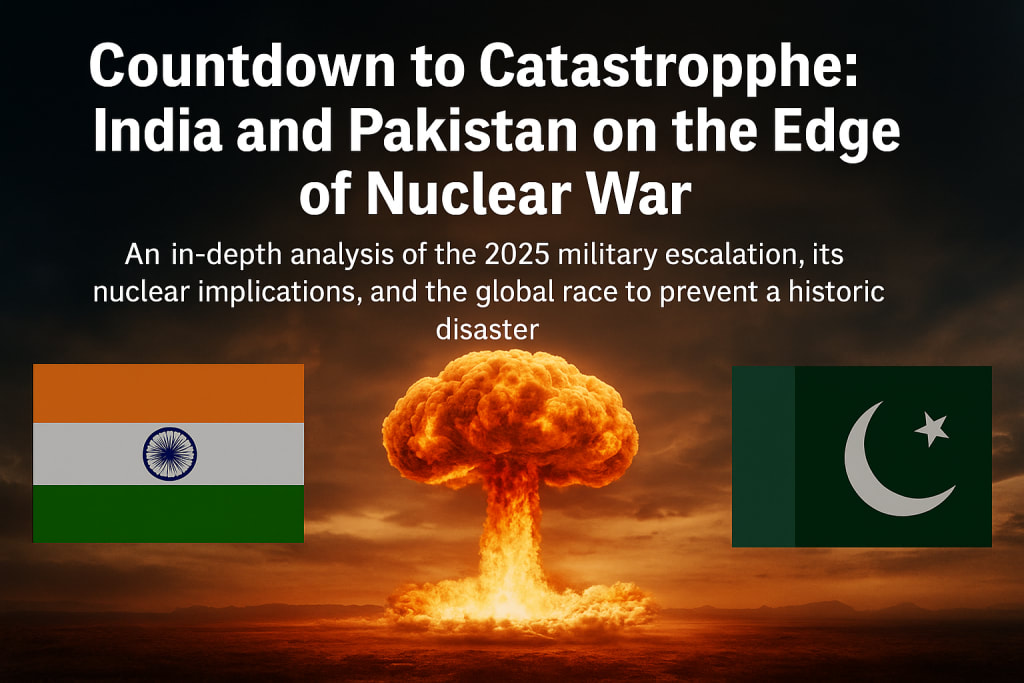
Countdown to Catastrophe: India and Pakistan on the Edge of Nuclear War
An in-depth analysis of the 2025 military escalation, its nuclear implications, and the global race to prevent a historic disaster.
Introduction
As tensions between India and Pakistan reach alarming levels in 2025, the specter of a nuclear conflict looms larger than ever. With both countries having fought three major wars and countless skirmishes since their independence in 1947, the latest flare-up—triggered by India's recent military strikes—has raised global concerns about the potential for a devastating escalation. Given their nuclear capabilities, any misstep could lead to consequences far beyond the subcontinent, affecting global peace and security.
The Immediate Trigger: Operation Sindhur
On May 7, 2025, the Indian Armed Forces initiated "Operation Sindhur," targeting multiple suspected terrorist camps in Pakistan-administered Kashmir. The Indian government claimed that these sites were being used to plan attacks on Indian soil by groups like Lashkar-e-Taiba and Jaish-e-Mohammed. In what was described as a "pre-emptive and surgical" strike, India used Rafale fighter jets, SCALP cruise missiles, and surveillance drones to neutralize what they described as imminent threats.
This operation marked the most significant cross-border strike since the Balakot airstrikes in 2019. Indian officials maintained that civilian casualties were avoided, and only terrorist infrastructure was targeted. However, Pakistan rejected these claims, alleging widespread damage, civilian deaths, and an unprovoked act of war.
Pakistan's Retaliation and the Escalation
In less than 24 hours, Pakistan responded with force. The Pakistan Air Force launched a series of retaliatory strikes on Indian military installations near the Line of Control. Multiple Indian drones were reportedly shot down, and Islamabad claimed to have destroyed several forward posts and logistical hubs. Pakistani Defense Minister Khawaja Asif delivered a televised address warning that "Pakistan will not hesitate to use all means necessary to protect its sovereignty."
This was followed by reports of intense artillery shelling across the border, aerial dogfights, and missile interceptions. Border towns like Jammu, Pathankot, and Amritsar in India and Lahore and Sialkot in Pakistan experienced blackouts, fuel shortages, and civilian evacuations. Social media and news outlets were flooded with images of destruction, prompting mass panic and fear of further escalation.
Nuclear Capabilities and Strategic Postures
India and Pakistan are both nuclear-armed states with a history of military standoffs. India is estimated to have around 160 nuclear warheads, while Pakistan possesses a similar arsenal. Both nations have developed a range of delivery systems, including ballistic and cruise missiles capable of carrying nuclear payloads.
While India has historically maintained a "No First Use" (NFU) nuclear doctrine, there have been growing indications in recent years that this policy could be reviewed under extreme circumstances. Pakistan, on the other hand, has never committed to NFU and maintains a more ambiguous posture, suggesting a willingness to use nuclear weapons preemptively if its core interests are threatened.
This doctrinal divergence adds a layer of unpredictability. Experts warn that any miscalculation, intentional or otherwise, could escalate quickly into a nuclear exchange. The presence of tactical nuclear weapons on both sides further complicates the equation, as the threshold for their use in battlefield scenarios is significantly lower.
Global Reactions and Diplomatic Moves
The international community has responded with urgency. The United States has sent diplomatic envoys to both New Delhi and Islamabad, urging restraint and offering mediation. China, a strategic partner of Pakistan, has called for an immediate cessation of hostilities and convened an emergency meeting at the United Nations Security Council.
The UN Secretary-General, António Guterres, issued a stark warning: "The risk of a nuclear exchange in South Asia is no longer theoretical. It is a clear and present danger. The world must act swiftly to de-escalate this crisis."
Countries across Europe and Asia have advised their citizens to leave the region and have started contingency planning for refugee flows, trade disruptions, and potential nuclear fallout. The global stock markets have shown signs of volatility, with defense and energy sectors experiencing significant surges.
Civilian Impact and Humanitarian Concerns
While military engagements dominate the headlines, civilians on both sides are bearing the brunt of the conflict. Schools and businesses have shut down, hospitals are overwhelmed, and millions are living in constant fear of air raids or missile strikes. In border regions, families are fleeing en masse, seeking safety in already overcrowded shelters and camps.
Human rights organizations have warned of a brewing humanitarian crisis. Water supplies have been disrupted, communication lines are down, and access to basic necessities is dwindling. If the situation continues to deteriorate, the region could witness mass displacement on a scale not seen since the Partition of 1947.
What the Future Holds
Political analysts are divided on how the situation might unfold. Optimists hope that international diplomatic pressure will force both nations to step back from the brink. Realists fear that nationalist politics, domestic pressures, and military pride could override rational decision-making.
A key concern is the possibility of "catalytic escalation," where an isolated incident, such as a missile misfire or a rogue military unit’s action, triggers an unstoppable chain reaction. The presence of nuclear weapons makes this scenario not just plausible, but terrifyingly likely if current trends continue.
Conclusion
The India-Pakistan conflict of 2025 has pushed the world dangerously close to the edge. While history offers examples of past crises that were eventually defused through diplomacy, the current situation is unprecedented in its intensity, speed, and stakes. The global community must act decisively—not only to broker peace but to ensure that South Asia does not become the epicenter of the world’s first nuclear war of the 21st century.
Only time will tell whether reason and diplomacy can triumph over rage and retribution. But one thing is certain: the cost of failure would be incalculable.
About the Creator
Keep reading
More stories from EMRANUZZAMAN and writers in Journal and other communities.
The American dream betrayed: Silencing voices
The United States of America, once self-proclaimed as the bastion of freedom, equality, morality, and the ultimate authority on democracy and human rights—or so Hollywood would have us believe—has long been complicit in waging wars that ruthlessly murder innocent men, women, and children around the world. Although the "American dream" is often portrayed as a quaint house in a serene suburb with a white picket fence and a golden retriever in its backyard, the actual American dream of a self-aware taxpayer is simply not to have their hard-earned money siphoned into the trillion-dollar military-industrial complex that perpetuates cycles of violence and devastation abroad. They would much rather have access to affordable healthcare, housing, and higher education.
By EMRANUZZAMAN9 months ago in Journal




Comments
There are no comments for this story
Be the first to respond and start the conversation.