
Alaskan native art
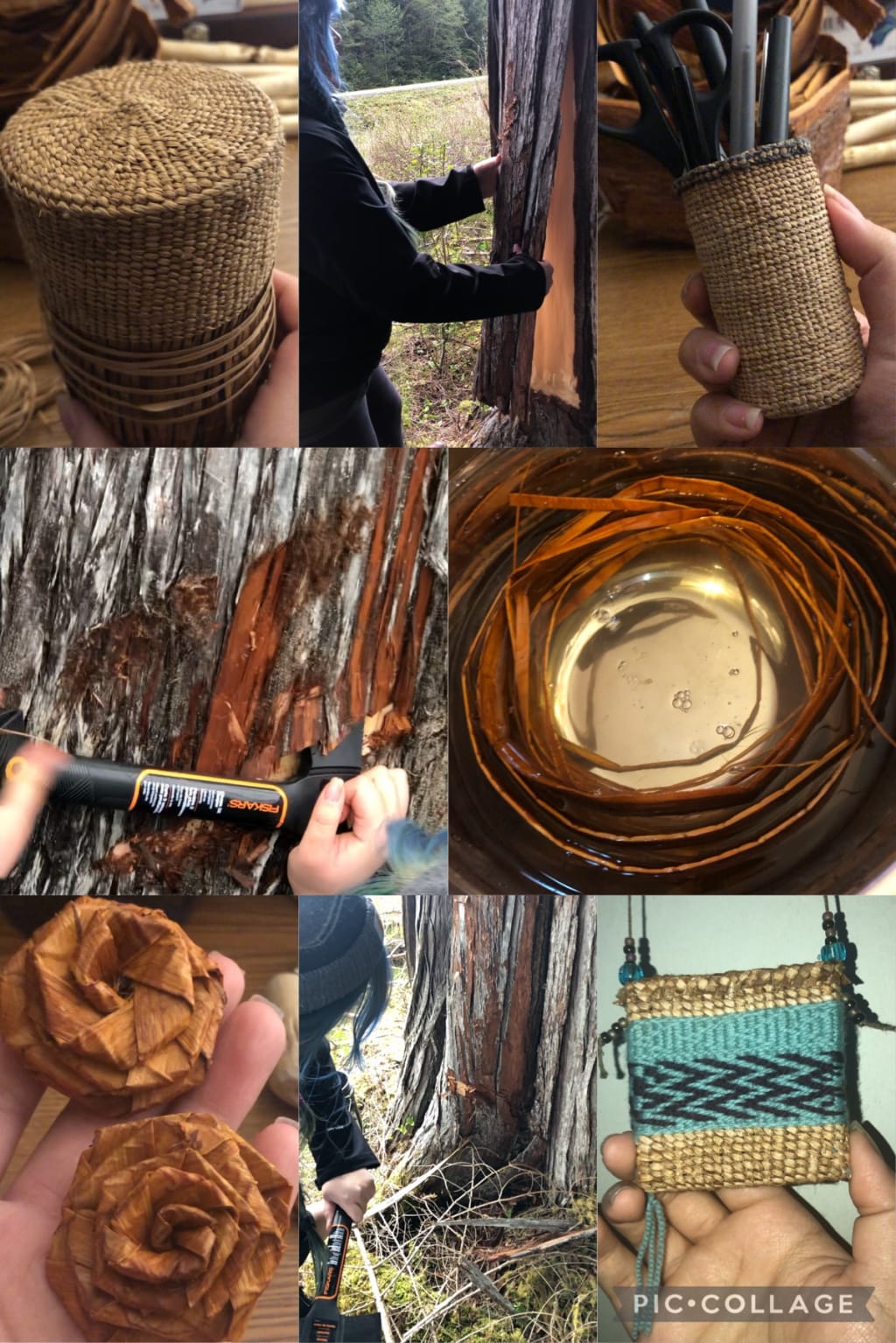
Gathering cedar bark for weaving, one of many cultural mediums

At the mere age of 6, my first day of native arts class was spent learning the basic rules of tool safety, and being taught the pledge of allegiance in my native tongue, Tlingit. Since we were just kids with little hands, we started out carefully beading simple necklaces. After weeks of practicing with needle and thread, eventually we were given a pair of fiskars and felt fabric, to cut out the shapes that would become our first beading projects.
Our teacher, clan leader and master carver, Jon Rowan taught me almost everything I know. From sewing to painting,from sanding to carving, and helping me perfect the details in my formline. Throughout the years of having him as a teacher, I learned so much about my culture. One of my all time favorite parts of being in his class was having him tell us stories that have been passed down for many generations. Our classroom sat just below one of the largest collections of standing totem poles. On fridays if we were behaving in class, he’d take us outside and let us pick a totem pole we wanted to learn about, as each one had been carved to represent our origin stories that brought us where we are today.
As I got older, I transferred schools just 7 miles away. I wanted a change of scenery, and ultimately my options for native art had changed, but possibly for the better. I still had the option to continue native arts with a new teacher, but then I had the opportunity to take an additional class, traditional cedar weaving.
Little did I know that taking up weaving would spark a passion that lead me to fall in love with my culture all over again. It’s one of the many reasons I love the spring time. As the sap flows heavily through the western red and Alaskan yellow cedar trees, it’s time to harvest.
Before going out, I make sure I have my bag with my sharp Fiskars hatchet, knife, and tobacco to use as an offering to the spirit of the tree. For hundreds of years my people relied on cedar trees for shelter, canoes, totem poles, and weaving. All of those still being crafted to this day.
Women in our tribes would weave intricate hats, mats, baskets, and rope. Where I live, many of the indigenous people here are primarily Tlingit, Haida, or Tsimshian. All people with a long history of utilizing cedar trees, and the bark from it in all parts of our lives. Hundreds of years ago women from these tribes would weave baskets so tight, that they would hold water.
Present day cedar weaving has not changed, although the modern tools we have definitely make collecting the bark an easier process. Among the many traditional weaving projects, there are some newer ones being learned and taught around. My favorite currently has been cedar roses, both big and small and easy to craft, especially for beginners who are completely new to the art.
There are some amazing professional weavers that travel Alaska to teach anyone willing to learn how to weave simple, or patterned baskets. While the art form is traditional, anyone of any ethnicities who want to learn is welcome to do so. Most importantly, if anyone wants to learn to gather bark for personal use there are some basic guidelines to follow.
First, gain respect and understanding for nature. Second, you never want to take too much from a single tree. Taking more than what fits in your hand can kill the tree. If you live in an area where cedar trees are abundant, you never want to take from the same tree someone has already stripped. If you live in an area where they’re sparse, it’s best not to take any if you find some. It’s also very important to know wether or not you’re allowed to be foraging in the area you’re in. If you’d like to try but can’t gather for yourself, there are groups out there on the internet willing to share some of their hard work with others who don’t have access.
I’m so excited to be here sharing my knowledge, and even more excited to teach my kids when they’re older.
About the Creator
Madison Dawn Nickerson
23 year old Alaskan native artist, passionate about my culture and the bountiful harvests provided by nature. I’m a mom of 2 under 2, determined to teach my kids traditions that were once banned but not forgotten. @alaskan8ive907
Keep reading
More stories from writers in Journal and other communities.
Silver Screen Magic with Mae West
American actress and singer Mae West became a popular film actress during the Great Depression. She started entertaining in vaudeville, then performed on Broadway, and finally went to Hollywood. She signed up with Paramount Pictures and made her debut in the 1932 film “Night After Night.” She also starred in musicals, comedies, and crime dramas. The American Film Institute named her one of the best classic Hollywood actresses.
By Rasma Raisters4 days ago in Geeks


Comments
There are no comments for this story
Be the first to respond and start the conversation.