
THE INNER MONOLOGUE OLYMPICS: Overthinking Events You Haven’t Even Attended Yet
A Pompous Post™ Special Report on Mental Gymnastics and Existential Sweat

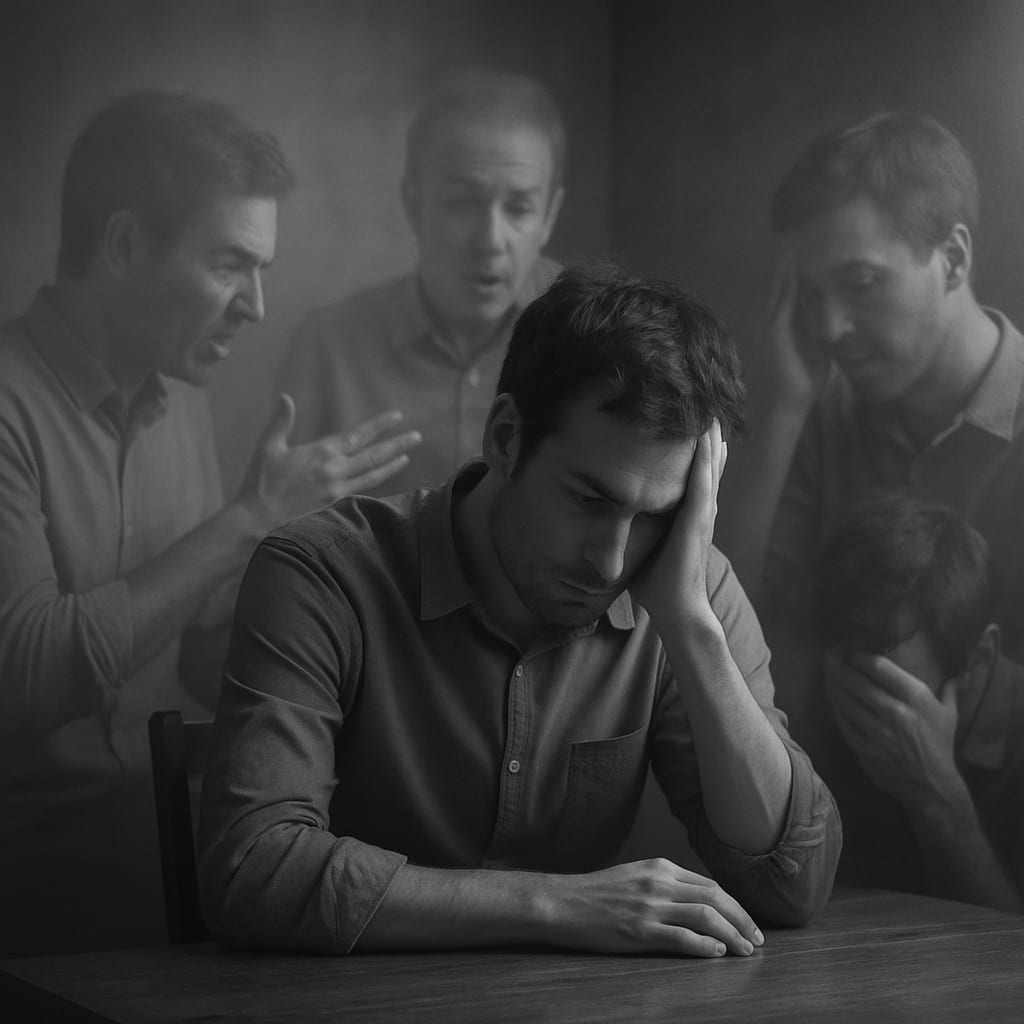
In a stunning display of psychological endurance, humanity has collectively entered what experts are calling The Inner Monologue Olympics. A high-stakes mental tournament where every competitor is both the athlete and their own worst critic.
Recent studies from the National Institute of Chronic Overthinking confirm that 98% of people spend an average of six hours a day rehearsing conversations that will never happen. The remaining 2% are currently doing so right now.
This exposé dives deep into the modern condition of anticipatory anxiety. That relentless pregame warm-up your brain performs, before you’ve even left the house.
🥇 Event 1: The Small Talk Marathon
The Small Talk Marathon is one of the most grueling events in the Overthinking Games. Contestants must mentally prepare for interactions with strangers, acquaintances, or... worst of all... coworkers at non-mandatory social functions.
“It’s a mental triathlon,” says Dr. Lana Curie, lead researcher at the Institute for Hypothetical Scenarios. “They rehearse dozens of conversation openers, panic, and then say something like ‘So… uh… how about that… stuff?’”
Elite overthinkers can visualize a full 12-minute conversation before stepping foot in the room.
One anonymous participant described their method:
“I start by picturing how I’ll stand. Then how I’ll nod. Then how I’ll leave gracefully without tripping on the carpet. By that point, I’m too emotionally drained to actually go.”
Spectators report that this event often ends with participants pretending to check their phone while whispering, “Okay, breathe, just act natural.”
🥈 Event 2: The Text Message Relay
This event tests reflexes, endurance, and the ability to turn a simple “sure thing” into a Shakespearean soliloquy.
Competitors must reply to a harmless text, “Hey, want to grab lunch?”, with out sounding too eager, too cold, or too human.
Common performance patterns include:
- Typing “Sounds good!”
- Deleting.
- Rewriting as “Sure thing!”
- Deleting again.
- Settling on “Yeah, totally :)”
- Then deleting the smiley face because it feels too desperate.
“It’s a delicate balance between chill and unhinged,” says psychologist Dr. Grant Alby, author of ‘Oops, I Overthought It Again.’ “They fear coming off weird, which ironically makes them seem weird.”
Many competitors train daily, overanalyzing emoji usage, punctuation tone, and response time. The true masters? They never hit send.
🥉 Event 3: The 3 A.M. Hurdles
It’s quiet. You’re horizontal. The room is dark. Your body says “sleep,” but your brain says, “Remember that thing you said in 2009?”
Welcome to the 3 A.M. Hurdles... the event that no one trains for, yet everyone wins.
Athletes toss and turn while replaying decades-old embarrassments with Olympic precision. Common hurdles include:
- “Did that email sound too passive-aggressive?”
- “Why did I wave twice?”
- “Did I really call my teacher ‘Mom’ in the 7th grade?”
The reigning world champion, Everyone Alive, describes it best:
“It’s like watching your own blooper reel on repeat, but every scene ends with you saying something profoundly stupid.”
💭 Event 4: Freestyle Catastrophizing
The freestyle event requires no specific topic... just boundless imagination and emotional instability.
Contestants invent worst-case scenarios for events that haven’t happened and probably never will.
- A doctor’s appointment? Definitely cancer.
- A work email? Definitely a firing.
- A friendly “we need to talk”? Definitely prison.
Experts note that Freestyle Catastrophizing often includes dramatic inner monologue narration like:
- “What if they ask me a question I can’t answer?”
- “What if I forget my name?”
- “What if my laugh sounds like a dying harmonica?”
These thoughts spiral until the participant convinces themselves to cancel plans, hide under a blanket, and practice how they’ll apologize later.
🪞 Event 5: The Mirror Pre-Game Interview
Before every major social event comes the sacred ritual: standing in front of the mirror and practicing basic human expressions.
“You have to warm up the face muscles,” says Dr. Curie. “Many overthinkers don’t realize their ‘friendly smile’ looks like they’re confessing to a crime.”
Athletes spend up to 20 minutes perfecting phrases like “I’m fine, thanks!” while holding a water bottle like it’s a prop from community theater.
This is also where competitors refine the classic facial combo: Smile + Nodding While Dead Inside. It’s a crowd favorite, often paired with Overly Enthusiastic Wave Followed by Regret.
🥇 Event 6: The “You Too” Sprint
Perhaps the most iconic overthinking event in existence. You’re at a restaurant. The waiter hands you your food and says, “Enjoy your meal.” Without hesitation, before reason can intervene, you respond: “You too!”
You have, in that instant, wished them a pleasant meal while they’re at work. The crowd gasps. Time stops. Your brain screams, “Why did I say that?!” Then begins the internal replay montage:
- You imagine the waiter laughing about it in the break room.
- You write an imaginary apology note.
- You replay the event for the next 17 years.
According to recent research, this “You Too” reflex affects 94% of the population and 100% of people who think too much.
Doctors classify it under Reflexive Social Disgrace Disorder. A chronic condition with no known cure.
🧍 Event 7: The Exit Strategy Floor Routine
Few events require such precision and courage. You’ve made it through the small talk, survived the buffet table, and now it’s time to leave. Gracefully, without anyone noticing your relief. Competitors must execute a flawless combination of:
- The “Well, I should probably…”
- The “Okay, great seeing you!”
- The “Let’s definitely do this again!” (knowing full well they won’t).
Points are deducted for:
- Leaving your drink behind.
- Hugging too soon.
- The accidental double goodbye.
One judge described the winning performance as “a perfect 10 in both politeness and sheer desperation.”
🧘 Event 8: The Hypothetical Argument Finals
In this crowd-favorite event, participants rehearse and win entire arguments that will never take place. Athletes prepare fake conversations in advance, delivering imaginary comebacks with flawless precision.
“Oh, I should have said that!” one competitor mutters triumphantly, six hours too late.
Psychologists call it preemptive righteousness... The rest of us call it Tuesday.
🔬 THE SCIENCE OF SELF-SABOTAGE
According to a mock study by the Society for Advanced Paralysis by Analysis, the average adult replays 42 imaginary conversations per week. That’s nearly 2,000 hours of mental reruns annually.
Dr. Parnham explains:
“The overthinking brain operates like a committee that never adjourns. Every decision is debated by twelve imaginary people, none of whom have snacks.”
The organization recommends therapy, mindfulness, and, if all else fails, wearing noise-canceling headphones inside your own head.
🏆 THE AFTERMATH: POST-OLYMPIC RECOVERY
After an exhausting day of imaginary disasters, competitors often experience Emotional Jet Lag. The feeling of having lived through ten social lives before breakfast.
Symptoms include:
- Staring blankly into space while your inner voice narrates your failure.
- Physically cringing at memories no one else remembers.
- Saying, “Why am I like this?” aloud to no one.
Veteran overthinkers cope by journaling, pacing, or declaring, “Next time I’ll be normal!”... a vow broken within 48 hours.
🥇 A WORD FROM OUR CHAMPIONS
We reached out to gold medalist Jenna Parker, who once rehearsed saying “hi” to a barista for three hours.
“I always think I’ll be calm this time,” she told reporters, “but then I start imagining what I’ll say if they compliment my shoes, or what if they don’t, and suddenly I’ve spiraled into existential dread before I’ve even left my car.”
She paused, looked thoughtful, then added, “Also, I once said ‘love you’ to a crossing guard.”
Her coach, Gary Mullins... yes, the same Mullins from our previous story; simply nodded and said, “Heh… tell me about it.”
🧩 THE FINAL REFLECTION
At the end of the day, the Inner Monologue Olympics are not about winning. They’re about participation... usually involuntary, occasionally panic-inducing, and always deeply unnecessary.
Because in a world filled with uncertainty, overthinkers have found a way to create even more of it... one imaginary conversation at a time.
So if you ever find yourself lying awake, replaying that time you accidentally called your boss “Mom,” remember: you’re not alone.
You’re just competing. And you, my friend, might already be in the finals.
📰 THE POMPOUS POST™
“Because sometimes the loudest voice in the room is the one inside your head.”
About the Creator
The Pompous Post
Welcome to The Pompous Post.... We specialize in weaponized wit, tactful tastelessness, and unapologetic satire! Think of us as a rogue media outlet powered by caffeine, absurdism, and the relentless pursuit to make sense from nonsense.
Keep reading
More stories from The Pompous Post and writers in Humor and other communities.
Pearl
1980 something. we all hung out at Pearl and you and i were nothing special, or so i thought. i mean we all danced, drenched in our own sweat, our own saline solution of fear, too many beers, shots, laughter, tears, fucks in the bathroom and i don't know when we began to be afraid. do you?
By ROCK aka Andrea Polla (Simmons)3 days ago in Fiction


Comments
There are no comments for this story
Be the first to respond and start the conversation.