
THE EPIC OF GILGAMESS AND OTHER MISNAMED MASTERPIECES
Investigative Report on the Ancient Art of Getting It Almost Right

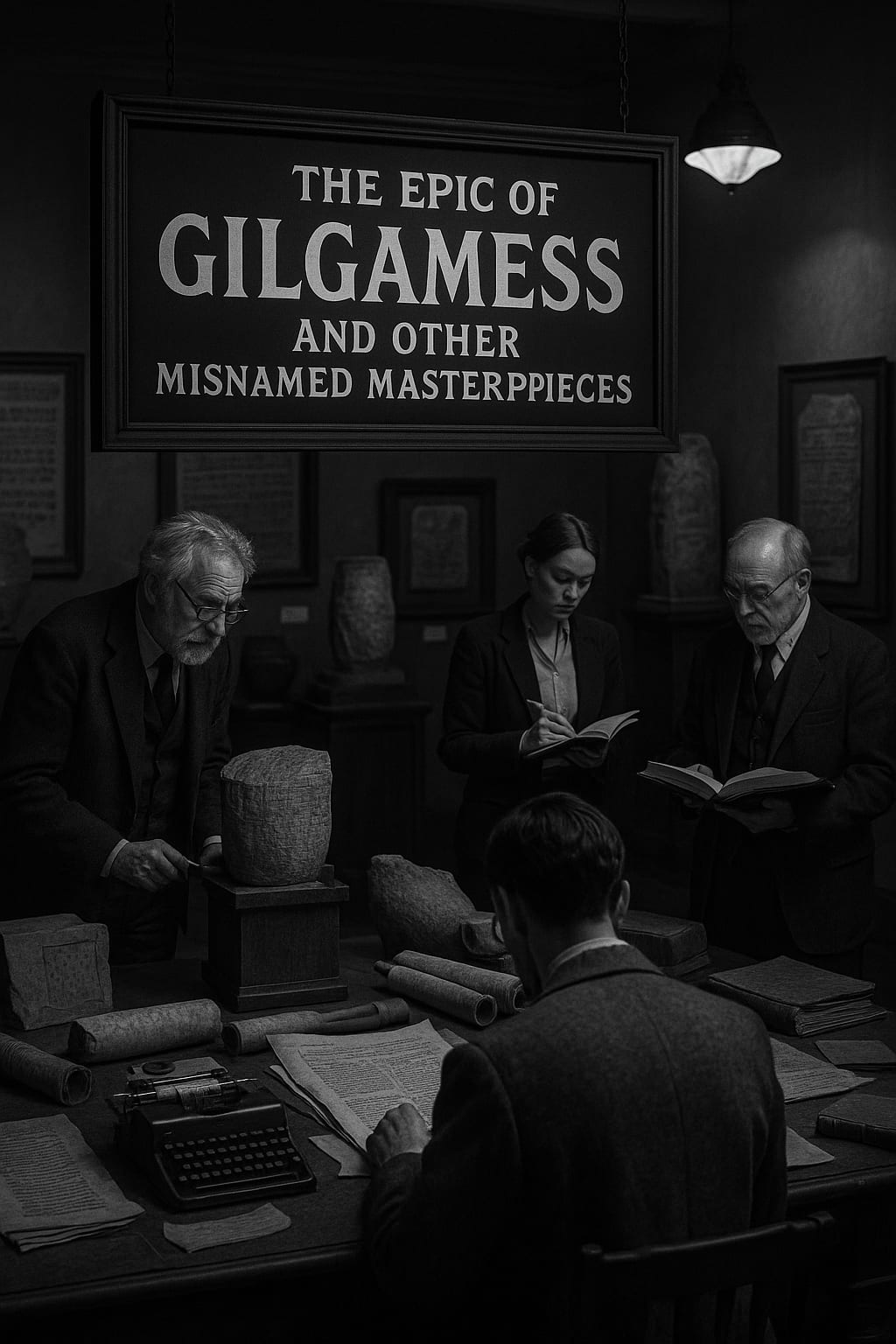
For centuries, scholars have marveled at humanity’s literary achievements. Works so profound they shaped civilizations, inspired revolutions, and confused generations of high schoolers.
But beneath the polished veneer of academia lies a darker truth… a truth of typos, mistranslations, and spelling so bad it deserves its own museum wing.
Thanks to newly unearthed documents from the Department of Linguistic Oopsies and Accidental Brilliance (a Pompous Post-funded research institute operating out of a disused RadioShack), we can finally reveal what the classics were supposed to say, and how a single misplaced letter changed literary history forever.
1. The Epic of Gilgamess
“The world’s first great story… told by a man who couldn’t spell his own name right.”
Long before Homer, Shakespeare, or even Grammarly, there was Gilgamess. An ancient Sumerian hero who set out in search of immortality and found only spelling errors.
The clay tablets, discovered in modern-day Iraq, were believed to tell the story of Gilgamesh. But closer analysis revealed the name “Gilgamess” carved repeatedly. As if the scribe’s chisel slipped or he was being heckled mid-inscription.
Highlights include:
- Gilgamess battling “Humbaboo,” a monster described as “confused but polite.”
- A tragic friendship with “Enkood,” who dies after being crushed by a poorly translated metaphor.
- A moral ending that roughly translates to, “Life is fleeting, proofreading is forever.”
2. The Iliad and the Oddity
“An epic tale of war, glory, and one guy who just didn’t belong there.”
The Iliad once chronicled the noble struggles of Troy and Greece. Until a translation mix-up introduced The Oddity; an extra scroll detailing the adventures of a confused foot soldier who accidentally joined the wrong war.
Highlights:
- The Oddity accidentally insults Zeus’s sandals.
- Achilles refuses to fight because someone stole his shampoo.
- Hector mistakes a pigeon for an omen and declares it “a sign to take a nap.”
Critics call it “an epic for anyone who’s ever wandered into the wrong Zoom meeting and just went with it.”
3. BeoWoof
“Bad spelling, worse pronunciation, and the loudest hero in Anglo-Saxon history.”
Once a proud poem of valor, BeoWoof emerged when a medieval monk sneezed mid-transcription and accidentally added a tail.
In this version, the mighty warrior BeoWoof isn’t slaying monsters, he’s chasing them up trees and barking at mead barrels.
Grendel’s reign of terror ends not in combat, but confusion, as the hero repeatedly stops to sniff the battlefield.
A popular children’s spin-off, "The Boy Who Cried Woof", followed shortly after, teaching generations the dangers of false alarms and loud terriers.
4. Dante’s Infernal
“A slightly warmer, mildly inconvenient version of Hell.”
A missing “o” turned Dante’s Inferno into Infernal, a travelogue of eternal bureaucratic irritation.
Instead of sinners burning, they’re stuck waiting in endless lines:
- The Circle of Lukewarm Coffee.
- The Forest of Paper Jams.
- The DMV of the Damned.
- Virgil’s role? Customer service representative.
Scholars now agree this was less divine punishment and more a sneak peek at modern existence.
5. The Count of Monte Crisco
“A tale of vengeance, redemption, and deep frying.”
Alexandre Dumas’ masterpiece of betrayal and revenge was nearly lost when a misprint turned “Cristo” into “Crisco.”
In this greasy retelling, Edmond Dantès escapes prison not for justice, but to open a fried food empire.
Highlights:
- The Count’s elaborate revenge is executed through cholesterol.
- Betrayal is served golden brown.
- The epilogue ends with a coupon for half-off calamari.
Critics called it “the juiciest revenge story ever written.”
6. Moby Duck
“The tragic maritime tale of one man’s battle with an inflatable bird.”
Herman Melville’s Moby-Dick was a symbol of obsession and man’s struggle against fate. Until one printing error gave us Moby Duck, a story about Captain Ahab’s doomed pursuit of a giant rubber bath toy.
“From hell’s heart, I squirt at thee!”
The book sold out immediately among children, collectors, and maritime psychiatrists.
7. Around the World in 8 Days
“A much shorter, much sweatier adventure.”
A single missing zero turned Jules Verne’s leisurely voyage into a caffeine-fueled sprint around the globe.
Phileas Fogg, now rebranded as Phileas Fogged, completes his trip in 192 consecutive hours. Surviving on espresso, adrenaline, and blind panic.
By Day 6, he’s circled France twice, sold his luggage for train fare, and shouted “KEEP THE CHANGE!” in twelve languages.
The sequel, Around the Block in 45 Seconds, was banned for promoting “reckless optimism.”
8. Pride and Prejudicial
“Jane Austen’s lost legal thriller.”
This courtroom drama replaces tea-time gossip with legal depositions.
Elizabeth Bennet, attorney-at-law, defends her family’s honor in Bennet v. Darcy, where romance meets litigation.
“Objection, your honor... that man is simply too proud.”
“Sustained.”
The novel ends with a settlement and an awkwardly worded apology letter written in cursive.
9. A Tail of Two Kitties
“It was the best of meows, it was the worst of meows.”
Dickens’ forgotten feline saga tells of two rival cats... one noble, one streetwise... whose dramatic feud over a single sunbeam captures the very essence of Victorian melodrama.
Key scenes include:
- The storming of the litter box.
- The heroic knocking over of priceless heirlooms.
- An emotional final meow that lasts five full pages.
Critics call it “a purrfect tragedy of whiskers and woe.”
10. The Great Gasping
“A tale of glamour, greed, and chronic obstructive pulmonary disease.”
In this tragic retelling of Fitzgerald’s classic, Jay Gasping throws lavish parties full of glitz, jazz, and heavy breathing.
Every page includes a coughing fit and a line like:
“Old sport,” he wheezed, “Old… wheeze.”
The climactic pool scene ends not in murder, but mild respiratory distress. Doctors later hailed it as “the definitive Jazz Age medical drama.”
11. War and Peas
“Tolstoy’s sweeping tale of love, war, and legumes.”
A single mistranslation in 1869 transformed Russia’s greatest novel into an agricultural cookbook.
Napoleon invades, but is distracted by an existential discussion about split peas. Pierre searches for meaning and a decent soup recipe.
Historians call it “heavy, but surprisingly fiber-rich.”
THE MUSEUM OF LITERARY OOPS
Sponsored by The Pompous Post™ and the Society of Unintentional Geniuses
Visitors are greeted by a solemn curator who whispers, “Everything in here was proofread by destiny... badly.”
Featured Exhibits:
The Old Man and the Seaweed - a gripping tale of kelp and regret.
Frankenstien - the lesser-known cousin who accidentally created a waffle iron.
Les Misérables: The Musical Chairs Edition - where no one ever gets to sit down.
Harry Putter and the Chamber of Bogeys - Quidditch meets golf errors.
A Farewell to Alarms - Hemingway’s introspective look at snooze buttons.
And, of course, the museum gift shop proudly sells:
- “Pride and Prejudicial: Legal Edition” tote bags.
- “To Grill a Mockingbird” aprons.
- “War and Peas: Split Edition” recipe books.
Closing Remarks: When Spelling Shaped Civilization
Every great civilization leaves behind stories, and sometimes, typos.
From BeoWoof’s noble howls to The Great Gasping’s wheezes, humanity’s most beloved epics prove one universal truth:
A single misplaced letter can change destiny… or at least make English teachers cry.
So here’s to the scribes, translators, and overconfident interns who shaped history one spelling error at a time. Without them, literature might have made sense... and how boring would that be?
📰 THE POMPOUS POST™
“Because sometimes history’s greatest works are just one typo away from greatness.”
About the Creator
The Pompous Post
Welcome to The Pompous Post.... We specialize in weaponized wit, tactful tastelessness, and unapologetic satire! Think of us as a rogue media outlet powered by caffeine, absurdism, and the relentless pursuit to make sense from nonsense.
Keep reading
More stories from The Pompous Post and writers in Humor and other communities.
THE WONDERS OF PET OWNERSHIP (AND OTHER LIES WE TELL OURSELVES)
POMP BAY, USA - For centuries, humankind has proudly proclaimed itself the master of the animal kingdom. We have domesticated wolves, tamed jungle cats, and invited birds to share our homes in exchange for a few crackers and the occasional unsolicited scream.
By The Pompous Post4 months ago in Humor
Ferdinand the Funny Rooster
Once upon a time, in a quaint little village surrounded by green fields and winding cobblestone paths, there lived a rooster named Ferdinand. Ferdinand was no ordinary rooster. He had shiny feathers in shades of red, orange, and green that glimmered in the morning sun, and a proud stance that made him look like the king of the barnyard. But Ferdinand had a very unusual problem: every time he tried to crow “cock-a-doodle-doo” at dawn, out came a loud, unexpected “woof-woof!”
By Michael Tomasetta5 days ago in Humor


Comments
There are no comments for this story
Be the first to respond and start the conversation.