

Orson Welles opens History of the World, Part I with that iconic voice, delivering the kind of grandiose, overly serious narration he's famous for. But this time, instead of some high-minded historical documentary, he's setting the tone for Mel Brooks' riotous parody of history itself. The contrast between Welles' weighty delivery and the absurdity unfolding on screen is the first of many jokes in this film. Immediately, we’re introduced to a group of Neanderthals engaging in some very prehistoric frooging, bumping, and grinding. It’s a direct parody of 2001: A Space Odyssey, but where Kubrick went for awe and mystery, Brooks leans into the lewd and ludicrous. These cavemen aren’t interested in the mysteries of the monolith; they’re simulating a variety of sexual acts, reveling in crude humor, and setting the tone for the irreverent ride through history to come.
The film wastes no time throwing out any adherence to historical accuracy, whisking us into a Stone Age where dinosaurs and humans coexist, though not exactly peacefully. Brooks delights in breaking the rules of time, logic, and reason as he pleases. Sid Caesar, playing the proto-human leader, doesn’t discover fire through a struggle for survival. Instead, he finds it conveniently provided by an already-lit torch. Why make sense when you can make jokes? Brooks is here to entertain, not educate, and he makes it clear that his version of history will be filled with anachronisms, slapstick, and absurdity.
From there, the timeline jumps to the biblical Exodus, with Mel Brooks taking on the role of Moses. In this gag, Moses receives three stone tablets from God, only to clumsily drop one, leaving us with the familiar ten commandments rather than the original fifteen. It’s a perfect example of Brooks’ talent for undermining sacred moments with humor, poking fun at the gravity of religious tradition. Moses, here, is not the heroic figure of legend but a hapless leader who just can’t catch a break. It’s a small scene, but it captures the essence of Brooks’ humor: irreverent, slapstick, and willing to take risks with cultural and religious taboos for the sake of a laugh.
The next stop on this historical whirlwind is ancient Rome, where Brooks appears as a "standup philosopher" (a thinly-veiled riff on a standup comedian), performing to a disinterested audience. Bea Arthur, in a brief but memorable role as a bureaucrat, delivers one of the film’s most quoted lines when she accuses Brooks of being a "bullshit artist." The whole scene is a meta-joke about philosophy and comedy, where Brooks revels in wordplay and anachronistic banter. In typical Brooks fashion, the jokes fly fast and furious, with rapid-fire gags layered on top of each other, from Bea Arthur's deadpan interrogation to the general silliness of a standup act in ancient Rome.
But Brooks doesn’t stop there. Enter Madeline Kahn as a lustful Roman empress, Gregory Hines as a witty Nubian slave, and Dom DeLuise as Nero, the gluttonous emperor who, as legend goes, "fiddled while Rome burned." Only here, Nero isn’t just fiddling—he’s farting and generally making a spectacle of himself, complete with a duck stuck up his posterior. Brooks turns the excess and debauchery of ancient Rome into a playground for his brand of crude humor, using Nero as a symbol of gluttony and indulgence while keeping the tone light and the jokes broad.
As we leap forward in time, the absurdity only heightens. Jesus (John Hurt) makes an appearance during the Last Supper, where Brooks, as a clueless waiter, turns one of the most sacred events in Christian history into a farcical mix-up over seating arrangements. It’s a classic Brooks gag, taking something revered and reducing it to a slapstick bit, but always with a wink and a nudge that lets the audience know he’s in on the joke.
The film’s pièce de résistance is The Inquisition scene, which is turned into a full-blown musical number. Brooks transforms one of the darkest periods in history into a glitzy, over-the-top spectacle, complete with singing nuns and a synchronized water ballet. The nuns shed their habits for swimwear, performing in a scene that’s part Busby Berkeley, part outrageous satire. The audacity of turning the Spanish Inquisition into a musical is pure Mel Brooks—no subject is off-limits, and no moment is too sacred to be lampooned.
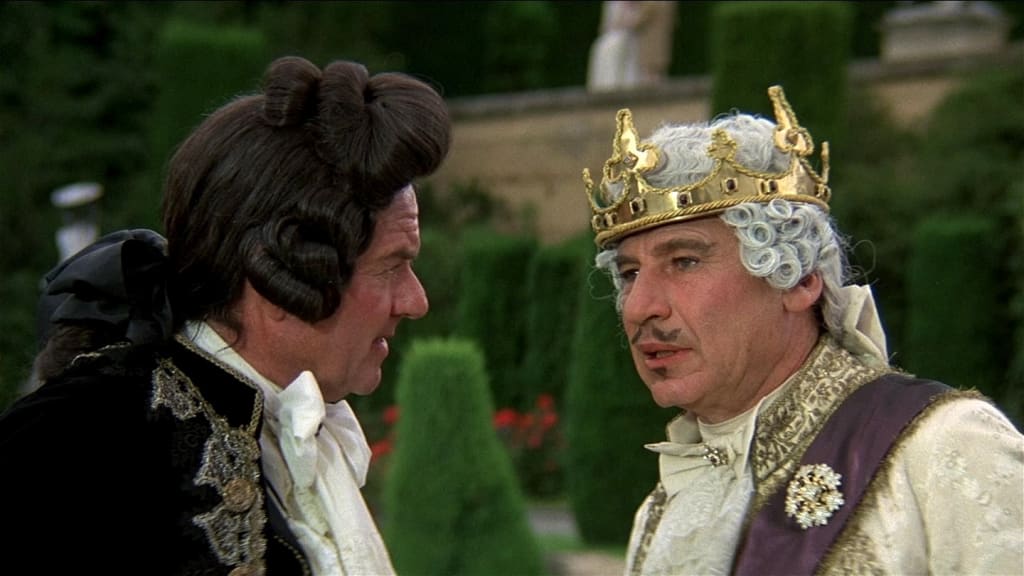
Finally, we land in the French Revolution, where Brooks plays Louis XVI as a mustachioed, beauty-marked tyrant who indulges in every vice imaginable. He plays chess with real people as pieces, hosts an orgy on a croquet court, and delights in proclaiming, "It’s good to be the king!" Harvey Korman shines as "Count de Money" (or as he irritably corrects, "De MO-NAY!"), and the absurdity peaks with a plot to swap the king with a look-alike servant, the "piss garçon," to escape the guillotine.
Brooks’ version of history is a gleeful whirlwind of nonsense, satire, and slapstick, with no era left unscathed. It’s a wild ride that takes history’s most solemn moments and turns them into punchlines, reminding us that with Brooks at the helm, nothing is sacred, and everything is funny.
History of the World Part 1 Official Trailer HD - Mel Brooks (1981)
Connecct with me on Facebook
About the Creator
Tom Baker
Author of Haunted Indianapolis, Indiana Ghost Folklore, Midwest Maniacs, Midwest UFOs and Beyond, Scary Urban Legends, 50 Famous Fables and Folk Tales, and Notorious Crimes of the Upper Midwest.: http://tombakerbooks.weebly.com
From ad men to mad men
It's after 2am in the morning when a local police patrol vehicle in Northern New Jersey spots a figure costumed as Quasimodo, The Hunchback of Notre Dame, proceeding southbound on the sidewalk along Lydecker Street. Though the hunchback’s costume stuffing offers added insulation, it's January, and friggin’ freezing. Carefully, the officers slow down, gently question the subject, and offer him a ride home.
By David W. Maury8 days ago in Humor
The World Is on Fire, But My Freezer’s Been Stockpiling Since 2017
📦 Section 1: Frozen Time Capsules – A Love Letter to Foods That Shouldn't Be Alive There comes a moment in every adult’s life when you open your freezer, stare into the icy abyss, and realize you’ve been harboring culinary fugitives from the past.
By The Pompous Postabout 3 hours ago in Humor




Comments
There are no comments for this story
Be the first to respond and start the conversation.