
Entanglement and quantum Teapots.
Absurd tales of quarks, neutrons and neurons.

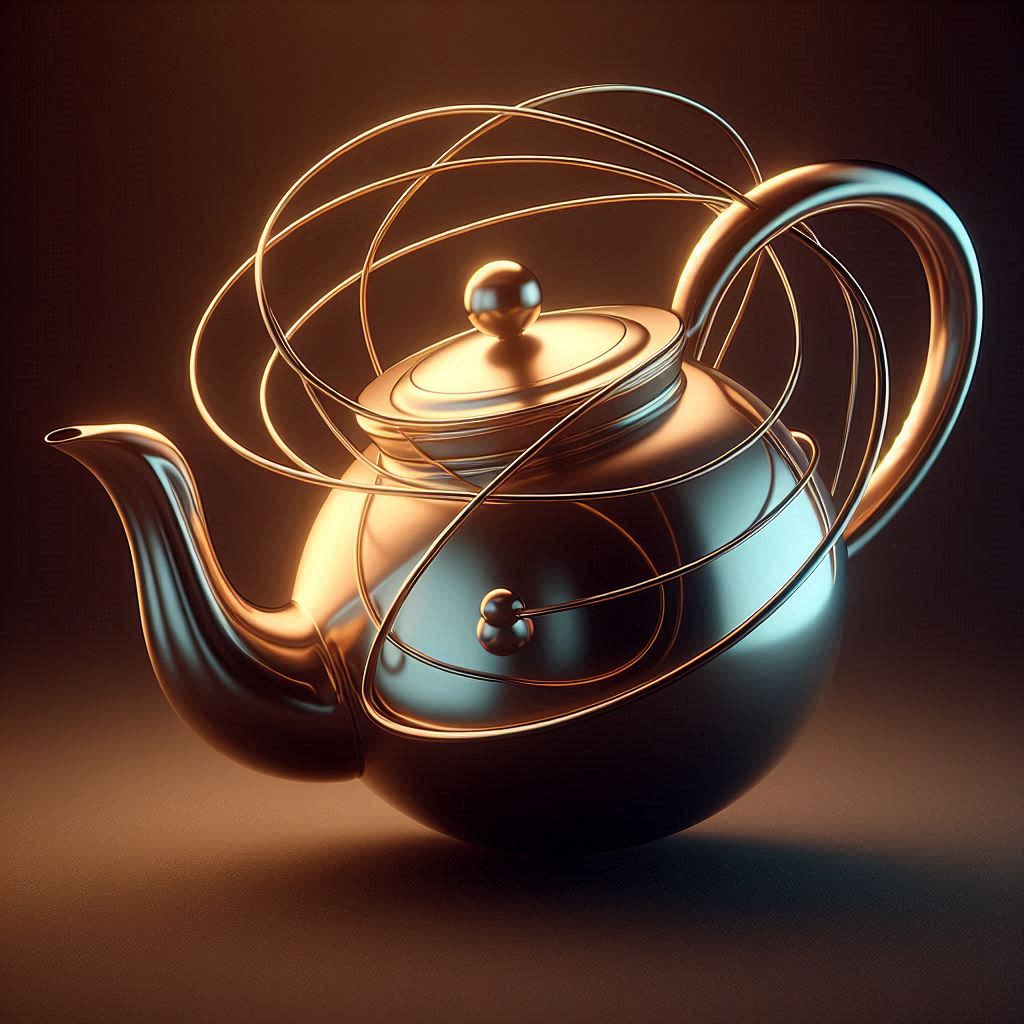
The Quantum Teapot.
Quaint indeed is the tale told of the village of Avon-upon-the-Heath, where lived an eccentric physicist named Professor Phi Quark. Professor Quark was renowned for his wild theories and peculiar experiments. His colleagues often mused that he had more quarks in his brain than neurons.
But the professor paid them no mind; he was too busy tinkering away in his cluttered laboratory.
One chilly morning, as the sun peeked through the mist, Professor Quark stumbled upon a most extraordinary teapot. It sat inconspicuously on a dusty shelf, wedged between a cracked Bunsen burner and a half-eaten sandwich. The teapot was unlike any other—its spout curved at a peculiar angle, and its lid seemed to defy the laws of thermodynamics. But what truly intrigued the professor was the label: “Quantum Teapot, Handle with Uncertainty".
Naturally, Professor Quark couldn’t resist. He dusted off the teapot, adjusted his spectacles, and brewed a cup of tea. As he sipped, he pondered the implications. Could this teapot be in two places at once? Did it exist in a superposition of states...both steeped and un-steeped? And most importantly, could it hold an infinite amount of Earl Grey?

He set up an experiment. Using a particle accelerator, he fired electrons at the teapot. To his astonishment, the teapot emitted a faint glow and hummed like a caffeinated photon. Quark dubbed it the “Quantum Tea-vibration Effect". His colleagues scoffed, but he pressed on.
Late one night, fueled by copious cups of tea, Professor Quark made a breakthrough. He discovered that the teapot’s handle was entangled with the sugar bowl across the room. When he stirred the tea clockwise, the sugar cubes in the bowl spun counterclockwise. It was as if the teapot communicated with the sugar through some cosmic tea leaves.

Word spread, and soon the scientific community descended upon Avon-upon-the-Heath. Professors from Cambridge, MIT, and even Alpha Centauri arrived, armed with laser pointers and skepticism. They debated the teapot’s quantum pedigree, its wave function collapse during high tea, and whether it preferred loose-leaf or bagged.
But then disaster struck. A rival physicist, Dr. Beta Quibble, challenged Professor Quark to a duel—a duel of equations. They faced off in the village square, chalk in hand, ready to prove their theories. The crowd held its breath as they scribbled furiously on the cobblestones.
Dr. Quibble argued that the teapot violated the Pauli Exclusion Principle. Professor Quark countered with a Feynman diagram that showed the teapot exchanging virtual photons with the sugar bowl. The tension escalated until...
With a vexed hiss...The teapot vanished.
In its place stood a virtual note upon the air, made of concentrated steam: “Dear Professors, I’ve decided to explore the multiverse. Perhaps in another reality, I’m brewing cosmic chai. Until then, keep pondering. Yours in uncertainty, Teapot".
And just like that, the Quantum Teapot slipped through a wormhole, leaving behind a perplexed crowd and a trail of faint aromatic peppermint tea.
Professor Quark retired to his laboratory, content. He knew that some mysteries were meant to remain unsolved, like the flavor of a parallel universe’s chamomile. And so, he brewed a fresh pot of tea, gazed out the window, and wondered what other curious artifacts lay hidden in the quantum attic of reality.

Even in the most mundane objects, the universe winks at us, inviting us to explore and delight in absurdities.
+++++++++++++
Superposition of state:
Quantum superposition is a fundamental principle of quantum mechanics that states that linear combinations of solutions to the Schrödinger equation are also solutions of the Schrödinger equation. This follows from the fact that the Schrödinger equation is a linear differential equation in time and position. (Eh?).

Wave function collapse:
In quantum mechanics, the collapse of the wave function is a fundamental concept that describes when a wave function transitions from a superposition of states to a single state. This occurs when a quantum system interacts with its environment, such as when a measurement is taken.

The Pauli Exclusion Principle:
Pauli's Exclusion Principle states that no two electrons in the same atom can have identical values for all four of their quantum numbers. In other words, (1) no more than two electrons can occupy the same orbital and (2) two electrons in the same orbital must have opposite spins.

The Feynman Technique: How to Learn Anything Quickly
Feynman believed that learning a new skill or concept should be an active process of "trial and error, discovery, free inquiry". He held that if you couldn't explain something clearly and simply it was because you didn't understand it well enough.

++++++++++++++++++++++++++++++++++++++++++++++++++++
About the Creator
Antoni De'Leon
Everything has its wonders, even darkness and silence, and I learn, whatever state I may be in, therein to be content. (Helen Keller).
Tiffany, Dhar, JBaz, Rommie, Grz, Paul, Mike, Sid, NA, Michelle L, Caitlin, Sarah P. List unfinished.
Keep reading
More stories from Antoni De'Leon and writers in Humor and other communities.
From ad men to mad men
It's after 2am in the morning when a local police patrol vehicle in Northern New Jersey spots a figure costumed as Quasimodo, The Hunchback of Notre Dame, proceeding southbound on the sidewalk along Lydecker Street. Though the hunchback’s costume stuffing offers added insulation, it's January, and friggin’ freezing. Carefully, the officers slow down, gently question the subject, and offer him a ride home.
By David W. Maury5 days ago in Humor
Canada Conducts Massive Airstrikes on Minnesota to Aid Heroic Protesters Battling Authoritarian I.C.E. Regime
In an act of compassion, the Canadian Armed Forces have initiated massive airstrikes against key centers of oppression in Minneapolis, in an action dubbed "Operation De-Icing" that supports local protesters demanding an end to the brutal regime of U.S. Immigration and Customs Enforcement (I.C.E.).
By Scott Christenson🌴3 days ago in Humor



Comments (1)
I especially loved how the sugar cubes spun counterclockwise when the tea was stirred clockwise