
Challenging Mathematical Calculations: Exploring Unconventional Results and Illusions
Unveiling the Mysteries of Mathematical Errors and Misconceptions
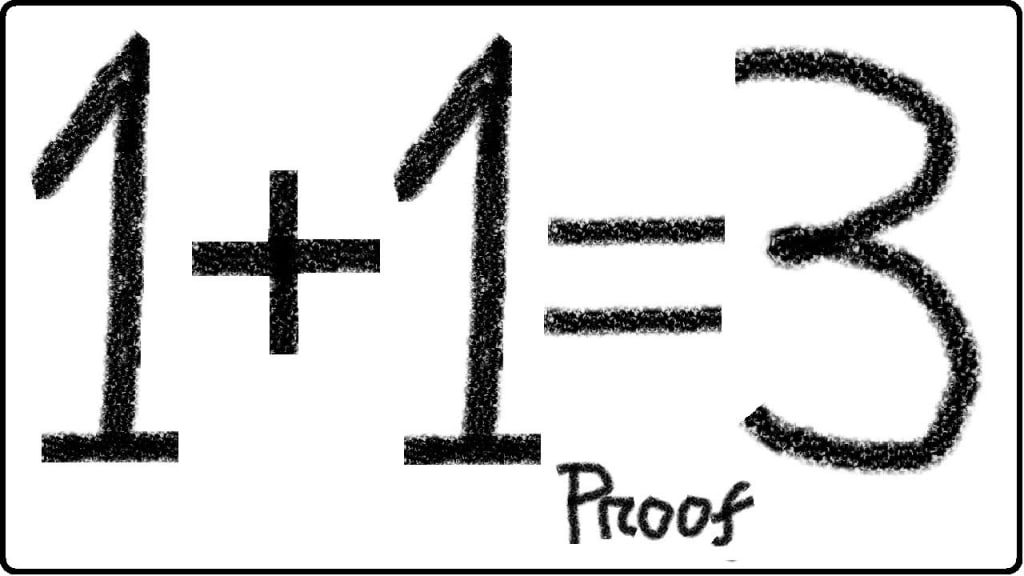
Challenging Mathematical Calculations: Exploring Unconventional Results and Illusions
Subtitle: Unveiling the Mysteries of Mathematical Errors and Misconceptions
Introduction:
Mathematics is a field known for its precision and logical reasoning. From basic arithmetic to complex equations, it provides a framework for understanding the world around us. However, occasionally, intriguing mathematical calculations emerge that challenge our established beliefs. In this article, we will delve into some thought-provoking calculations that appear to defy conventional mathematical rules. We will explore the claims that 1 plus 1 equals 3 and 2 plus 2 equals 5, seeking to uncover the errors and misconceptions that lead to these seemingly contradictory results. Additionally, we will discover a quick technique to mentally multiply any number by 11. Join us on this journey as we unravel the mysteries behind these peculiar mathematical phenomena.
Unveiling the Fallacy: 1 plus 1 equals 3?
The claim that 1 plus 1 equals 3 is a startling proposition that challenges our fundamental understanding of arithmetic. Robbie, an educator, and filmmaker, presents a mathematical calculation to support this claim. However, as we analyze the calculation step by step, we will identify where the errors occur and how they lead to the incorrect conclusion.
Robbie's Calculation Process:
Robbie begins by considering one on the left-hand side and another one on the right-hand side. He then rewrites the left-hand side as 41 minus 40 and the right-hand side as 61 minus 60. At this point, there seems to be no mathematical contradiction.
Further dissecting the calculation, Robbie breaks down 41 into 16 plus 25, with 40 as the remaining value. Similarly, he decomposes 60 into 36 plus 25, with 60 as the remaining value. Again, there appears to be no contradiction.
Robbie continues by expressing 16 as 4 squared and 25 as 5 squared, subtracting the resulting 14 as 2 times 4 times 5. Likewise, he rewrites 36 as 6 squared and 25 as 5 squared, subtracting the resulting 60 as 2 times 6 times 5. Up to this point, the calculation seems to follow mathematical rules.
The crucial turning point arrives when Robbie applies the formula (x - y)² = x² + y² - 2xy. Taking x as 4 and y as 5, he calculates (4 - 5)², which simplifies to 4² + 5² - 2(4)(5). However, he overlooks that the left-hand side already represents 1², leading to an erroneous cancellation of terms.
As a result, Robbie concludes that 4 equals 6 by dividing both sides by 2, and subsequently, 2 equals 3. However, the incorrect cancellation of terms and the flawed application of the mathematical formula are responsible for this fallacious conclusion.
Analyzing the Illusion: 2 plus 2 equals 5?
In addition to the claim that 1 plus 1 equals 3, Robbie presents another mathematical illusion: 2 plus 2 equals 5. Similarly, we will scrutinize the calculation and uncover the errors that lead to this apparent contradiction.
Robbie's Calculation Process:
Robbie sets both the left-hand side and the right-hand side as 0, allowing him to manipulate the numbers freely. By rewriting 0 as 16 minus 16 on the left-hand side and 0 as 20 minus 20 on the right-hand side, Robbie creates the illusion that they can go back and forth.
Next, Robbie decomposes 16 into 12 minus 4 and expresses 20 as -15 minus 5. This step appears to follow mathematical principles, but the crucial error lies ahead.
By extracting a common factor of 4 from the left-hand side and 5 from the right-hand side, Robbie simplifies the equation to (4 - 3 - 1) = (5 - 3 - 1). He erroneously cancels out the terms that match on both sides, leading to the conclusion that 4 equals 5.
Dissecting the Errors:
In both calculations, the fallacies arise from the flawed application of mathematical principles and incorrect cancellation of terms. The illusory results are not a reflection of mathematical truths but rather a consequence of the errors made during the calculations.
Understanding the Quick Multiplication Technique:
Apart from exploring these mathematical illusions, let's delve into a useful technique to multiply any number by 11 mentally. This technique allows for swift calculations without the need for a calculator.
The Quick Multiplication Technique:
To multiply a two-digit number by 11, consider the digits separately. Place the first digit on the left side, leave a gap, and place the second digit on the right side. Then, simply add the two digits together to obtain the result.
For instance, multiplying 25 by 11 follows this technique. Separating the digits as 2 and 5 and adding them results in 7. Therefore, 275 is the product of 11 and 25. Similarly, multiplying 43 by 11 involves separating the digits as 4 and 3, which adds up to 7. Hence, 473 is the product of 11 and 43.
Exceptions to the Technique:
Although the technique generally works for multiplying any number by 11, there are exceptions. For example, when multiplying 11 by 49, the sum of 4 and 9 is 13. In this case, the calculation involves carrying the tens place, resulting in 539.
Conclusion:
Mathematics is a realm of precision and logical reasoning, but occasionally, intriguing calculations emerge that challenge our beliefs. The claims that 1 plus 1 equals 3 and 2 plus 2 equals 5 captivate our attention, drawing us into the exploration of their errors and misconceptions. Through careful analysis, we have exposed the fallacies in these calculations, highlighting the importance of adhering to established mathematical principles.
Furthermore, we have learned a quick mental technique to multiply any number by 11, empowering us with a handy tool for rapid calculations. While mathematical illusions may entice us with their seemingly extraordinary results, a critical examination reveals the errors and misconceptions that underpin them.
Remember, mathematics is a powerful tool for understanding the world, and through rigorous application and adherence to its principles, we can continue to unravel its mysteries and advance our knowledge.
About the Creator
Keep reading
More stories from Ebenezer Nyame and writers in Humor and other communities.
From ad men to mad men
It's after 2am in the morning when a local police patrol vehicle in Northern New Jersey spots a figure costumed as Quasimodo, The Hunchback of Notre Dame, proceeding southbound on the sidewalk along Lydecker Street. Though the hunchback’s costume stuffing offers added insulation, it's January, and friggin’ freezing. Carefully, the officers slow down, gently question the subject, and offer him a ride home.
By David W. Maury4 days ago in Humor
Canada Conducts Massive Airstrikes on Minnesota to Aid Heroic Protesters Battling Authoritarian I.C.E. Regime
In an act of compassion, the Canadian Armed Forces have initiated massive airstrikes against key centers of oppression in Minneapolis, in an action dubbed "Operation De-Icing" that supports local protesters demanding an end to the brutal regime of U.S. Immigration and Customs Enforcement (I.C.E.).
By Scott Christenson🌴2 days ago in Humor




Comments
There are no comments for this story
Be the first to respond and start the conversation.