
You’ve Already Lost and You Don’t Know It
The Sunken Time Fallacy. Why We Stay Too Long, and What It Teaches Us

On a cold January morning in 2007, the Washington Post staged an experiment: world-class violinist Joshua Bell played incognito in a D.C. subway station. Thousands rushed past, many on their way to jobs they didn’t love, commitments they couldn’t shake, or routines they no longer questioned. A handful stopped to listen, but most were too deep in their daily grind to pause. It’s a fitting metaphor for a pervasive bias we carry: the sunk cost fallacy, or what might be more intuitively called the sunken time fallacy.
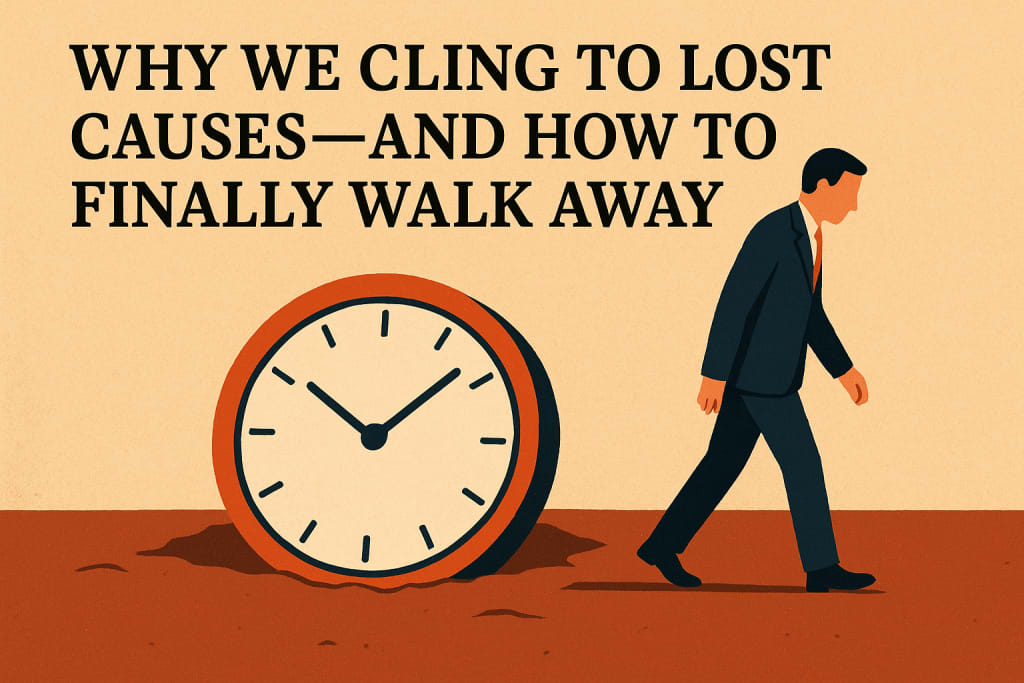
At its core, the fallacy describes our tendency to stick with decisions—jobs, relationships, projects—simply because we’ve already invested time, money, or energy. To abandon them feels like admitting waste, so we double down, even when reason tells us otherwise.
A Bias Older Than Behavioral Economics
Though the formal concept was popularized by economists in the 20th century, the roots of the sunk cost fallacy stretch back centuries. Ancient military history is littered with cautionary tales: generals who refused to retreat from unwinnable battles because “too much had already been sacrificed.” The British, for instance, prolonged their 19th-century Afghan campaigns long after it became clear that occupation was untenable. In business, one need look no further than the doomed Concorde supersonic jet program—kept alive for years because so much money had already been spent, despite forecasts that it would never be profitable.
Psychologists later confirmed what history had illustrated: humans are remarkably poor at “cutting losses.” Richard Thaler, a Nobel laureate in economics, famously showed how people’s decisions consistently deviated from rational cost-benefit analysis. Instead of evaluating future prospects, we anchor ourselves to the past—whether that past is measured in dollars or hours.
Why It’s So Common
The fallacy thrives because it feeds on deeply human instincts. Three stand out.
1. Loss aversion. Psychologists Daniel Kahneman and Amos Tversky showed that we feel the pain of losses more acutely than the pleasure of gains. Walking away from something we’ve invested in—even if it’s failing—feels like an unbearable defeat.
2. Identity and pride. Abandoning a long-term pursuit isn’t just practical; it can feel personal. The graduate student who leaves academia after seven years isn’t simply choosing a new career path—they may feel like they’re betraying their past self.
3. Social pressures. Culturally, persistence is lionized. “Never give up” is stitched into motivational posters and commencement speeches alike. To quit, even wisely, can look like weakness in a society that prizes grit.
Combine these forces, and it’s no wonder people pour years into careers that drain them, relationships that stunt them, or hobbies they no longer enjoy.
Lessons From the Fallacy
Yet if we look closely, the sunken time fallacy is not merely a trap; it’s also a teacher.
First, it reminds us that time is a non-recoverable resource. Money can be re-earned, but a decade spent in the wrong job cannot be refunded. Recognizing this forces a recalibration: decisions should be based not on what we’ve spent, but on what’s left to gain.
Second, it teaches humility. We are not as rational as we like to think. Acknowledging our biases makes us more compassionate toward ourselves and others when we struggle to let go.
Finally, it highlights the power of reframing. Instead of asking, “Have I wasted these years?”, we might ask, “What did those years teach me that I can carry forward?” Few experiences are pure waste if they sharpen judgment, resilience, or perspective.
Breaking Free
The practical antidote isn’t ruthless detachment—it’s mindful reassessment. Investors sometimes use the phrase, “Don’t throw good money after bad.” Applied more broadly: don’t throw good years after bad ones. That might mean reevaluating a degree program, reconsidering a business idea, or even ending a relationship that no longer serves either party.
Some experts recommend mental resets: imagining you are starting fresh today, with no prior investment. Would you still choose the same path? If the answer is no, the sunk costs should not be dictating your future.
Closing Reflection
We all have our versions of Joshua Bell’s subway concert—moments where we’re too entrenched in the march of past choices to recognize the opportunity, or freedom, right before us. The sunken time fallacy doesn’t just explain why we cling; it invites us to consider how to let go.
To leave something behind isn’t necessarily failure. It can be a declaration that your future is worth more than your past. And perhaps the greatest lesson of the fallacy is this: time already spent is gone, but time ahead is yours to reclaim.
Thanks for reading.
About the Creator
Gage
I write about stuff.
Restoring Balance in Medicine: Andrew Rudin MD on Why Prevention Must Come First
Modern healthcare has delivered extraordinary achievements. Medications control conditions that once shortened lives. Procedures restore heart rhythm, open blocked arteries, and prevent sudden cardiac events. Imaging technologies allow physicians to detect disease earlier and with greater precision than ever before. Yet despite these advances, many patients feel that care often begins too late. Treatment is efficient, but prevention is inconsistent. According to Andrew Rudin MD, this imbalance now represents one of the most significant challenges facing modern medicine.
By Dr. Andrew Rudin4 days ago in Humans
Wild Card Weekend Recap: What Happens Now?
I think I figured out why I love Wild Card Weekend so much. It's because it's the first playoff anything of the calendar year. The NFL season starts in the fall, and once upon a time, the champion was crowned either on or slightly before New Year's. The evolution of the NFL schedule has resulted in the playoffs starting just into the New Year, and currently, the final week of the season falls on the first weekend of the New Year, with Wild Card Weekend coming a week after that. So yes, chronologically, the NFL's Wild Card Weekend serves as the first playoff anything of the calendar year.
By Clyde E. Dawkins5 days ago in Unbalanced



Comments
There are no comments for this story
Be the first to respond and start the conversation.