
"Wired Within: The Hidden Patterns of the Human Mind"
Uncovering How Thoughts, Emotions, and Behavior Shape Our Lives and Decisions
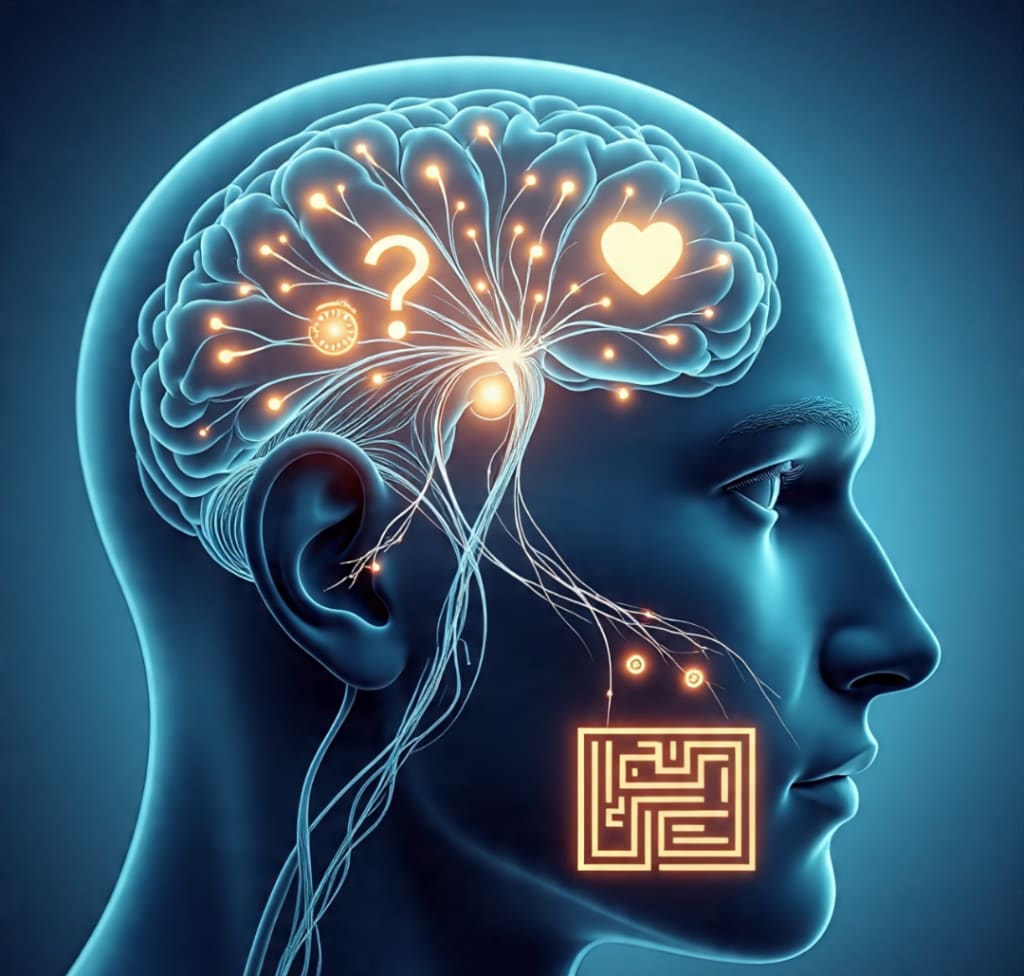
Wired Within: The Hidden Patterns of the Human Mind
Uncovering How Thoughts, Emotions, and Behavior Shape Our Lives and Decisions
---
It was nearly midnight when Ava finally closed her laptop. She had been lost in thought, again. Her assignment on human behavior was due the next day, but she kept circling back to a question that had no clear answer: Why do we think the way we do?
The human mind is a marvel. Every day, billions of people make decisions, form opinions, experience joy, sadness, anxiety, and love — all orchestrated by a mass of tissue weighing just three pounds. But what truly governs those experiences? Are we fully aware of our own thoughts, or are they shaped by unseen forces within us?
Ava’s interest in psychology wasn’t just academic. Over the past year, she'd watched her best friend, Maya, change in ways she couldn't understand. Once outgoing and confident, Maya had become withdrawn and anxious. Ava had struggled to support her, wondering what was happening behind the quiet stares and forced smiles. The textbook answers felt too abstract. She wanted to know how the patterns in our minds actually work — not just clinically, but personally.
Psychology offers several lenses through which to examine the mind. One of the oldest is behaviorism — the idea that behavior is learned through conditioning. Pavlov’s dogs salivated at the sound of a bell because they were trained to associate it with food. In the same way, humans associate experiences with emotions and reactions. A child ignored by their parents might grow up craving validation. A student scolded for speaking out may develop a fear of public speaking.
But that’s only part of the story.
Cognitive psychology, a more modern approach, suggests that it’s not just external factors that shape us, but the way we interpret those factors. Two people can go through the same breakup, yet one might feel liberated while the other spirals into depression. Why? Because their internal narratives — the thoughts they believe about themselves and the world — are different. These mental scripts often run silently in the background, shaping how we perceive reality.
Ava thought about Maya again. She remembered a conversation they had months ago, when Maya confessed, "I feel like I’m failing at everything, even when I’m not." It wasn’t just what was happening in her life — it was how she processed those events.
The brain’s structure offers more clues. Deep inside is the amygdala, the brain's emotional alarm system. It detects threats and activates fear responses, often before the conscious mind even realizes what's happening. It’s why a sudden loud noise makes your heart race, or why old trauma can be triggered by something as simple as a smell or a word.
Nearby is the prefrontal cortex, the rational decision-maker. It's responsible for planning, impulse control, and logical thinking. Ideally, it keeps the emotional brain in check. But when stress is high — say, during a fight, a breakup, or even a big test — the emotional brain can hijack our responses, leading us to react impulsively or irrationally.
As Ava researched deeper, she found something that resonated: Neuroplasticity — the brain's ability to rewire itself based on experience. This meant that even painful patterns could change. Thoughts are not fixed. With practice, people can reshape how they think, feel, and behave.
This idea gave her hope — not just for her assignment, but for Maya.
She remembered reading about cognitive behavioral therapy (CBT), a technique used to help people identify and challenge distorted thoughts. A person who constantly thinks, "I'm not good enough," can learn to reframe that thought into something more accurate, like, "I’ve made mistakes, but I’m still learning." Over time, this reshaping changes the brain’s wiring — forming new, healthier pathways.
Ava realized that psychology wasn't just about studying disorders or theories. It was about understanding the silent mechanisms within each of us — the ones that shape how we love, fear, trust, and heal. The mind is like a city at night: lit up by familiar roads, yet still filled with dark alleys we’ve never explored.
The next day, Ava submitted her assignment with a new sense of clarity. She titled it “Wired Within: The Hidden Patterns of the Human Mind.” But the real reward wasn’t the grade she’d get. It was what came afterward — when she sat down with Maya and said, “You don’t have to go through this alone. And I think I finally understand a little more about why things feel the way they do.”
Because understanding the mind doesn’t just explain what it is — it helps us connect, heal, and grow together.
About the Creator
Keep reading
More stories from Muhammad Saad and writers in Humans and other communities.
Inside the Human Mind: The Mechanics of Thought and Behavior
Imagine waking up on a rainy morning. You feel sluggish, maybe even irritable, without really knowing why. You skip breakfast, rush through traffic, snap at a co-worker, and by lunchtime, you’re wondering: Why am I like this today? The answer lies in the invisible network of psychological forces that work beneath our awareness—shaping our thoughts, emotions, and behaviors. Human psychology isn’t just about what we think or feel in a moment; it’s a vast interplay of biology, experience, memory, and social context. Understanding this interplay is like opening a map to the mind—and perhaps, to ourselves. At the core of human psychology is the brain—an organ of staggering complexity. With over 86 billion neurons firing in constant communication, it manages everything from heartbeats to daydreams. Yet, psychology teaches us that the brain isn’t just a machine. It's shaped by our relationships, our traumas, and our culture. Take, for instance, the concept of cognitive biases. These are mental shortcuts our brain uses to make sense of overwhelming information. They're incredibly useful—until they’re not. The confirmation bias, for example, causes us to favor information that confirms what we already believe, even if it's wrong. This explains why people argue passionately about politics or climate change, even when presented with clear evidence. Our brains don’t just process facts; they defend our identities. Then there's emotional regulation, a concept central to psychology. Emotions aren't random. They're survival tools. Fear kept our ancestors alive. Joy bonded families and tribes. But in modern life, the same mechanisms can cause anxiety in traffic, jealousy on social media, or burnout at work. The field of psychology studies how we can better understand and manage these feelings—through therapy, mindfulness, or even small habits like gratitude journaling. But perhaps the most fascinating part of psychology is identity—the story we tell ourselves about who we are. From childhood, we absorb roles, expectations, and messages: You’re the smart one, You’re too sensitive, Boys don’t cry. Over time, these messages form a mental blueprint. This is called the self-concept, and it becomes the lens through which we view the world. This self-concept can empower—or limit—us. For example, someone who grows up believing they are "bad at math" may avoid opportunities in science or finance, regardless of their true potential. A psychologist might work with this person to uncover the root of that belief, challenge its truth, and gradually reshape the narrative. But we don't just carry our past inside us—we carry others. Humans are deeply social creatures, and much of what we think or feel is influenced by those around us. The famous Stanford prison experiment demonstrated how easily people conform to social roles and expectations, even when it contradicts their personal values. More recent research into mirror neurons shows how our brains are wired to empathize—we literally feel what others feel. In today’s fast-paced, digital world, our mental health is under more strain than ever. Anxiety and depression are at all-time highs, particularly among young people. But the good news is that awareness of mental health is also growing. Tools from psychology are becoming more mainstream—from therapy apps to school wellness programs to corporate mindfulness training. Still, one of the most powerful insights from psychology remains timeless: change is possible. Neuroplasticity—the brain’s ability to rewire itself—means that we’re not stuck with the same habits or thoughts forever. With time, support, and effort, people can break cycles of addiction, heal from trauma, or learn to live with purpose. So the next time you find yourself reacting emotionally, making a snap judgment, or feeling stuck in a pattern, remember: that moment is shaped by countless layers—biology, belief, experience, and context. You’re not broken. You’re human. And understanding psychology isn't about labeling yourself. It’s about getting curious. Because once you understand how the mind works, you can begin to work with it—and maybe even change your life.
By Muhammad Saad 8 months ago in Humans
First Date Planning Tips To Ensure Success And Positive Connection
The initial date determines the atmosphere of a prospective relationship and careful consideration at this stage is important. An effective first date enables both the parties to be in a space in which they feel at ease, relaxed and receptive to being connected. As a positive influence, it is important to consider the setting, activities, and timing, which may decrease the anxiety and provide positive interactions. Efforts, courtesy, and sincere interest on the first date can make an impact because it shows that one has planned the date well and has thought about it. Making strategic choices will keep both the partners entertained as they get to know each other in terms of compatibility, interest and chemistry. These aspects are to be prioritized in order to have a meaningful memorable experience.
By Mark Hipsterabout 8 hours ago in Humans
Who is your "Person"?
It's important to recognize that you cannot go through life as easily on your own. My name is Elizabeth and I'm a survivor of child abuse and horrific trauma. Healing from trauma is not a quick fix and recognizing that it will take time, is part of the struggle.
By Elizabeth Woods5 days ago in Psyche



Comments
There are no comments for this story
Be the first to respond and start the conversation.