
Wired to Wonder: Unlocking the Secrets of Human Psychology
An Exploration of How Our Minds Work, Why We Behave the Way We Do, and What It Means for Our Future
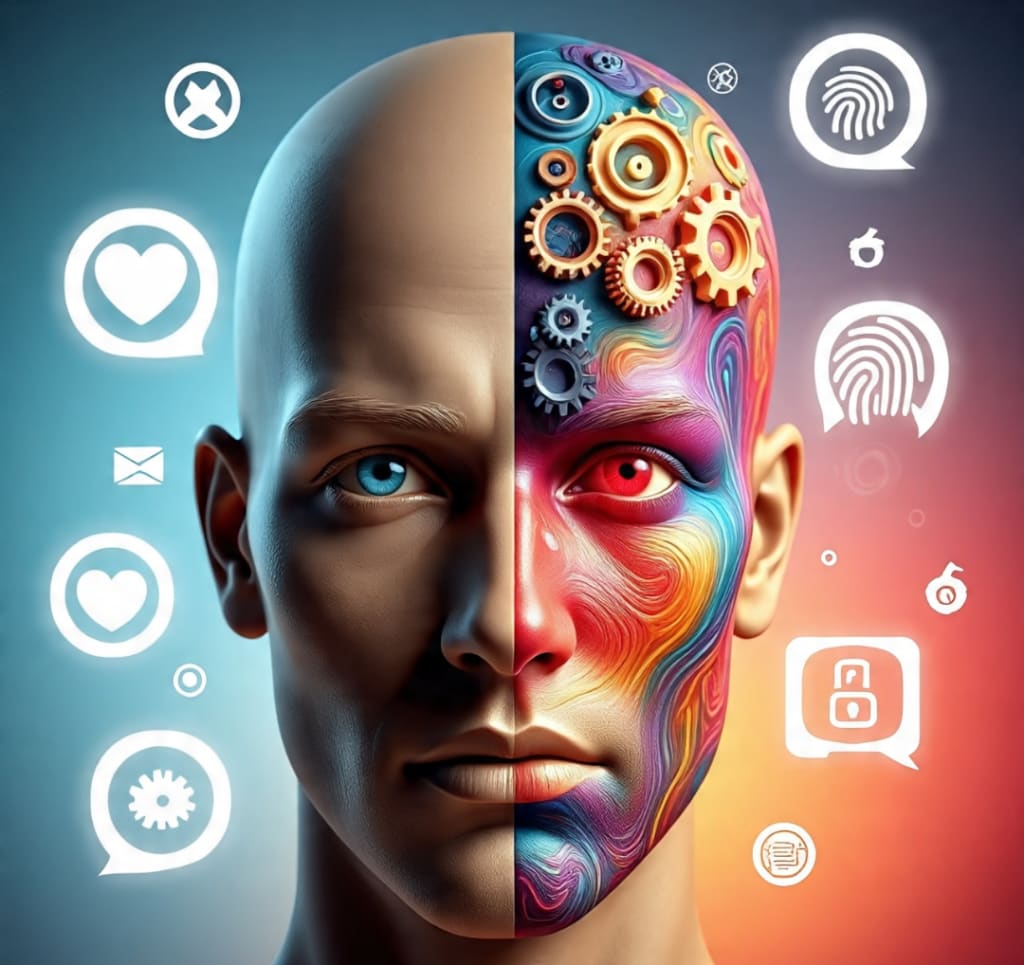
Sixteen-year-old Maya stared at the ceiling of her dimly lit bedroom, her thoughts louder than the lo-fi music playing in the background. Why do I feel so anxious before talking to people? Why does one compliment lift my mood for hours, while one insult ruins my day?
She didn’t know it yet, but her late-night wondering was a very human thing to do.
In school, psychology sounded like just another elective. But after an awkward group presentation and a spiraling week of self-doubt, Maya was determined to understand what was really going on inside her head. She wasn’t alone—humans have been trying to decode their minds for thousands of years.
---
The Search for Self
The next day, Maya stayed after class to ask her psychology teacher, Mr. Alvarez, a question.
“Why do I care so much about what people think? Even strangers?”
Mr. Alvarez smiled. “That’s a great question. The short answer is: survival. The long answer? It’s about identity, belonging, and evolution.”
He explained that humans evolved in social groups. Thousands of years ago, being rejected by the group could mean death. So the brain developed warning systems—like anxiety—to keep us alert to social threats.
“What you feel before a presentation,” he said, “is your brain treating it like a life-or-death moment, even though it’s not.”
Maya was surprised. “So I’m not just weird or overly sensitive?”
“Not at all. You’re wired to wonder about others’ opinions. It’s how we survived and how we connect.”
---
The Two Minds
Maya dove into books, videos, and articles about psychology. One concept stuck with her: the idea of two systems in the brain—System 1 and System 2.
System 1 was fast, automatic, emotional. It reacted instantly to a loud sound or a scary face. System 2 was slower, more deliberate—the part that solved math problems or wrote essays.
It made sense. When Maya saw someone laugh while looking at her, System 1 whispered, They’re laughing at you. System 2 tried to reason, Maybe it’s a coincidence, but by then, her heart was already racing.
Knowing this gave her a strange sense of control. If she could pause and let System 2 catch up, maybe she could manage her reactions better.
---
The Emotion Paradox
One rainy afternoon, Maya noticed a boy at school crying after a phone call. No one went near him.
She thought about something else she’d learned: humans are naturally empathetic, but also uncomfortable with strong emotions—especially sadness.
She remembered reading about mirror neurons—tiny parts of our brain that activate when we see someone else feeling something. They’re why we wince when someone stubs their toe, or feel joy when a friend succeeds.
Empathy was wired into us. But society often told us to hide it. Boys were told not to cry, and girls were called dramatic.
That day, Maya walked over and offered the boy a tissue. He didn’t say much, but he smiled. And for the first time, she felt like she understood emotions—not as weaknesses, but as signals meant to connect us.
---
The Puzzle of Personality
One evening, Maya took a personality quiz online. She’d read about the Big Five personality traits: Openness, Conscientiousness, Extraversion, Agreeableness, and Neuroticism. Psychologists used them to understand human behavior across cultures and ages.
Her results showed high openness and introversion—exactly what she expected.
It hit her that there was no “normal” brain. People processed the world differently based on genes, upbringing, and experience. Someone might seem cold but just be cautious. Another might be loud because they’re masking insecurity.
This changed how she saw her classmates. Maybe the girl who bragged all the time wasn’t arrogant—maybe she needed reassurance. Maybe the boy who never spoke up wasn’t disinterested—maybe he was anxious, just like Maya.
---
Healing and Growth
In her final project for psychology class, Maya created a presentation titled “The Brain is Not the Enemy.” She talked about how understanding anxiety, emotion, and personality helped her stop fighting herself—and start accepting her mind as something to work with, not against.
“Psychology doesn’t give you all the answers,” she concluded, “but it gives you a better map.”
After the presentation, a quiet student from the back of the room approached her.
“I feel the same way,” they said. “Thanks for saying it out loud.”
---
Epilogue: The Ongoing Journey
Maya didn’t become instantly confident. She still overthought text messages and replayed awkward conversations. But she had tools now. She knew her brain was trying to protect her, even when it overreacted.
Human psychology, she realized, wasn’t about “fixing” yourself. It was about understanding the strange, beautiful machinery of the mind—and using that knowledge to live with more compassion, curiosity, and courage.
And as long as humans kept wondering why we are the way we are, the journey of discovery would never end.
About the Creator
Keep reading
More stories from Muhammad Saad and writers in Humans and other communities.
The Power of Positive Love
Jayden was 13 when he first met Micah—a moment that would quietly change the course of both their lives. Jayden had always been the kid who sat at the back of the class, hoodie up, headphones in. He spoke only when called on, avoided eye contact, and had a reputation for being “difficult.” But few people knew that Jayden’s world at home was one of instability—his father gone, his mother working double shifts, the house silent except for the hum of the fridge and the occasional late-night argument next door. Micah was different. He was the kind of kid who smiled at the lunch lady, asked questions in class without embarrassment, and always seemed to be surrounded by people. Yet, unlike others in that crowd, Micah noticed things—especially the things people didn’t say. It started with a pencil. Jayden had forgotten his on a math test day. As he rifled through his backpack in frustration, Micah leaned over and slid a spare onto his desk without a word. No smirk, no comment. Just a small act of kindness. “Thanks,” Jayden muttered. “No problem,” Micah said, smiling like it was the easiest thing in the world. Jayden didn’t forget it. --- Over the weeks that followed, Micah kept reaching out in small ways. Sitting beside Jayden in science. Inviting him to join a group project. Asking him how he was doing—not as a formality, but like he actually wanted to know. Jayden resisted at first. People usually wanted something: a laugh, an answer, an explanation. But Micah just wanted to be there. “I don’t get it,” Jayden finally said one day after school. “Why are you being nice to me?” Micah shrugged. “Because I like you. You’re real. And I think you could use a friend.” That was the first time in years someone had said that to Jayden without pity or sarcasm. It landed somewhere deep—beneath the armor, beneath the skepticism. A simple truth: You’re not invisible. You’re worth knowing. --- Psychologists call it attunement—the ability to truly be present with another person, to make them feel seen, heard, and understood. It’s more than sympathy. It’s connection. And for kids like Jayden, it can be life-changing. When people experience consistent, positive relationships, their brains begin to form new patterns. Instead of running on survival mode—hyper-aware, emotionally guarded, withdrawn—they start to feel safe. The nervous system calms. Trust becomes possible. That’s what was happening to Jayden. At home, nothing had changed. His mom still worked nights, and his little sister still asked questions he didn’t always know how to answer. But something inside him had softened. He didn’t walk around feeling like the world was out to get him anymore. Because now, in one small corner of it, he had a safe place. --- Micah didn’t try to fix Jayden. He didn’t lecture him or pull him into the spotlight. He just stayed close. On bad days, he waited out the silence. On good days, they laughed until their sides hurt. They played video games, rode bikes, and built a treehouse in Micah’s backyard, hammering old planks and naming it “The Fort of Truth.” No lying allowed, no pretending necessary. It was the first place Jayden felt completely himself. One night, as they watched the stars from the fort, Jayden whispered, “Sometimes I still expect you to just stop talking to me.” Micah turned to him, serious for once. “I’m not going anywhere, Jay. Not unless you tell me to.” Jayden didn’t respond. He didn’t need to. The tears that welled in his eyes said everything. --- Studies in adolescent psychology show that one of the most protective factors against anxiety, depression, and self-doubt is having even a single secure relationship. Not a perfect one. Not a dramatic one. Just one person who shows up consistently, listens with empathy, and accepts you as you are. For Jayden, Micah was that person. And over time, Jayden began to change. He started speaking up in class. Laughing more. Making eye contact. Not overnight, and not without setbacks—but steadily. He even joined the art club, encouraged by Micah’s belief that his doodles were more than just distractions. One teacher commented, “Jayden seems lighter this year.” Micah just smiled. --- By the time they turned 15, their bond was unshakable. They weren’t just friends—they were anchors in each other’s lives. And while Micah gave Jayden safety, Jayden gave Micah something too: depth, honesty, the kind of loyalty you can’t fake. One afternoon, Micah said, “You know, I used to think being happy meant being surrounded by people. But I think... it’s really about being known.” Jayden nodded. “Yeah. I think love is when someone sees the mess and stays anyway.” They high-fived after that—because emotional moments always ended in humor with them. But the truth hung in the air, solid and unspoken. --- Takeaway: The power of positive love isn’t reserved for romantic relationships or picture-perfect families. Sometimes, it’s found in the quiet strength of a friend who chooses to stay. Who listens without trying to fix. Who believes in you before you believe in yourself. For Jayden and Micah, that love wasn’t loud. But it was steady. And it changed them both—mind, heart, and everything in between. Because in the end, it’s not about how many people care. It’s about finding one who really does.
By Muhammad Saad 6 months ago in Humans
Silver Screen Magic with Mae West
American actress and singer Mae West became a popular film actress during the Great Depression. She started entertaining in vaudeville, then performed on Broadway, and finally went to Hollywood. She signed up with Paramount Pictures and made her debut in the 1932 film “Night After Night.” She also starred in musicals, comedies, and crime dramas. The American Film Institute named her one of the best classic Hollywood actresses.
By Rasma Raisters4 days ago in Geeks



Comments
There are no comments for this story
Be the first to respond and start the conversation.