
Who was the Most Hated Pharoh?
The Pharaoh who tried to meddle with people's beliefs and religion.
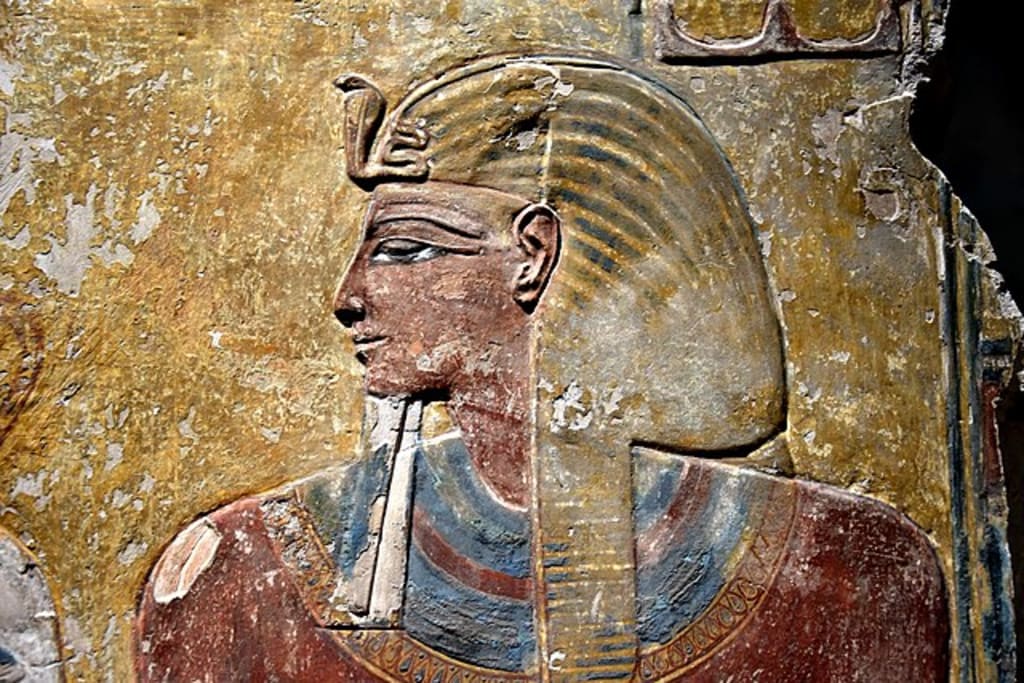
TheAncient Egyptian civilization dates back to nearly 5,000 years ago and was situated alongside the Nile River.
The river was exceptionally important to the civilization for habitation purposes. It allowed the ancient Egyptians to farm and provided a water source to shield them from the hot and dry landscape of the desert.
The Ancient Egyptians were inventive and tenacious, and their civilization lasted around 3,000 years. They invented their calendar system known as the solar calendar and a written language that we know today as the hieroglyphics.
They had a religion that consisted of worshipping over 2,000 gods and goddesses and a steadfast belief in the afterlife. They preserved the bodies of essential figures through mummification and constructed burial tombs for important personalities.
The ancient Egyptians were ruled by kings and queens that were called pharaohs.
Who was Akhenaten?
Akhenaten with his wife Nefertiti and children | Credit: Joy of MuseumsAkhenaten was a Pharaoh of the 18th Dynasty of the New Kingdom of Egypt, and he ruled for roughly 17 years.
He was given the name "Amenhotep" at birth, which means "Amun is pleased." He was born as the second son of Amenhotep III and his queen Tiye. He assumed the position of Pharaoh due to his older brother, Thutmose's unexpected death in childhood.
After his father's passing, he was crowned as Pharaoh, making him the 10th ruler of the 18th Dynasty. He married Nefertiti, making her his queen, and they had at least six daughters together. Nefertiti also had a different fan base of haters, which is a story for another time.
The Egyptian Pharaoh made quite a hateful reputation during his reign. Historians describe him as someone who had big almond eyes, a thin body, and a bloated stomach. His unusually large head made him look like an alien.
His reign as Amenhotep IV lasted five years, during which he followed the policies of his father and the religious traditions of ancient Egypt. During his fifth year as Pharaoh, he introduced new policies of his own.
In the same year, he showcased a dramatic shift in religious beliefs. He changed his name from his birth name to the one we know today: Akhenaten. Akhenaten means 'of great use of to Aten', Aten being a deity in the religion of ancient Egypt and the one Akhenaten followed diligently.
Akhenaten's reign, known as the Amarna Period, is considered the most controversial era in ancient Egyptian history. He is also regarded as the most hated Pharaoh of ancient Egypt.
A Brief History of the Amarna Period
An illustration of the Egyptian god Amun | Credits: Egyptian Family TreeAt the time of his ascension to the throne, the worshipping of many gods was common. Aside from the Egyptian gods, Ra and Osiris, Amun was considered the king of the gods. Amun was also considered the central deity and was the most worshipped god in the Nile Valley at the time.
Even though different cults were worshipping various deities, they co-existed harmoniously. However, the cult of Amun prospered more than the others, and by the time of Akhenaten's ascension, they had amassed more wealth than the royal family. The priests of Amun were rumoured to have owned more lands than the Pharaoh himself.
During the first five years of his reign, Akhenaten allowed the worship of all gods. However, historians believe that by the influence of his mother, Queen Tiye, Akhenaten's attention gradually shifted to one god, Aten.
Later, as a sign of his dedication to Aten, he changed his name to Akhenaten and abolished the worship of all other gods other than Aten. He also moved the capital city of Egypt from Thebes to a city he formed, Akhetaten, which meant 'Horizon of Aten'. The city was later known as Amarna.
During the ninth year of his reign, he declared Aten the supreme deity and announced himself as Aten's only messenger denouncing other priests and religious leaders. He called for vandalism and the destruction of temples dedicated to Amun. Many priests of Amun started to hide texts to preserve their religion. By the end of his tenure as pharaoh, he declared himself and Nefertiti as gods and demanded to be worshipped as such.
This dramatic shift in religion and the introduction of radical policies earned him the reputation of a heretic king who had abolished Egypt's traditional religious rites. After 17 years of controversial rule, Akhenaten passed away and was entombed in a necropolis east of Amarna.
Subsequently, he was referred to as the most hated Pharaoh in ancient Egypt's history.
Now the question here is why?
Sculpture of Akhenaten | Credits: BritannicaThere is no pharaoh more frowned upon than Akhenaten in the course of ancient Egypt's history.
The ancient Egyptians were fans of the status quo and didn't like change. With the reign of Akhenaten came a monumental change in religion for the region.
He abolished the polytheism that was being followed harmoniously and imposed the religion of Aten. He leveraged his wealth to erect mass monuments and temples for the new city. Temples were built without roofs and frustrated royal envoys.
Akhenaten disregarded politics and the affairs of the state after proclaiming himself as a god. He neglected diplomacy in favour of establishing his religion. He only paid attention to diplomatic proceedings of his liking and ignored the rest. After the previous work of the pharaohs to strengthen international relations, this behaviour was considered a disappointment to the people of Egypt and their allies.
Consequences of the Amarna Period
In the years following his burial, Akhenaten's sarcophagus was desecrated. After his death, Egypt reverted to polytheism, and the religion of Aten was discarded and forgotten.
This was done so by Akhenaten's son, who was named Tutankhaten at birth. Upon his ascension, the son changed his name to Tutankhamun to reflect his rejection of Atenism and returned the country to Amun. He also restored Thebes as capital.
Tutankhamun's successors, primarily Horemheb, later tore down the temples and monuments built by Akhenaten and had his name and those of Akhenaten's immediate successors struck from the records.
We can see that history does not remember Akhenaten favourably; however, historians do.
The Historians' Take On Akhenaten
Modern historians and philosophers regard Akhenaten's religion as revolutionary and consider it the birth of monotheism. Akhenaten is the first monotheist on record and ironically has the most notable contribution to history out of all the pharaohs.
Sigmund Freud, a distinguished psychoanalyst, argued that Akhenaten added something to monotheism. Freud went as far as claiming that a priest of Atenism named Moses then led the followers of the Pharaoh.
However, the creation of Judaism cannot be credited to Akhenaten, but there are some similarities between the two religions. Akhenaten's religious beliefs are thought to significantly influence the later development of monotheistic religious faith. Whether his motivation was to reject polytheism or to suppress the influence of the cult of Amun, he ultimately changed the course of history.
About the Creator
Keep reading
More stories from hamza dogar and writers in Humans and other communities.
She Gave Him the Nose Job he Wanted, by Killing Him.
If there is a story that exceeded the humane limits of manipulation, toxicity, and an imaginary false narrative, then this should be it. This is the story of Shayna Hubers, who lived up to the famous line that goes, "If I cannot have him, no one can."
By hamza dogar3 years ago in Criminal
She Left Me For A Rich Guy, Look How She Turned Out
I sat back and watched you this weekend. I saw the photos. I saw the smiles. I saw the man you chose over the empire we were building. And for the first time in three years, I didn’t feel a sting of jealousy. I felt a cold, hard sense of irony.
By Nanu Nnabuife5 days ago in Humans




Comments
There are no comments for this story
Be the first to respond and start the conversation.