
WHEN THE OREO CRACKED
A personal perspective on growing up white inside a black person’s body
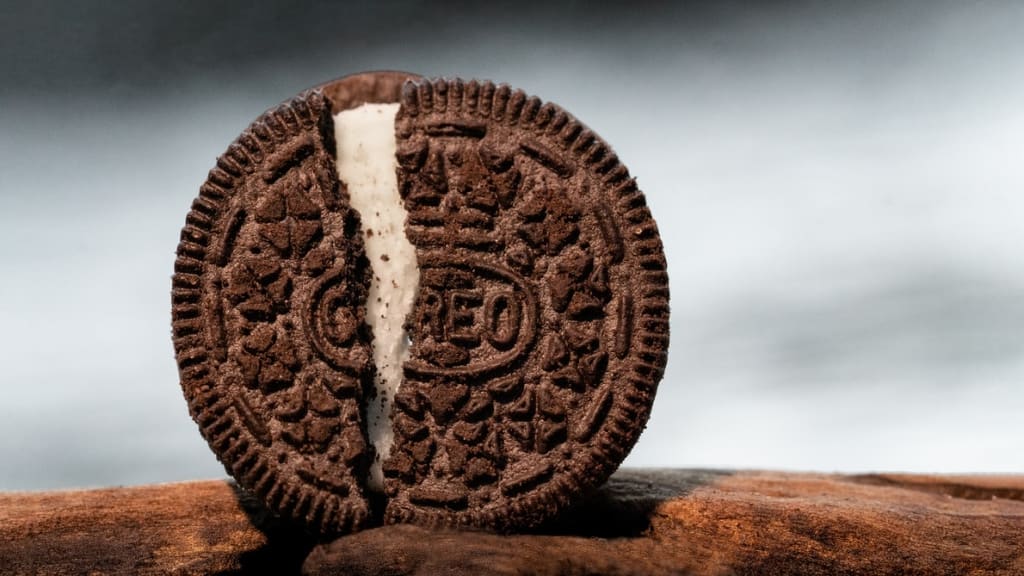
Most everyone who likes eating cookies have experienced Oreos. It’s the two chocolate disks cookie with a white crème filing in the center. This cookie, as a snack, is a classic, both in its taste and history.
THE REAL TRUTH
But the chocolate icing-filled cookie is not the only thing designed that way. Sometimes, and in an altogether different way—yet similar--people are like that, too. I’ve found this to be true firsthand.
As far as I know, with no exaggeration of any kind, I’ve always been an Oreo. A black person outwardly, with a mindset—the essence of myself at the core of my being—being very much a white person. I can’t say when I actually discovered this; perhaps it’s a truth I’ve always known but couldn’t explain-- and yet, I really don’t care what you or anyone thinks about it either. Not to be rude, but please just hear me out. Because, although I might can’t say when exactly it all began, I can tell you the very day something inside me cracked—a sort of Humpty Dumpty kind of fall where all the king’s horses and all the king’s men couldn’t put me back together again--and I saw myself as I really truly am . . . and I ceased from that point on to label myself a white person living inside a black man’s body. It came, somewhat, as a rude awakening.
The truth is, I didn’t know any better.
All my life I was raised (and trained) to think a certain way: to be white.
Everything taught me that.
You see, I didn’t really know I was black until many, many years later. By that I mean, I knew I was African American on the outside (sort of—no one never really confronted me about that or explained to me the difference between living black and thinking white), but inside—deep inside--it was a far, far different story.
All my life I was raised around white people. My neighborhood in Indianapolis, the large metropolitan city where I grew up in Indiana, was exclusively white with a sprinkling of black, Hispanic, Native American, and Asian families, scattered here and there. So, the grocery stores, the schools, the churches—for the most part—in my immediate neighborhood--were exclusively white. Nobody ever sat me down to said: “Now, see here, James, you’re black! A Negro. Which means you’ll have to conform to certain ways of thinking and behaving." No, no one told me that. Not my mama. Not my daddy. No uncles or aunts. Not the friends I played with or the movies I watched or the songs I sang or the church I attended. No one. Not the girls I loved or the boys I fought. Not a soul! So I grew up thinking I was like the majority of the people in the neighborhood or on TV or at church. I thought I was--white.
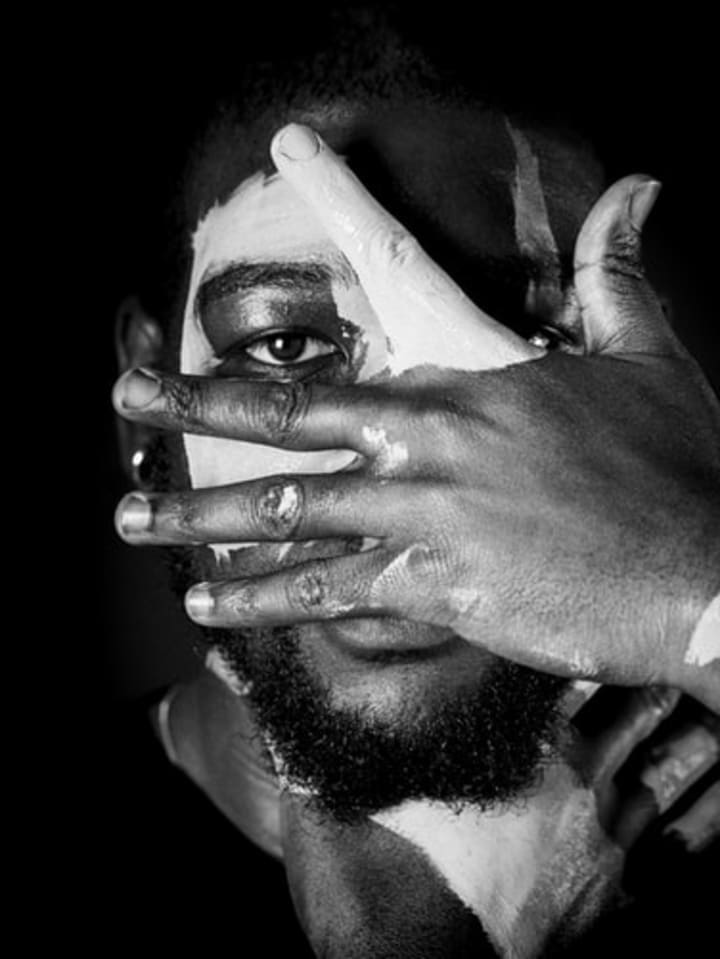
Now, before I go further, let me give you a quick explanation of what I mean by “WHITE.” For me, the term white—or white thinking--wasn’t a racial thing. It was a way of thinking and living and embracing life to its fullest context—a way at self-acceptance that transcended how other people viewed you—more on the order of Thomas Anthony Harris’ 1967 self-help book and its philosophy: “I’m OK--You’re OK.” It’s a way of seeing yourself in the world, not having limits, or personal or social hang-ups of any kind, whatever. Being white to me meant, being ME.
SEPARATING FACT FROM FICTION
And I think a lot of this thinking came from the way I viewed the world, and myself, from what I saw on television. OK, sure, not everything I saw about myself and life, can’t be based solely based on that alone, but a great deal of it was. Let me begin by mentioning I grew up in the 1960s, during the Civil Rights Movement era when it was in full swing and my family’s home TV—we only had one--was an old Black and White unit. And what that meant (now get this), it meant that everyone on TV--from Dick Van Dyke to Bewitched, The Beverly Hillbillies to Gomer Pyle and Gilligan’s Island-- were all of a grayish color, even Bill Cosby, Sammy Davis Jr., and –what’s his name, the dark black guy with the trumpet who smiled a lot . . . Oh, yes, Louis Armstrong—they all looked grayish, too. Just a few shades darker on a B/W set. That’s why, the Nat King Coles and the Martin Luther Kings of that era, were all gray to me--but never really solid black, and everyone else was a light gray, not never purely white. And I don’t know why, but I placed myself in the light gray category. I didn’t see myself as a black person.
What was a black person anyway?
Most of the time, back then, the news portrayed black people as poor, struggling, suffering people, and my parents had done their best to shield my siblings and I from the struggling, the sufferings and, of course, their poverty, too. It seemed these people were always caught up in the struggle of remembering their past. And that seemed—at least to me—that’s what my parents sought to shelter us from. It wasn’t that we were detached from the reality of these things—back then when I was a kid, these things were always on the news—and was very real--but I think what my parents hoped to instill in us was the hope that life could be better. And I think that’s where the “white” mindset came into being for me. And, of course, my education took me away from identifying with most black people, too.
It centered around a different way of thinking.
All the people we studied about in school were white. I’d heard the name Roosevelt and Lincoln and Jefferson, more times than I could spit at. My knowledge of history swelled like the fruits of watermelon seeds spurring a harvest of French revolutions and the Bay of Pigs and of gangsters riddling holes in the sides of cars, with the likes of Hitlers marching across Europe, or of Washingtons cutting down cherry trees, or of little girls pointing the accusing finger at innocent folk during the Salem Witch Hunts. But never once did I heard of the Underground Railroad, or of the song “Left Every Voice and Sing” written by poet James Weldon Johnson as the Black national anthem. And who was Ralph Bunche or Thurgood Marshall; and did Marian Anderson actually sing for presidents? My knowledge was so inadequate. I didn’t know, and didn’t care to know, that the man who discovered three hundred different uses for the peanut was a black scientist named George Washington Carver. It wasn’t until recently that I’ve learned that slaves built the Whitehouse, and the list goes on and on and on---things I didn’t know about because they were not part of my core curriculum. This part of history remained, for me, undiscovered and long overlooked, passed up, erased, or completely forgotten about.
—and so too was a great part of me. I grew up not identifying with my people but living--to some degree--a big lie.
You see, I was an Oreo--as white on the inside as I could possibly be.
Yelp, yum, yum! . . . one of the good kind, too—with double stuffing! I could quote for you Shakespeare and recite the Gettysburg Address by heart. I knew the difference between Picasso’s paintings from works by Monet. I’d listen to Classical music and fell in love with Country and Pop, and I knew most of their artists.

SEEING IS BELIEVING
But then something happened.
The first eye-opening experience that let me know I was an Oreo happened when I was ten years old, at summer camp. I’d just started noticing girls and had fallen head-over-heels in love with a young redhead named Norma. A white girl from a different part of the state. She and I would pair up for all sorts of things and I didn’t want to do any events with no one else other than her. One black kid, an intuitive boy, saw all this and brought it to my attention. As perceptive and straightforward as he was, he pulled me aside one day and whispered in my ear: “Are you an Oreo?” (By that he was asking if I was an uncle tom). I chuckled to myself, digging the toe of s sneaker in the dirt and quickly got away from him. I wasn’t homophobic, but I thought somehow what he asked, was some secret pick-me-up line for boys who liked other boys. I wasn’t into that, so I made it a point to avoid that kid for the rest of the camp. It wasn’t until years later that I discovered what that term meant. I found out that an Oreo is a term that means a person is black on the outside but acts, or thinks of him or herself, as white.
I think one reason why I got away thinking of myself this way for so long was because I didn’t take race, or race matters, too seriously. As I thought about it later, I began to realize that what distinguished a lot of my black friends from myself, was just that very thing: they thought and talked about race almost all the time. It seemed to be a reoccurring theme of theirs. But I didn’t think about it, not at all. I remember hearing, shortly after he died, how my cousin, Country legend Charley Pride, dealt with racism. It is said that he never let it get next to him. He shook it off and turned the other cheek, so to speak, and went on to the next concert. In my life, I’ve learned to do the same. It’s not a “look the other way and let people run all over you” sort of thinking, but it’s a mindset that says, “I’m not going to let you control me by telling me who I am.”
Only later did I begin to wonder if the idea of race--being white or black, brown, red or yellow--if it's a composite of the foods a person eats, the places a person goes, the music a person listens to, the movies a person watch, the people a person hangs out with. So that, the people a person calls family, the values and beliefs that group of people adhere to, I wondered whether it matters in shaping a person’s racial identity. To be raised by wolves, you think you’re a wolf. To be raised by monkeys, you think you’re a Tarzan. (A few years ago, when I was a college professor in China, I came across a blond-hair white kid who had been raised in China by a Chinese family. That was all the boy knew—being Chinese. He walked and talked and thought as a Chinese person—because he couldn’t help himself). And if this is the case for me, then I AM very much a white person -- inside. So, I thought, can racial identification be applied as gender identification is now being considered—even though my father was black?
Uhmmmm, interesting. Right?
Take for example when I was a teen, growing up in the suburbs of Indianapolis, during the 1970s—at a time when my body began to become aware of itself and I’d find myself acutely attracted to white girls. I guess some of this was normal for a teenage boy gradually awakening to his hormones, but to be honest, I didn’t know any better. I was only fourteen.
I had this desire, my God, when I’d see a big-legged white girl walk by (this was when the mini shirt first came out, and they were short, short)—Wow! My heart would beat out of my chest. I’d get all sweaty palmed and out of breath—it sometimes took me hours, literally hours, to calm down.
I can tell you about this because, years later, when I finally married, I married a white woman. Not that black girls were not appealing to me. I liked the look of all kinds of women from every race. (And the woman I’m dating now isn't white or black). But there was something in me that told me that, in order to be the best that I could be, in order for me to have the best I could possibly get—at the time--it had to be “white” in order to be right. I was wrong, of course—women of every race are beautiful, and much to be desired—but, of course, at the time, that’s how things felt for me. It wasn’t a matter of taste, and had nothing to do with personality. It was a core way of thinking brought on by years upon years upon years of being an Oreo.
But then THE CRACK happened.
--What brought it on?

THE DAY A BIG BURLY DARK-SKINNED BLACK GUY CAME AFTER ME WITH A GUN
My Oreo sort of crumbled and cracked the day I almost lost my life to a crazy gangster drug-lord who targeted me over a room full of white people.
It all happened on a day when I was visiting friends with my ex-wife, on the wrong side of town. My ex had been having severe back problems, and when her doctor, a pain specialist, stopped giving her as much hydrocodone as she felt she required, she sought out a street hustler we’ll respectfully name here as “Sunshine.” Sunshine paddled the stuff, all kind of drugs—for a hefty price. Sunshine was a three-hundred-pound dusty, dishwater blond who was Romy’s woman. The drug-lord Romy Mayflower (Not his real name, but it'll do) had just got out of prison and was as much a terror on the inside as he had been on the outside—they say, while in prison, he’d either personally killed three men, or had them murdered—and for some reason, because he had so much money, influence and power—he’d simply walked away from these murders unscathed. Romy was no one to play with. Standing six-foot-three--soaking wet--he was and easy two-hundred-eighty-pounds of raw muscles. He was so wacky in the head, he really didn’t care what side of the law you were on, if he had a beef of some kind against you, you were as good as dead.
Over time, my ex, and Sunshine had gotten very close--as tight as you could be to a woman who brags she'd murdered a man for not paying her a sum of money he'd owed. At times, my ex not only purchased meds from Sunshine, but whenever Sunshine's supply was low, she'd arrange to get some from my ex. Somehow, my ex always seemed to talk her doctor into giving her large quantities by prescription. So the women bought and sold medicine from each other. Sunshine had a lot of people lining up, waiting for the pills she knew my ex-wife was going to have. But, unfortunately, something went drastically wrong with that final deal. Sunshine had given my ex five-hundred dollars for the doctor’s fed to be exchange for the entire script from the pain specialist. But acting on a tip from one of my ex’s unbenignant friends--an old high school pal of hers with whom she ceased to give free medicines to—the man had called her doctor’s office and told them about the arrangements she'd made with Sunshine—and learning this, the doctor, not wanting to be a part of any criminal activities, prepared for my ex a letter of termination. He fired her as a patient. I was there and witnessed the entire event. I saw the exchange. My ex stood at the counter with the cash in hand to pay for her doctor’s appointment, and when she handed the money to the woman at the counter, the lady handed her a sealed envelope. My wife was stunned. Opening it, the message told her never to come back to that office, and if she did, the authorities would be immediately called.
By the time my ex got home, Sunshine was sitting out in the driveway waiting on her. She told Sunshine what had happened, and Sunshine drove off in a huff, not saying a word. Later than night my ex and I went to visit friends who knew both Romy and Sunshine. They are a white couple and there were other friends there too. Everyone, except me, was white. We were eating pizza and watching a game and sharing stories. To this day I’m not quite sure how Romy knew I was there at the friends' house. Perhaps they saw my car. All I know is, while I stepped to the back of the house to go to the toilet, suddenly the front door banged open and Romy stood in the center of the room waving a pistol and yelling that he’d come to blow my brains out.
“Pride! Where’s Pride? I’m gonna kill him!”
Everyone tried to calm him down, but he would listen to none of them. He somehow knew I was there—my ex and I scarcely went anywhere alone—especially to that side of town. But Romy’s mind was content on getting me back for wrong done to his woman. I wasn’t responsible and had tried to convince my ex beforehand not to get involved with these people. But somehow in Romy’s mind I was the culprit.
I began to realize that I was being singled out, not because I had done something wrong, but in the eyes of this mad man, I was the responsible party. Not just because I was the male, and the husband to my ex, but more solely on the grounds he could not see me being anything other than who I really was—an Oreo, unlike himself, thinking I was privileged and white and totally innocent of all wrongdoing, with lily-white hands and shiny teeth. For him and Sunshine, he had all but completely immersed her into his black subculture. She talked like a black woman. Drove in her car with a lean like some gangster punk might do. She was black, inside, but not out. But I--I was just the opposite: who was a college graduate, who hd been a news reporter, who had taught school, and had traveled to different parts of the globe--so I was equally confusing to him as he was to me, because I was totally accepted into my wife’s white society. Her very well-to-do southern family--once very prejudice and staunch haters of racial mixing--had all seemed to have gotten religion when I came along. I was fully embraced from the very start. And they treated me like a son-in-law, a brother-in-law, a cousin by marriage--all of it--every single one. They'd take me with them on family outings to their lake house, to the beach, amusement parks--and even on extended vacations aboard. I was family. Embraced by all.
So, the moment I heard Romy yelling out my name in he living room, I ran to an ajar door in another room and glimpsed him through the crack between the wall and the door. The big dark man loomed enormous in the center of the crowd like a bear in heat in those faded jeans of his and sleeveless t-shirt. He kept pacing back and forth, waving that gun and seemed to grow angrier the more the others tried to calm him down.
“WWhat did he do?” I heard a male voice ask.
“The nigga stole from me!”
“Stole what?”
“MONEY!" I heard Romy say, and there was murder in his eyes.
The house didn’t have any doors in that part of the house where I hid, but it had plenty of back windows. The windows faced the backyard that led to an alley with rows upon rows of other houses back there.
The moment I heard Romy knock a few of the men down as he charged through the rooms in search of me, I jumped out a window and ran ducking my head down up the alley. Behind me I heard screaming and broken glass and the sharp report of a pistol being fired. The ground seemed to shake as a bullet whizzed by my right ear
Then another, and another.
“You lit’le nigga!” bellowed the big man who had made it out into the alley and was taking shots at me. His body, being so big, was heavy and slow. Returning back to the house, he got in his truck and combed the allies and back streets in an effort to find me.
I hid behind dumpsters and in doorways and behind trees until I got far enough away and went about two miles to another friend’s house and stayed there a few days. I have never returned to that neighborhood, have never seen Romy or Sunshine again, and have learned a valuable lesson that has remained with me to this day--some fourteen years later:
It changed me and the outlook I have on myself. It seemed perhaps before I was living in a haze. Now that’s changed. The Oreo, of me, has cracked. I don’t see myself living in a bubble, or in some dream state—and I’m not going around looking for demons of racism under every rock or stone. I still live with a clear conscious, and without an accusing eye or a suspicious ear. Some people see things or heard things the way they want to. Things about race and race relations that may or may not be there. They make mountains out of molehills.
We need to open up and find a way to talk about things.
I think this Oreo is wiser. I know I can’t please everybody. I’m not meant to be a people pleaser—and in life, none of us really can be. I just know I will try my best to continue the hope in life my parents taught me those many years back. With hope we can inspire each other.
Humpty Dumpty is back on the wall held together by scotch tape.
For as long as I can remember, I’ve always loved being an Oreo. Black on the outside but stuffed with white filling inside. A sweet, sweet taste. It’s who I am. The way I am. I don’t know how to be anyone else.
And yet, it’s only been recently since I’ve fully opened the hard chocolate cookie shells and begun licking the icing.
About the Creator
Jyme Pride
Some people form love affairs with numbers. Others, it's music, sports, money or fame. From an early age, mine has been words. Oftentimes, it's words that makes a person . . . .
Keep reading
More stories from Jyme Pride and writers in Humans and other communities.
SOAR-R-R-R
AND THAT VERY day it rained. No, not the fine cold drizzle common for this time of year in late November, with the air chilled to a crisp and a mist so fine you can wave your hand through it and not feel wet. Today’s rain was different, and Bryan was aware of it the instant he cracked his eyes and squinted at the curtains. It was an all-out downpour moving swiftly, and strong. Big angry raindrops pushed by wind, splashed on rooftops, pavement, cars; slamming hard like pebbles against Bryan’s windowpanes as he lay listening to its noise. He knew today was going to be messy.
By Jyme Pride5 years ago in Families
Autonomy Is The Real Privilege
Good morning, freedom-seekers! Today we’re gonna be looking at autonomy. A strange word, I know; one many would probably look at blankly and run away from on sight. We’re gonna figure out what it actually means, consider how it’s achieved, and decipher just how deeply most of us are tangled up in dependence without realising it.
By That ‘Freedom’ Guy2 days ago in Humans
When NASA Astronaut Sunita Williams Retires, What Remains
Some careers feel larger than the job itself. They leave traces in classrooms, in quiet conversations, and in the way young people imagine their future. The thought of the moment when NASA astronaut Sunita Williams retires carries that kind of weight. It is not just about stepping away from missions or flight suits. It is about pausing to look back at years spent orbiting Earth, pushing human limits, and showing what persistence looks like in real life. For many, her journey has been a steady presence rather than a loud headline. As questions surface about when and how her active career may end, it becomes a natural moment to reflect on what she has given, and what will remain long after she leaves spaceflight behind.
By Muqadas khanabout 14 hours ago in Humans




Comments
There are no comments for this story
Be the first to respond and start the conversation.