
What It Means to Truly Forgive Someone
Letting go isn’t weakness — it’s how we set ourselves free.


Introduction: The Weight I Didn’t Know I Was Carrying
I used to think forgiveness was something you gave to others.
That it was about saying, “It’s okay,” even when it wasn’t.
But over time, I learned something harder — forgiveness isn’t about excusing someone’s actions. It’s about freeing yourself from the grip of what they did.
For years, I carried pain like a quiet shadow. I smiled on the outside, but inside, I was heavy — weighed down by anger, resentment, and questions that would never be answered.
It took me years to understand that forgiveness isn’t about forgetting the hurt.
It’s about choosing not to live in it anymore.
________________________________________
1. The Hurt That Stayed Too Long
There was someone in my life — someone I trusted deeply — who broke that trust in a way that shattered me.
I won’t go into the details, because the truth is, the story isn’t about them.
It’s about what I did with the pain they left behind.
For months, I replayed every word, every moment, every “what if.” I wanted them to feel what I felt. I wanted an apology that never came.
But mostly, I wanted peace — and that was the one thing my anger couldn’t give me.
The more I held onto the bitterness, the smaller my world became.
Until one day, I realized I wasn’t punishing them — I was punishing myself.
________________________________________
2. The Myth of Forgiveness
Forgiveness is often misunderstood.
People say, “You just have to forgive and move on.”
But it’s not that simple.
Forgiving doesn’t mean saying what happened was okay.
It doesn’t mean you have to trust that person again.
And it doesn’t mean you have to let them back into your life.
Forgiveness simply means you’ve decided their actions will no longer control your peace.
It’s not about pretending it didn’t hurt. It’s about accepting that it did — and still choosing to heal anyway.
________________________________________
3. The Moment I Let Go
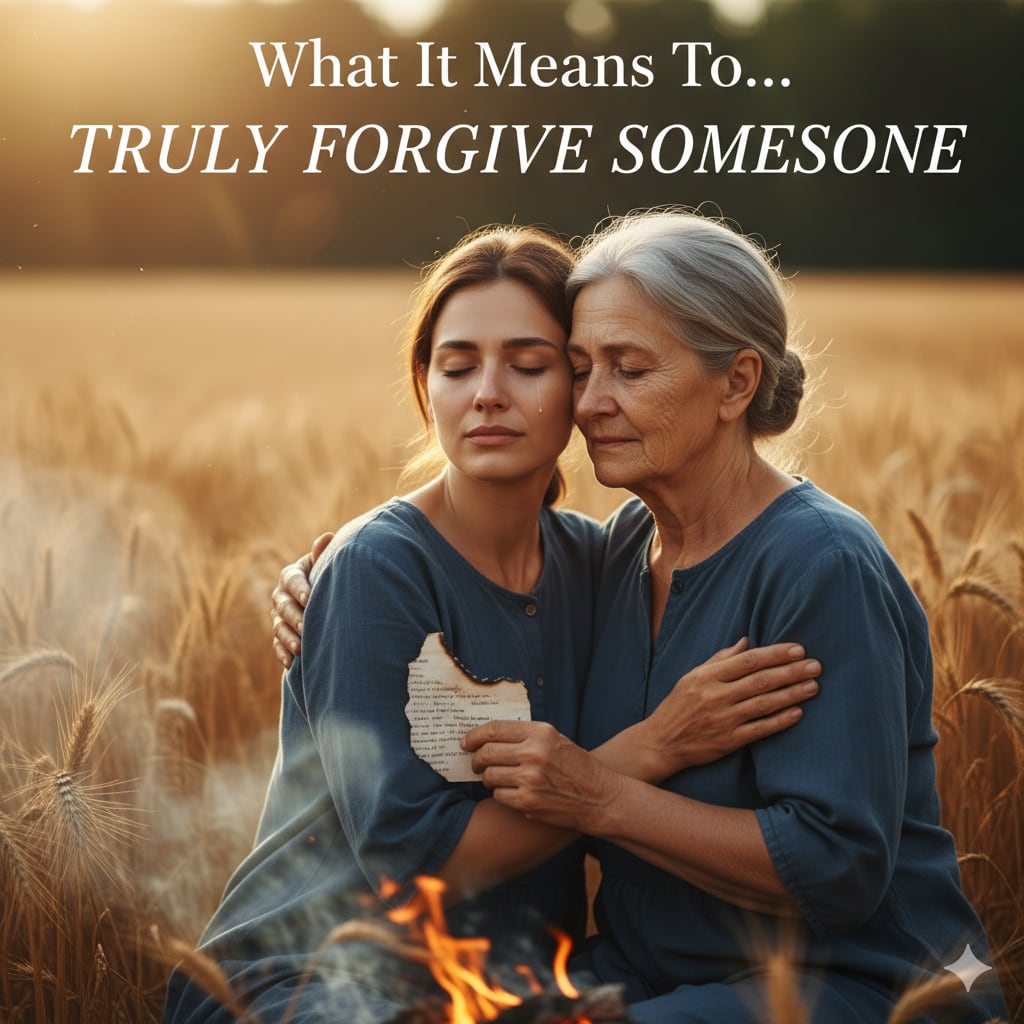
One afternoon, I wrote a letter I never intended to send.
It wasn’t polite or poetic. It was raw. Honest.
I poured out everything — the hurt, the anger, the disappointment, the love that had turned into pain.
When I finished, I didn’t hit send. I folded it and burned it.
As I watched the paper curl into ash, I whispered, “I forgive you — but not for you. For me.”
In that quiet moment, I felt something I hadn’t felt in a long time — peace.
Not joy, not closure — just peace.
And I realized that was enough.
________________________________________
4. The Real Work of Forgiveness
Forgiving someone isn’t a single act. It’s a process — sometimes slow, sometimes painful.
You’ll think you’ve moved on, and then something will trigger a memory that brings the hurt back.
But each time, you get a little stronger.
Each time, the wound closes a little more.
Forgiveness is like tending a scar — it may never disappear, but one day, it stops hurting to touch.
And the most beautiful part?
Once you forgive, you stop defining yourself by what broke you — and start remembering who you were before the pain.

________________________________________
5. The Freedom That Followed
After I forgave, I noticed something surprising — I had more space inside me.
Space for laughter.
For creativity.
For peace.
For new relationships that didn’t carry the weight of the past.
I started realizing that holding grudges doesn’t protect us — it just blocks the light.
Forgiveness, on the other hand, lets the light back in.
It’s not weakness; it’s strength.
It takes courage to let go of what hurt you, especially when the world tells you to hold on.
________________________________________
6. Forgiving Yourself
Here’s the part no one talks about: sometimes, the hardest person to forgive is yourself.
For trusting the wrong person.
For staying too long.
For not speaking up.
For letting anger eat away at you.
I had to forgive myself, too.
Because the truth is, we all make choices that we wish we hadn’t — but hating ourselves for them doesn’t heal anything.
Self-forgiveness is where true peace begins.
You can’t give to others what you refuse to give yourself.
________________________________________
Conclusion: Forgiveness as Freedom
Forgiving someone doesn’t erase the past. It simply frees you from living in it.
When you forgive, you take your power back. You stop being the victim of someone else’s choices and start becoming the author of your own healing.
It’s not about them anymore.
It’s about your peace. Your freedom. Your future.
Forgiveness isn’t about forgetting.
It’s about remembering — and still choosing love over bitterness.
Because at the end of the day, the act of forgiveness isn’t for the one who hurt you.
It’s for the one who deserves peace the most — you.
----------------------------------
Thank you for reading...
Regards: Fazal Hadi
About the Creator
Fazal Hadi
Hello, I’m Fazal Hadi, a motivational storyteller who writes honest, human stories that inspire growth, hope, and inner strength.
Keep reading
More stories from Fazal Hadi and writers in Humans and other communities.



Comments
There are no comments for this story
Be the first to respond and start the conversation.